
Coin Bounce Ads: Drop Coins, Watch Them Bounce
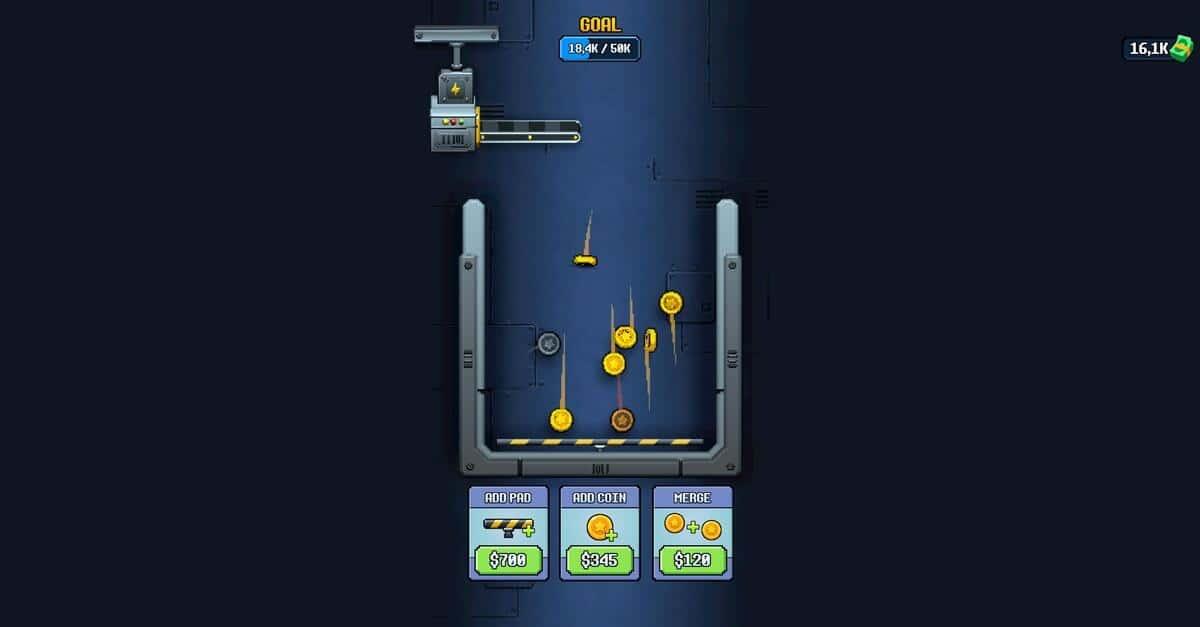
"Drop coins, watch them bounce, and earn" — the line runs through Coin Bounce's playables in English and German alike. The game followed the same loop: a launch that dropped and stalled, then a restart that kept climbing for a month to a 239-plan peak.
Maya Chen
Content Editor, Mobile Game UA
Published
Updated
Coin Bounce Ads: Drop Coins, Watch Them Bounce
"Drop coins, watch them bounce, and earn" — the line runs through Coin Bounce's playables in English and German alike, and it is the whole pitch. The game itself followed the same loop: a launch that dropped and stalled, then a comeback that kept climbing for a month to a 239-plan peak, on a shelf built almost entirely from Unity and Mintegral playables.
What this breakdown covers
- The third shape. Coin Bounce shipped August 6 with eight plans that stopped within a week; the record then sat on five creatives and zero plans for over two months. The return opened October 20 — the third title to return after a long silence this site has documented, each with a different network strategy.
- A climb, not a spike. From ten plans at the restart to a 239 peak on November 7 in eighteen days, then a stable plateau near 250 through November 22. No spike-and-fade; the book grew and held.
- 213 creatives, 460 plans. The second-run window (October 20 – November 22) with 37 creatives carrying a reinvestment flag and 22.9 million in estimated lifecycle exposure.
- Unity and Mintegral carry the demos. All twelve of the heaviest units are Unity or Mintegral playables and videos from October 24–30 — the Meta base covers 57.6 percent of plans but not one heavy creative.
- One line, two languages. Mintegral ran the same "Drop coins, watch them bounce, and earn" playable in English and German versions — localization applied to a single proven concept rather than spread across new ones.
- A US lead and a tight Western band. The US 31.3 percent with 54 exclusives; Spain, Japan, Canada, Switzerland, Australia, France, Germany and the UK fill a band between 18 and 25 percent.
Two months of silence, then a climb that held
Coin Bounce is a coin-dropping idle tycoon from Mobsmile Games AS, released on August 6. Its launch book lasted five days: eight plans in delivery, then zero from August 11. The account went quiet: five creatives and no plans for more than two months — the same shape: silence, then a second run this site has now documented three times, on three different network strategies.
The return opened October 20 at ten plans and did something the other two restarts did not: it climbed steadily instead of spiking. October 23 brought the first plan jump (59), the supply followed on October 24–30, and the book climbed from 143 plans on October 30 to a 239 peak on November 7. After the peak it did not fade — the record held a plateau near 250 through November 22, with a fresh 168-creative supply day on November 16 keeping the shelf stocked. A restart that grows for eighteen days and then holds is a different commitment level from a one-week spike.
Unity and Mintegral carry the demos; the Meta fan sets the base
The channel book splits into two jobs. The base is the familiar Meta fan — Facebook, Instagram, Threads and Audience Network each at 57.6 percent on the same 265-plan count — holding steady delivery volume across the window. The shelf is something rarer: every one of the twelve heaviest units sits on Unity or Mintegral, networks that usually hold one or two percent of a book like this.
The Unity builds are four near-identical playables opened October 24, at 432,000–548,000 estimated exposure each. The Mintegral layer followed on October 28–30 with six playables and a video at 385,000–487,000 — including the same "Drop coins, watch them bounce, and earn" line in English and German. A third tier of AppLovin (11.7 percent), Mintegral's video partner, plus AdMob (4.3), IronSource (4.1) and WhatsApp (2.2) fills out a network list that touches ten surfaces while leaning on none of the usual two.


A US lead and a tight Western band
The market list mirrors the comeback's scale. The United States: 31.3 percent of plans, with 54 targeting it alone. Behind it, nine markets fill a band between 18 and 25 percent — Spain 25.2, Japan 23.9, Canada 23.7, Switzerland 22.6, Australia 22.4, France 22.0, Germany 21.1, the UK 21.1 and Singapore 18.3. Only the US block carries real exclusive weight; the rest ride the same base.
The band is Western-heavy but not Anglosphere-only — Japan sits third at 23.9 percent, and Switzerland fourth. At 51 markets observed, the spread matches the book's size: a curated high-value list for a 460-plan comeback, not a global spray.
What to copy, and what to doubt
Three things here are portable. One: the comeback's network choice was the differentiator — where other silent-book restarts went to the Meta fan or doubled an existing rail, Coin Bounce built its interactive shelf on Unity and Mintegral and let the Meta fan carry volume. For a small budget, the second-tier networks offered playable placement the crowded majors price out. Two: the four-build Unity set — near-identical playables opened the same day — treats the demo shelf as depth rather than a single test. Three: the two-language playable pair, English and German on the same concept, localizes one proven idea instead of splitting the budget across untested ones.
What to doubt is the quiet part. This teardown sees delivery, not outcomes: the download label covers Google Play only and reads above 500,000, and no retention, revenue or actual cost data appears here. The Unity-and-Mintegral shelf may reflect network-side deals or minimum-spend tiers rather than a deliberate strategy. And the plateau near 250 has held for two weeks — long enough to call stable within the window, too short to call durable. It can say the comeback chose uncommon networks and kept climbing. It cannot say the choice was why.
See which networks carry the shelf on every restartCreativeScope monitors creative intake, plan openings and network rotation daily across 40+ networks — including the second-tier platforms most reports skip.
FAQ
- What is Coin Bounce?
- A coin-dropping idle tycoon from Mobsmile Games AS, released on August 6, 2026 with a public Google Play download label above 500,000. This breakdown covers its return, October 20 to November 22, with the August launch noted as background.
- Why is the restart called the third shape?
- The site has now documented two restart books alongside this one. Just a Squire came back on the Meta base with an AppLovin layer; Jam Bus grew its existing AppLovin rail into an AdMob partnership. Coin Bounce came back on Unity and Mintegral playables while the Meta fan carried the base - a third network strategy for the same shape: silence, then a second run.
- How big is the return window?
- 213 creatives and 460 ad plans across October 20 to November 22, with 37 creatives carrying a reinvestment flag and 22.9 million in estimated lifecycle exposure. Daily plans climbed from ten at the restart to a 239 peak on November 7, then held a plateau near 250.
- Which networks carried the heavy creatives?
- Unity and Mintegral. All twelve of the heaviest units are Unity or Mintegral playables and videos opened October 24-30 - Unity builds at 432,000-548,000 estimated exposure and Mintegral playables at 385,000-487,000, including English and German versions of the same line. The Meta fan covers 57.6 percent of plans but none of the heavy units.
- Which markets lead?
- The United States at 31.3 percent of plans with 54 targeting it alone, then a tight Western band: Spain 25.2 percent, Japan 23.9, Canada 23.7, Switzerland 22.6, Australia 22.4, France 22.0, Germany 21.1, the UK 21.1 and Singapore 18.3. 51 markets observed.
- What are the data caveats?
- Creative and plan counts are deduplicated delivery records per Asia/Shanghai natural day; channel and market coverage overlaps and does not sum to 100 percent; exposure figures are global lifecycle estimates; download figures cover Google Play only (label above 500,000). No install, retention or revenue data is used.
Figures are CreativeScope delivery estimates for the period stated; creative and plan counts are de-duplicated, daily counts are per natural day, and download figures cover Google Play only. Channel and market shares are based on plan coverage with multi-attribution, so they overlap and do not sum to 100%. No install, retention or revenue data is used.
Get this live in your agent
These rankings come from a single MCP tool. Free key, ask in plain English.
Full genre × market grid?
Team plan unlocks every genre and market cut, plus AI teardowns.