
Transformers at 40: Does Furman's Script Survive the Loop?
Simon Furman wrote the story; the launch ads sell the loop. What 7,593 ad plans reveal about a 40th-anniversary Transformers mobile title.
Daniel Brooks
Creative Strategy Analyst
Published
Updated
Transformers at 40: Does Furman's Script Survive the Loop?
The franchise turned forty, the licence went to Wanda Cinemas Games with Hasbro, and the studio hired the writer who built the Transformers canon in the eighties. Simon Furman's original script is the strongest asset this launch owns. What the creatives raise is a different question: whether the loop underneath it lets that script breathe.
What this breakdown covers
- The anniversary is a campaign object, not a calendar note. The franchise dates from 1984, so forty landed in 2024 — and this title shipped in November 2026 still wearing the label. The pre-registration package shows what the label is for: 1,000 free summons, Jazz and Bumblebee unlocked, plus a 40th-anniversary avatar frame and nameplate. A date you can put inside a reward is a date you can put inside a media plan.
- Furman is the asset. A British comics writer who spent the eighties on Marvel UK's Transformers book, he is where a generation's sense of canon comes from. Hiring him is not a press-release garnish — it is the only claim in this launch that a forty-year-old fan cannot wave away.
- The premise solves the licence's oldest problem. Autobots and Decepticons share one squad against the Chaos Legion, a corrupting force threatening Earth and Cybertron alike. A forced alliance breaks faction logic, which gives characters who never shared a frame a reason to speak to each other — and gives new players no back catalogue to memorise.
- The creatives split the job in time, not in strategy. The preheat flagship image quotes the script verbatim: an original story by Simon Furman. Every launch-week unit sampled drops the writer and sells the loop — download now, choose your formation. Story persuades; mechanics convert.
- The mechanics are pre-battle, not twitch. Five classes, five traits, synergy bonuses for matching them, positioning locked before the fight, then the battle resolves itself. The depth sits on the squad screen, which is why “strategy RPG” and “idle RPG” can both be true of the same build without either being a lie.
- Volume was built to carry a narrative most of it never repeats. 2,183 creatives and 6,054 plans went out on the preheat record between September 1 and November 16; launch day alone added roughly 882 creatives and 1,921 plans across both records. That is a large amount of inventory spent on a story the majority of units do not tell.
Forty years is not a backdrop — it is why the calendar exists
Transformers started as a toy line and a Marvel comic in 1984, which puts the fortieth anniversary in 2024. This game arrived in November 2026 still carrying the label, which is worth saying plainly rather than smoothing over: an anniversary in a licensed business is a window a rights holder chooses to open, not a fact the calendar enforces. What matters commercially is not the arithmetic but what the label was converted into.
Here it was converted into inventory the player can hold. The pre-registration package promised 1,000 free summons, unlocked Jazz and Bumblebee on day one, and handed out a 40th-anniversary avatar frame and nameplate — a cosmetic whose entire value is that it says forty on it. That is the cleanest use of an anniversary available to a free-to-play launch: a badge that costs the studio nothing to mint, means something only to people who already care, and gives every returning fan a visible reason to be seen in the first week.
The same label did a second job on the media side. A pre-registration ladder staged at 500,000, 1,000,000, 2,000,000 and 3,000,000 sign-ups turns audience growth into four scheduled news beats, and the title cleared the first rung before launch. An anniversary gives a buyer something a release date cannot: permission to talk about the product for months before anyone can play it. Editorial desks will cover forty years of a franchise; they will not cover a pre-registration form.
Furman is the asset — and the premise is why it works
Simon Furman wrote Transformers for Marvel UK through the eighties, in the period that fixed what the property sounds like when it takes itself seriously. Ask a fan in their forties where their idea of canon comes from and the answer is usually that run, not the cartoon. So when Wanda credits him with an original story, it is not a name on a poster; it is a claim about texture that the audience is equipped to check.
The premise he was handed is unusually well suited to a mobile squad game. Instead of another round of Autobots versus Decepticons, both factions suspend the war against the Chaos Legion, a corrupting force powered by unstable chaos energy that threatens Earth and Cybertron. A shared enemy does structural work: it lets Optimus Prime and Megatron occupy the same formation without either breaking character, and it gives secondary characters — Grimlock, Ratchet, Soundwave, Arcee — room to disagree with each other rather than merely shoot. For new players, the beauty is that the premise needs no syllabus. Two sides, one bigger threat, go.
What the script cannot do by itself is survive distribution. A mobile title delivers story in level dialogue, character bios and event text, in fragments between battles, and the strongest comic writing in the world reads thinner when it is cut into thirty-second beats. Whether the writing lands as Furman or as flavour text is the single question this launch cannot answer from the outside — and it is the question the anniversary framing quietly promises an answer to.
Then the creatives tell you what the campaign believes
Advertising is where a studio states, in public and at volume, which part of the product it thinks sells. This launch is unusually legible on that point, because the copy is quoted verbatim in the archive.
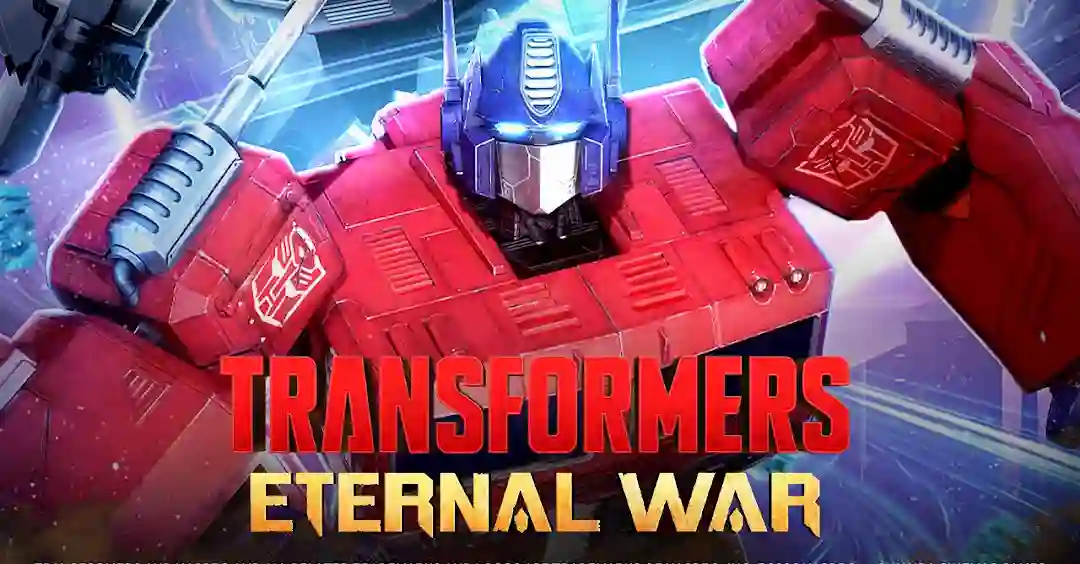
The preheat book leads with the writer. Its heaviest unit — one image, delivered from August 6 to November 11, three months across two release-date slips, an estimated 1.36 million in lifecycle exposure — carries the line: “Autobots and Decepticons unite against the Chaos Legion in an all-new Transformers strategy RPG featuring an original story by Simon Furman.” Genre label, licence, premise and author in one sentence. That is a fan-facing argument, and it ran longer than most evergreen creative ever gets to run.
Then the same book shifts register for the pre-registration close: a family of at least 21 sibling images delivered October 24 to 26, all carrying “Pre-register Now — A New Chapter Starts Now.” No writer, no premise, no Chaos Legion — just the call to action and a chapter that implies the one fans already know. Twenty-one variants of one sentence is not creative laziness; it is a media buyer buying frequency on a deadline.

On launch day the author disappears entirely. November 12 put roughly 882 new creatives and 1,921 new plans into delivery across the two records, and the launch-week units sampled sell the loop and nothing else: “Transformers: Eternal War is live. Download now and lead your first squad.” A second family reframes the product outright — “This new idle RPG mobile game brings the new conflict to life. Choose your formation and enter the fight.” Not one of them quotes Furman.
Read carefully, this is not two campaigns, and it is certainly not two ways of selling one game. It is a single funnel in time order: authorship persuades, mechanics convert. The preheat record does the arguing over three months; the launch record does the closing in five days. Two publisher records appear in the delivery data — Wanda Cinemas Games for the long preheat, HOOLAI GAME LIMITED for the ignition from November 10 — but the evidentiary claim here rests on the copy and the dates, not on the account split, which is a reporting structure and nothing more.
How the loop actually runs — five classes, five traits, one decision point
The mechanics explain why the copy can call the same build a strategy RPG and an idle RPG without contradiction. Combat is 5v5. Every character belongs to one of five classes — Vanguard to hold the line, Assault to break formation, Firepower for ranged output, Recon for sight and initiative, Support for sustain — and carries one trait from a set of five: Fearless, Dynamic, Resourceful, Resolute, Inspiring. Matching the right trait to the right class triggers synergy bonuses that decide fights more reliably than raw rarity. You pick the lineup and the positioning before the bell, then the battle resolves on its own.
That is why “idle” is not a downgrade claim. The decision point is moved forward, from reaction time to squad construction: the depth lives in a screen you study between battles, not in inputs during one. Around it sits the Ark, the base you expand with support facilities that generate resources and level the roster while you are offline — the retention floor that lets a licensed title ask for ten minutes a day instead of an hour.
For a franchise audience, the loop has a specific consequence. Furman's premise promises character drama; the build delivers squad composition and a base timer. Both are legitimate, but they attract different people: the reader who came for Megatron and Optimus forced into one formation, and the player who came because the ad said idle and wants numbers to go up. The preheat copy recruits the first group; the launch copy recruits the second. The game has to hold both, and that is the real risk in this launch — not the media buy, which is disciplined, but the expectation gap the two copy styles create.
What the ads can and cannot prove
Delivery data is good at three things here: it tells you what the copy said, when it said it, and how much inventory carried it. It can show that an authorial claim ran on one evergreen image for three months while a few hundred launch units ignored it, and it can show the moment the argument switched from story to arrival.
It cannot show whether the script works. No install, retention or revenue series is cited for this title, the store download label available on the Android record is too sparse to read as reality, and estimated exposure is a lifecycle weight per creative — useful for comparing creative mass, worthless as a view count. Most importantly, nothing in this data says how much Furman actually wrote, how much survived the cut, or whether the anniversary badge converted a single pre-registration. The anniversary, the author and the loop are all claims; only their advertising is measurable.
If you are shipping a licensed title, this is the sequence
Five moves, in order. One: convert the anniversary into something a player can own — a frame, a nameplate, a dated reward — so the node exists inside the product and not only in the press release. Two: buy authorship rather than borrowing it, and put the writer's name in the first sentence of the launch argument. Three: run that argument long and cheap, on one or two evergreen units, for as long as the date keeps moving. Four: switch to mechanics only when the product is actually downloadable, and let the idle or strategy vocabulary do the closing. Five: leave one social lane open that competitors ignore — here WhatsApp targeting sat on 17.4% of launch plans and 64.4% of preheat plans, which is not normal for a Western mid-core book and is the cheapest way to let a forty-year-old franchise travel on fan conversation instead of paid reach.
Around the close, one unit is worth noting because it is not a media buy at all. A TikTok creative entered delivery on November 11 on the preheat record — “Think You Can Save Earth? #Transformers #TransformersEternalWar” — with an estimated 498,454 lifecycle exposure, the largest single-unit figure observed across both books that week. On a forty-year-old licence, a hashtag is the cheapest brand search you can manufacture, and it costs nothing to keep running after the paid book cools.
What to copy, and what to doubt
Copy the sequence, not the swagger. Make the anniversary a reward before it is a headline. Treat the writer as the only claim a hostile fan cannot dismiss, and give that claim the longest-running unit in the book. Keep the story copy running through every delay, because a moving date punishes anything with a short shelf life. Change vocabulary, not product, when the store link goes live. And leave one cheap social lane open for the audience that still forwards things to group chats.
Doubt the easy conclusion that a famous name rescues a mobile adaptation. The launch bought three months of narrative goodwill and then spent week one on formation screens, which is a rational media decision and a poor guarantee of how the script reads on a phone. If the writing holds, the anniversary framing was earned; if it does not, the campaign has promised a texture the build cannot deliver, and the reviews will say so in the language of betrayal rather than disappointment. That is the part of this launch no delivery data can settle.
Want to see which licensed launches lead with authorship — and which switch to mechanics within days of going live?
Check CreativeScope plansQuestions we get about this one
- What is Transformers: Eternal War?
- A free-to-play mobile title built by Wanda Cinemas Games in partnership with Hasbro, released November 12, 2026 on iOS and Android after a regional soft launch in Australia, New Zealand, Singapore and the Philippines. It combines 5v5 tactical squad battles, idle progression and Ark base management, with an original story by Simon Furman.
- Who is Simon Furman, and what did he write here?
- A British comics writer who wrote Transformers for Marvel UK through the eighties, in the run that shaped how the property reads when it takes itself seriously. For this game he wrote an original story in which Autobots and Decepticons suspend their war to face the Chaos Legion, a corrupting force powered by unstable chaos energy that threatens both Earth and Cybertron.
- Why does the 40th anniversary matter commercially?
- Because it converts into product and into calendar. The pre-registration package included a 40th-anniversary avatar frame and nameplate, 1,000 free summons, and Jazz and Bumblebee at launch — a dated cosmetic players can display. The franchise dates from 1984, so the fortieth fell in 2024; this launch reused the label in 2026, which is what an anniversary window looks like when a rights holder chooses to keep it open.
- How does the gameplay actually work?
- Players set a five-character lineup and their positioning before a fight, then the battle resolves automatically. Every character holds one of five classes — Vanguard, Assault, Firepower, Recon, Support — and one trait from Fearless, Dynamic, Resourceful, Resolute and Inspiring; matching traits to classes triggers synergy bonuses that outweigh raw rarity. Between fights, players expand the Ark, whose facilities generate resources and level the roster while offline.
- Do the ads sell the story or the mechanics?
- Both, in sequence. The preheat record's evergreen image quotes the script directly — “an all-new Transformers strategy RPG featuring an original story by Simon Furman” — and ran from August 6 to November 11. Launch-week units drop the writer and sell arrival and formation instead. Story persuades during the wait; mechanics convert at the store link.
- Why do two advertiser records appear for one game?
- The monitored set tracks two store records for the same title: a preheat record filed under Wanda Cinemas Games (2,183 creatives, 6,054 plans in the window) and a launch record under HOOLAI GAME LIMITED (828 creatives, 1,539 plans, almost all after November 10). Counts stay per record and combined figures are labelled as such. The split is a reporting structure; it is not evidence of two products or two sales strategies.
Method. Figures come from CreativeScope's delivery data for Transformers: Eternal War over September 1 – November 16, 2026, across the two advertiser records described above (store records: Wanda Cinemas Games; HOOLAI GAME LIMITED), with latest material snapshots dated November 16 and latest ad snapshot month November 2026. Creative counts are de-duplicated per game and creative; plan counts per game and plan. Daily in-delivery counts are per Asia/Shanghai natural day. Product, story, class and anniversary facts come from the official store listing and launch coverage; delivery timing is the evidence for the November 12 go-live. Ad copy is quoted as delivered.
Scope limits. Channel shares are computed on plan coverage with multi-attribution, so they overlap and do not sum to 100%. Launch-day combined figures sum the two records and are labelled as such; all other counts are per record. Estimated exposure is a global lifecycle estimate per creative, used only to compare creative weight — it is not a period increment or a view count. Store download labels on the Android record are too sparse to be read as install volume, and no install, retention or revenue figures are cited. Nothing here measures how much of Furman's script reached the build, and no causal claim is made between delivery timing and install timing.
Get this live in your agent
These rankings come from a single MCP tool. Free key, ask in plain English.
Full genre × market grid?
Team plan unlocks every genre and market cut, plus AI teardowns.