
Colony Flow Ad Creatives: Why the Ant Puzzle Hook Works
Explore Colony Flow ad creatives with CreativeScope: UA channel mix, market traction, theme data, and ant-colony puzzle examples for mobile game UA teams.
Maya Chen
Content Editor, Mobile Game UA
Published
Updated
CreativeScope UA Teardown
Colony Flow! · Ant-colony puzzle ad creatives · Review period: June 15-July 8, 2026CreativeScope tracked Colony Flow! across mobile ad networks as ABI GAMES PTE. LTD. pushed a casual puzzle built around ant transport, color matching, and blocked paths. The campaign shows how a familiar path-clearing loop becomes easier to read when the theme explains every action on screen.
Why Colony Flow Is Easy to Read in Ads
Colony Flow! is built around a simple, tightly defined rule set. Players tap numbered cubes, move them into a five-slot tray, and clear matching pixel blocks only when ants can reach the target color. If the tray fills or the path is blocked, the pressure is clear right away.
That cause-and-effect chain gives each creative a clear job in the first seconds. The ants are not just decoration; they explain why pieces disappear, why color matters, and why blocked routes create failure. For global UA teams, this makes Colony Flow! a focused case study in theme-led gameplay framing.
Data Scope and Metric Notes
CreativeScope data in this teardown covers Colony Flow! activity observed from June 15 to July 8, 2026, with additional campaign end dates visible for selected creatives. Active-creative counts, campaign records, and estimated impressions are directional UA intelligence signals, not verified spend, ROAS, revenue, or exact paid acquisition volume.
The game profile also showed a separate profile-level download field of 1.2M. Because the reviewed Android install trend and the profile-level download field come from different CreativeScope views, this article keeps them separate and uses the trend dataset only for pacing analysis.
Market Traction: Install Spikes Aligned With Creative Expansion
The reviewed Google Play trend captured 84,886 Android download increments across 24 observed days from June 15 to July 8, with the latest Android snapshot at 84,910 on July 8. The strongest visible jumps came on June 30, July 7, and July 8.
Creative uploads increased ahead of the largest observed install jumps in the reviewed dataset. CreativeScope's investment trend view recorded 240 new ad creatives and 288 new campaign records across the same window, with a first major upload wave on June 16 and a second visible push on July 7.
UA Channel Mix: Network-Heavy Distribution Across Tracked Records
From June 15 to July 8, tracked campaign records leaned heavily toward mobile ad networks. AppLovin, Unity, Mintegral, and AdMob together accounted for most tracked platform share, while YouTube contributed a smaller but still visible share of tracked records.
Country distribution was broad rather than concentrated. Japan, France, the United States, Germany, Singapore, Spain, and Brazil led the tracked country list, but none dominated the mix.
Creative Themes: Soft Visuals With Immediate Rule Feedback
CreativeScope's theme-tag view showed a clear pattern: Colony Flow! did not need heavy story setup. The strongest theme clusters focused on cute-style hooks, instant feedback, level display, and achievement completion. Mood tags leaned relaxed and soothing, while visual-style tags leaned cartoon and pixel.
These tags overlap, so they should not be summed as exclusive buckets. The pattern still matters: the campaign leads with clarity before introducing difficulty. Viewers first understand what the ants do, then see where the puzzle can fail.
Creative Spotlight: Five Ways the Campaign Makes the Same Rule Feel New
The top creative set points to a well-controlled variant system. Colony Flow! keeps the core rule stable, then changes the entry cue: real ant footage, branded pixel art, character skin, pressure scene, or playable hand guidance.
Why it works: The opening borrows attention from a familiar natural behavior. Once ants begin moving around a food object, the later block-clearing action feels easier to understand.
Why it works: The viewer can predict the reward: clearing the board completes a cute image. That gives each move a visible destination, not just a cleared tile.
Why it works: The character wrapper adds warmth without changing the puzzle rule. That lets UA teams test audience affinity for the look while keeping the gameplay legible.
Why it works: A large obstacle makes failure easy to read. The viewer sees both the desired route and the reason it cannot happen yet.
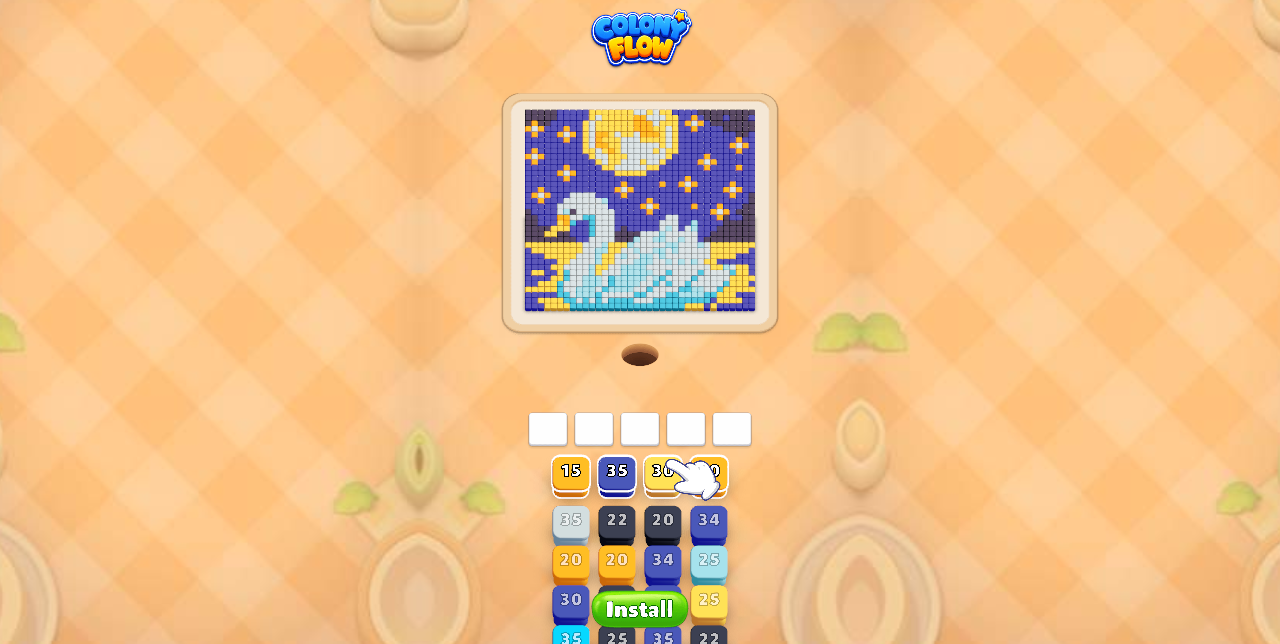
Why it works: The finger guide reduces hesitation on the first move. The swan reveal keeps the completion reward visible even in a wider playable layout.
Why the Ant-Colony Theme Works for This Puzzle Loop
Ants carrying blocks away is an intuitive reason for pieces to disappear. The theme reduces the need for text overlays.
Each successful move creates motion: ants move, paths open, and the board changes. That makes the payoff visible within seconds.
Blocked paths and full slots are easy to show. The audience can understand the mistake even if they have never played the game.
Food scenes, pixel reveals, character skins, and playable guides all preserve the same basic rule, which supports clean creative comparison.
Testing Playbook for Puzzle Game UA Teams
Colony Flow! suggests a focused testing framework for puzzle teams that want to refresh a familiar mechanic without hiding the rule.
- Test the first cue: Compare real-world ant behavior, cute pixel reveal, character skin, and pure gameplay entry frames.
- Hold the rule stable: Keep color matching, limited slots, and blocked paths consistent so performance differences are easier to interpret.
- Separate calm from pressure: Run relaxed completion scenes against obstacle-heavy scenes to see which audience segment responds.
- Use playable guidance carefully: Finger prompts can lower confusion, but the reward reveal still needs to be visible before the install CTA.
- Read heat as a signal, not a final verdict: Estimated impressions and campaign records help prioritize review, but they do not replace spend and retention validation.
CreativeScope Take
Colony Flow! is a clean example of theme-led puzzle packaging. The campaign keeps the underlying path-clearing color-match rule simple, then rotates the creative wrapper: ants at food, pixel-picture completion, character reveal, pressure obstacle, or guided playable layout.
For UA teams, the takeaway is to treat theme as a comprehension layer. When the theme explains why a move matters, the ad can spend less time teaching and more time building curiosity.
FAQ
What is Colony Flow!?Colony Flow! is a casual puzzle game from ABI GAMES PTE. LTD. that builds its core ad creative loop around ant transport, color matching, limited slots, and blocked paths.
What makes Colony Flow ad creatives stand out?The ad creatives make the puzzle rules visible through ant movement. Viewers can quickly see why a piece moves, why a path is blocked, and what completion looks like.
Which channels carried most tracked Colony Flow campaign records?In the June 15-July 8, 2026 review period, AppLovin, Unity, Mintegral, AdMob, and YouTube accounted for most tracked campaign-count share in CreativeScope.
How should teams read estimated impressions in this teardown?Estimated impressions indicate relative delivery heat for selected creatives. They are not verified spend, ROAS, revenue, installs, or exact daily impression increments.
Related Reading
Data Notes
- Review period: June 15-July 8, 2026 for trend, platform, country, and creative theme analysis.
- Game profile metrics reflect the CreativeScope snapshot used during production: 483 campaign records, 274 ad creatives, 57,230,756 estimated impressions, and 116 countries or regions tracked.
- Google Play download increments cover Android observations available in the reviewed dataset; the latest cumulative snapshot is not a daily value.
- Theme tags overlap across hook, mood, style, and topic views, so the counts should not be added together as exclusive categories.
- Article schema is pending final CMS canonical URL, hero media, and publish date. FAQPage and VideoObject structured data are included below.
Get this live in your agent
These rankings come from a single MCP tool. Free key, ask in plain English.
Full genre × market grid?
Team plan unlocks every genre and market cut, plus AI teardowns.