
Smash Fest-Style Ads: Why Destruction Creatives Spread
See how Smash Fest and Royal Smash turn simple projectile destruction into mobile game ad creatives, playable ads, and UA testing angles.
Emma Lee
Editorial Research Contributor
Published
Updated
CreativeScope Creative Intelligence
According to CreativeScope data as of August 4, 2026, Smash Fest and Royal Smash show two different ways casual game teams are turning a simple projectile-and-destruction mechanic into mobile game ad creatives. Smash Fest focuses on fast, readable impact. Royal Smash keeps the same destruction loop but adds reward cues, stronger value framing, and broader channel coverage.
The "recent 30-day heat" metric used in this article refers to estimated lifetime impressions for active creatives observed in the 30-day window. It is useful for comparing relative campaign heat, but it is not spend, revenue, ROAS, or verified 30-day incremental impressions.
Key Takeaways
- Smash Fest-style games are spreading because the creative formula is easy to understand: aim, launch, hit the structure, and watch the result.
- The mechanic is older than the current trend. Crush the Castle, Angry Birds, and Knock Balls all helped validate projectile play plus visible structure destruction.
- Smash Fest appears to be testing a more stripped-down satisfaction loop, with AppLovin carrying most observed campaign records across both iOS and Android listings.
- Royal Smash uses the same low-friction destruction frame but adds reward display, number bursts, free-to-play cues, and wider multi-network coverage.
- For UA teams, the opportunity is not to reproduce the cannon or castle. The opportunity is to build a first-frame object, impact feedback, and format mix that feels different enough to test.
Why the Format Is Easy to Adapt
Smash Fest-style ads work because the viewer does not need a tutorial. The target object is visible. The projectile is visible. The outcome is visible. A viewer can understand the promise before the ad explains a setting, character, economy, or progression system.
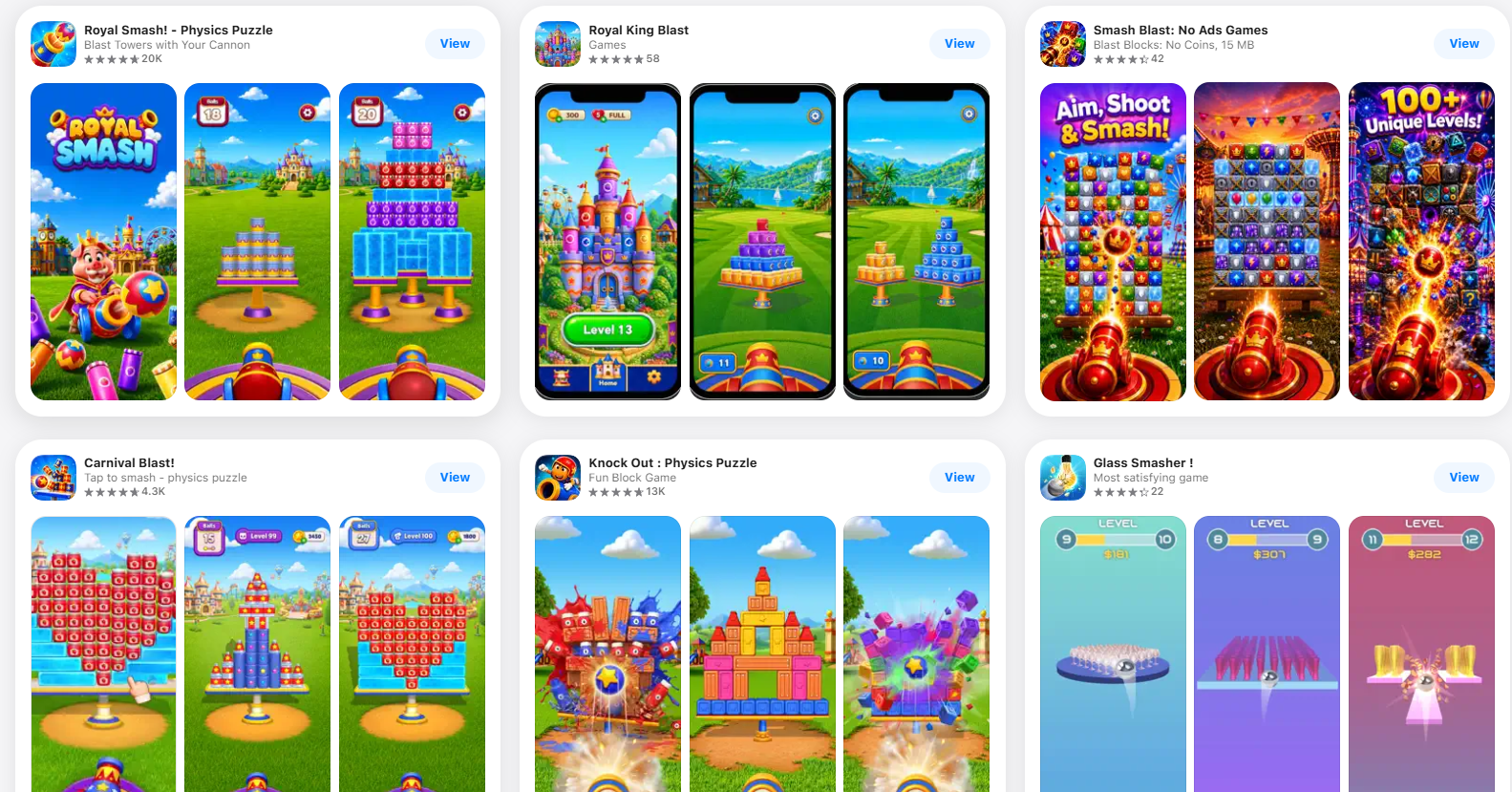
That clarity makes the format attractive for casual UA. Teams can swap the target object, change the scene, exaggerate the collapse, or move the same mechanic into playable ads without rebuilding the entire creative strategy. Supermarket Blast can use shelves and cans. Royal Smash can use castles and royal scenery. Stack Smash, Knock Fever, and Fair Shot can test different impact objects while keeping the same core loop.
The Older Mechanic Behind the New Ad Trend
The creative pattern did not start with a current hit. Projectile play can be traced back to artillery-style games, where players adjusted angle and force to hit a target. The more relevant lineage for today's ad creatives is structure destruction: Crush the Castle made the act of hitting a building and watching it collapse central to the experience; Angry Birds turned the same idea into a touch-first mass-market format; Knock Balls reduced the setup even further by focusing on cannons, balls, structures, and impact feedback.
Smash Fest sits on that same line. Its campaign value comes from compressing the loop into an ad-friendly sequence: the viewer sees what to hit, sees the hit happen, and immediately gets a burst of physical feedback. That is why the format can work in short video and playable inventory.
What Follow-On Games Change
Follow-on titles are not only changing the surface art. The more important tests happen at the first-frame level: what object the viewer sees, what kind of hit feedback the ad promises, and whether the scene gives the mechanic a different memory cue.
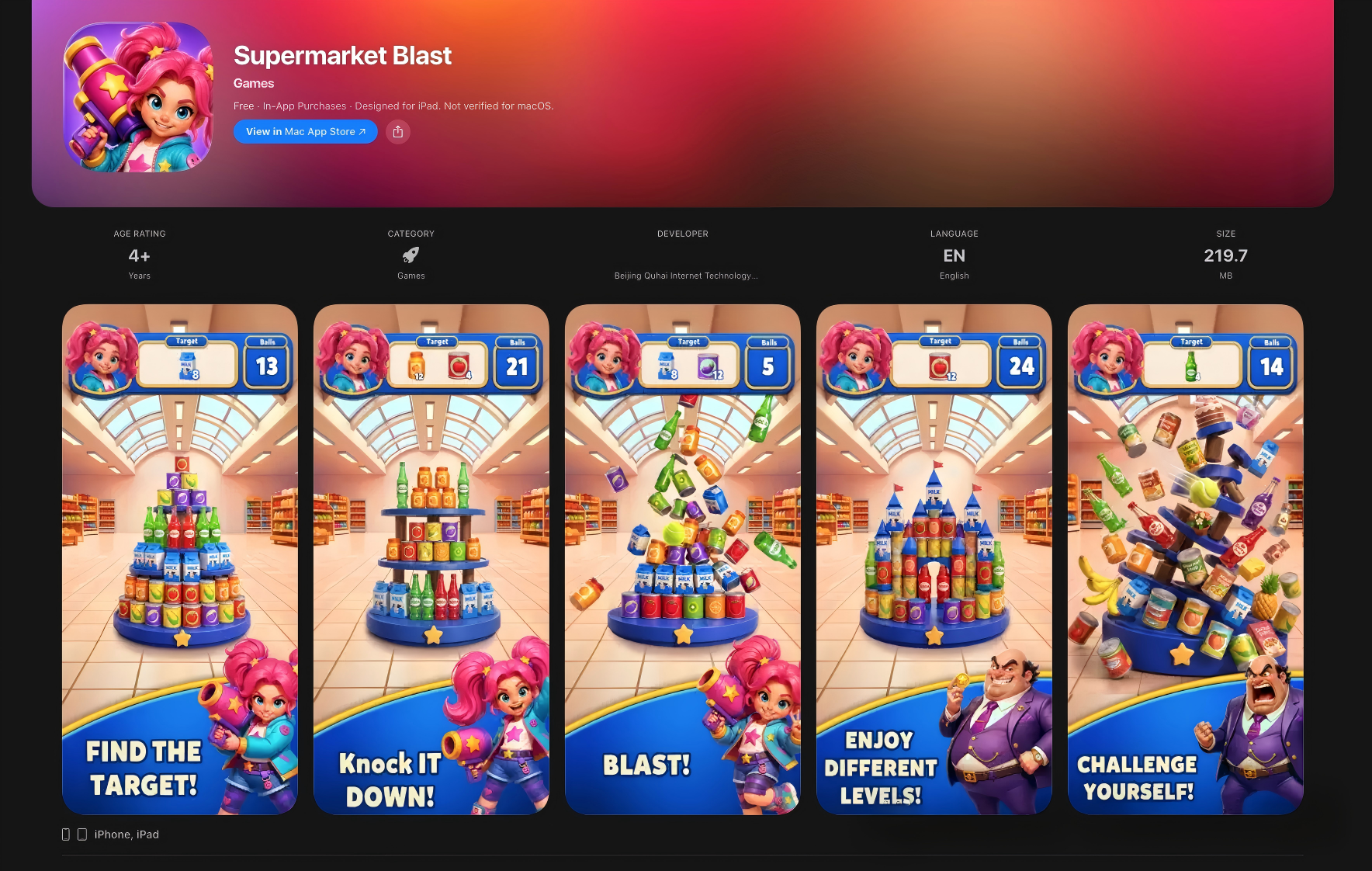
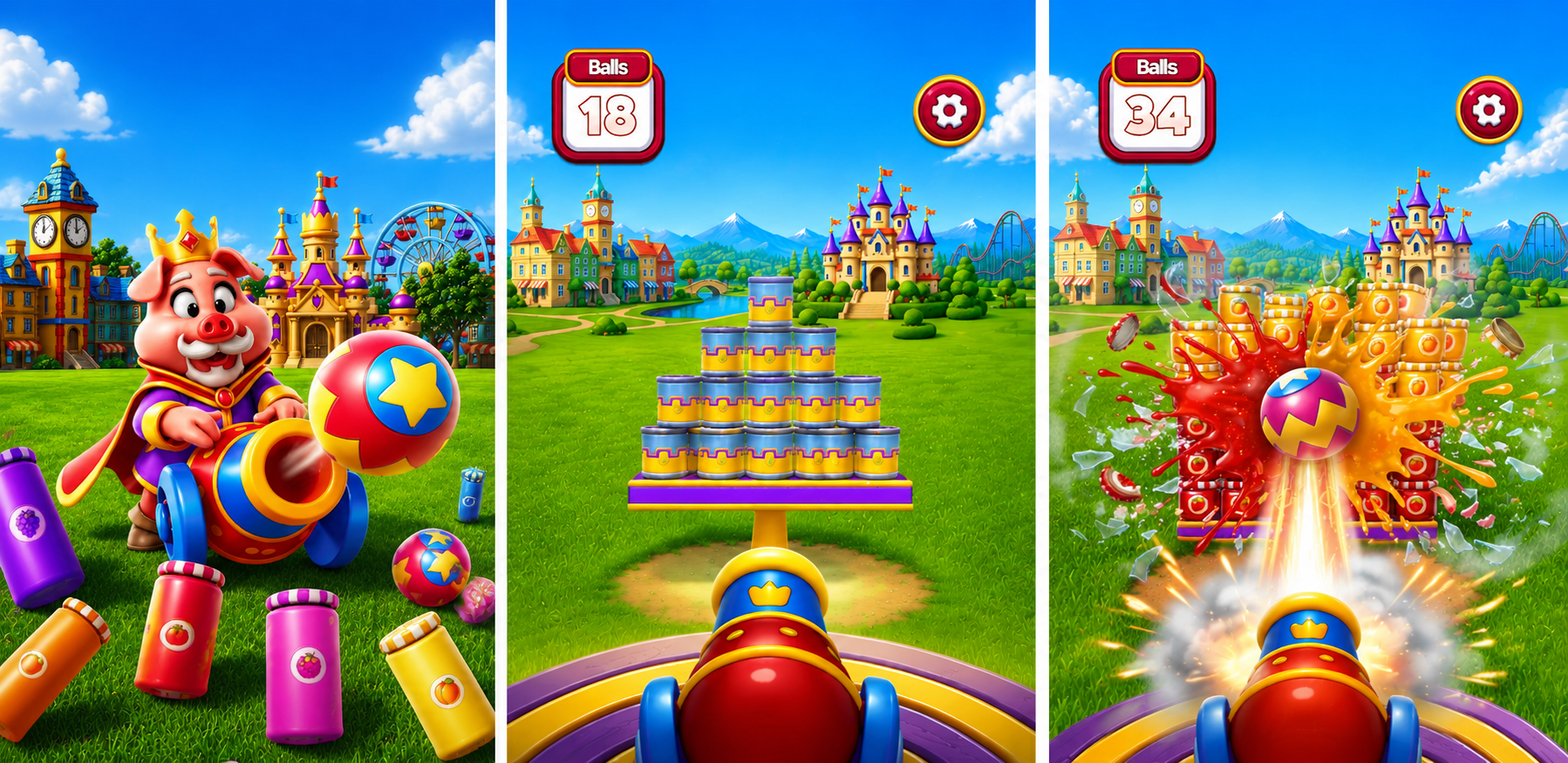
For UA planning, those visual differences can be translated into four test variables.
| Creative Element | How Follow-On Titles Use It | What to Watch |
|---|---|---|
| Target object | Shelves, cans, castles, blocks, or towers create a new first-frame read while keeping the same action. | If the object looks too close to the original, the ad feels derivative before the viewer sees the gameplay. |
| Scene wrapper | Royal, supermarket, grassland, or amusement-park settings add memory cues around the mechanic. | Surface-level scenery does not fix weak hit feedback. |
| Impact feedback | Collapse, explosion, clearing, number bursts, and reward popups turn one shot into a satisfying event. | If the result is too small, the creative becomes a generic "hit the thing" ad. |
| Format mix | Video can cut the best moment; playable ads let the viewer perform the aim-and-fire action. | Repeating the same impact shot across every format quickly creates fatigue. |
Smash Fest Is Testing a Stripped-Down Satisfaction Loop
CreativeScope data separates Smash Fest's iOS and Android listings. The iOS listing had 1,011 active campaign records, 1,011 active ad creatives, and roughly 33.81M recent 30-day heat. It also had 1,022 active creatives in the 180-day window, 52 covered countries or regions, and a platform mix concentrated on AppLovin.
The tracked Android listing had 500 active campaign records, 497 active ad creatives, roughly 13.87M recent 30-day heat, and 500 active creatives in the 180-day window. It also covered 52 countries or regions. AppLovin represented roughly 99.4% of observed campaign records, while AdMob accounted for about 0.6%, or three campaign records.
The creative labels point in the same direction as the gameplay itself. High-frequency hook signals include level challenge, instant feedback, one-tap clearing, level display, and visual effects. The mood signals lean toward excitement, tension, satisfaction, relaxation, and stress relief. In other words, the campaign is not trying to sell a deep story. It is testing whether a viewer sees the target, anticipates the hit, and wants to take the shot.
Royal Smash Adds Reward and Channel Breadth
Royal Smash takes the pattern in a different direction. The core action is still projectile destruction and visible collapse, but the campaign appears less concentrated and more conversion-oriented.
For Royal Smash, CreativeScope tracked 776 active campaign records, 709 active ad creatives, roughly 36.78M recent 30-day heat, and 741 active creatives in the 180-day window. Campaign coverage reached 55 countries or regions. Observed platforms included AppLovin, Mintegral, Facebook, Audience Network, Instagram, Threads, Messenger, Unity, AdMob, YouTube, and Vungle.
The hook labels are more benefit-led: reward display, number bursts, free-to-play cues, level challenge, and conversion guidance. Content labels include reward information, core selling points, drop-rate displays, level challenge, and mechanics. That mix suggests Royal Smash is not relying only on the hit-and-collapse moment. It is connecting the same physical satisfaction loop to stronger reasons to download.
CreativeScope Take
Smash Fest-style games should be evaluated as a low-friction destruction framework, not as a single title to imitate. The core UA question is whether the creative can make the target, action, and result readable in the first few seconds while still giving the viewer a new reason to care.
For creative strategists, the next step is not just listing those variables. It is turning them into separate tests with clear decision signals. Video can sell the best collapse moment. Playable ads can let viewers try the action. Static or end-card assets can add value cues. Treating all of these as the same ad idea makes it harder to see which part is actually carrying the campaign.
| Creative Test | Planning Question | Decision Signal |
|---|---|---|
| First-frame clarity | Can the viewer understand the goal before any explanatory copy appears? | Keep variants where the target, action, and payoff are readable in the first seconds. |
| Feedback intensity | Does a bigger collapse, explosion, clearing effect, or reward popup improve the payoff? | Scale feedback styles that improve hold rate without making the ad feel noisy or misleading. |
| Scene differentiation | Does the setting help the asset stand apart from adjacent destruction ads? | Keep scene wrappers that change first-frame memory, not just background color. |
| Format role | Should this concept be sold through video payoff, playable interaction, or static value cues? | Compare click quality, downstream retention, and the gap between curiosity clicks and engaged users. |
FAQ
What kind of game mechanic is behind Smash Fest-style ads?
It is a lightweight mix of projectile play, aiming, structure destruction, and physics feedback. The viewer sees a target, launches an object, and watches the structure collapse or clear.
Why are these mechanics easy for other teams to adapt?
The rule is simple, the first frame is easy to understand, and the production team can test new target objects or scenes without changing the core action. The harder part is making the impact feedback and visual wrapper feel distinct.
How does Royal Smash differ from Smash Fest in the observed data?
Royal Smash keeps the same destruction loop but adds more conversion-oriented creative labels, including reward display, number bursts, free-to-play cues, and broader multi-network campaign coverage.
How should UA teams test a similar mechanic?
Start by turning the mechanic into separate creative tests: first-frame clarity, feedback intensity, scene differentiation, and format role. Then use decision signals such as hold rate, click quality, and downstream retention instead of judging every variant only by the first click.
Explore Creative Intelligence
Use CreativeScope to search mobile game ad creatives, compare opening hooks, track campaign coverage, and turn creative patterns into better UA testing briefs.
Build a creative research workflow or explore more CreativeScope Blog analysis.
Data Notes
CreativeScope metrics in this article describe monitored creative and campaign activity. Recent 30-day heat is used as a relative scale indicator and should not be read as spend, revenue, ROAS, or verified incremental impressions.
Get this live in your agent
These rankings come from a single MCP tool. Free key, ask in plain English.
Full genre × market grid?
Team plan unlocks every genre and market cut, plus AI teardowns.