
Easy Go Ads: A Small Entrant in the Arrow-Puzzle Boom
A tiny newcomer to the arrow-puzzle boom put 353 of 355 ad plans on AdMob in 31 days; Germany and Japan lead a 119-market spread with no US in the top ten.
Daniel Brooks
Creative Strategy Analyst
Published
Updated
A tiny newcomer in the arrow-puzzle boom runs 355 ad plans in 31 days — 353 of them on a single network, spread over 119 markets, led by Germany and Japan, not the US.
The data scope
All figures come from CreativeScope’s ad-intelligence dataset for Easy Go: Arrow Puzzle Games (store publisher listing: Wood Puzzle Sudoku Games), measured over 2026-09-09 to 2026-10-09. A plan is one ad delivery setup; a creative is the underlying image, video or playable it points at. “Exclusive” means a plan whose target-country list contains exactly one market.
This is a deliberately small sample by our standards — 355 plans is roughly a tenth of what mid-size casual records run in a month — and that is the point. At this scale every structural choice is visible: which network gets the money, which markets lead, and what a team does when it only maintains one buying system.
One piece of context frames the record. Arrow-puzzle games became one of 2026’s breakout casual formats — a language-free, one-tap genre that travels well — and Easy Go is one of the many small entrants that arrived after the category proved itself. That is background only: the analysis below stays on how this particular book is bought.
The game in one paragraph
Easy Go: Arrow Puzzle Games is a minimalist path-solving puzzle: grids full of one-way arrow segments that must be traced or untangled in the right order, wrapped in a cream-paper aesthetic with a red-white-blue arrow icon. The store listing sits under the publisher name Wood Puzzle Sudoku Games with a 50K+ downloads label and no usable launch date, so we read it as a small live product in steady acquisition rather than a launch. The ad copy barely changes from record to record — one English description about challenging your logic and training your brain does duty for nearly everything — which fits a buy that behaves like a subscription, not a campaign calendar.
One network, 99.44%
Of the window’s 355 plans, 353 run through AdMob — 99.44%. The remainder is two AppLovin plans (0.56%) and one YouTube plan (0.28%); coverage is multi-attribution, so those slivers can overlap with each other but barely dent the AdMob monopoly. There is no Meta package, no TikTok, no ironSource or Vungle — nothing else registers.
Bar length equals the printed share on a true 0–100% axis. Coverage is multi-attribution: a plan can touch more than one network, so the three shares can overlap and do not need to sum to exactly 100%.
One network changes what the creative operation looks like. AdMob inventory is fed by app campaigns, and app campaigns reward volume: many small assets, broad targeting, machine-managed rotation. That is exactly the shape of this record — 304 creatives for 355 plans, close to one plan per creative, almost no family reuse, and a format mix (next section) built almost entirely out of static images. On Meta the same team would need five surface variants and a video-first package; here it needs one feed and a template.
Germany and Japan lead — the US is not on the list
The ten biggest markets spread across a 121-plan band: Germany (217 plans, 16 exclusive), Japan (197, 23), Spain (184, 5), France (177, 10), South Africa (136, 9), Serbia (131, 4), Australia (130, 12), Switzerland (109, 5), Singapore (108, 8) and Thailand (96, 5). The United States does not appear in the top ten at all. For an English-language puzzle game running Google app campaigns, a top-ten list without the US is the single most distinctive fact in the record.
Exclusivity barely exists anywhere: the largest single-market book (Japan, 23 plans) is a rounding error against Germany’s 217, and every exclusive count in the top ten sits between 4 and 23. Where Idle Cat Gunner walls off three countries, Easy Go shares everything with everyone — one global asset pool, lightly tilted toward Europe and East Asia.
Bar length = ad plans targeting the market on a fixed axis (full bar = 240 plans); orange = plans exclusive to that market, teal = plans shared with other markets. Values show coverage · exclusive count. The US falls outside the top ten.
One localization seam does show, and it is on the copy level rather than the asset level. Most records ship a standard English description (“Welcome to Easy Go – a minimalist arrow puzzle game…”). But a distinct set of images — at least six separate creatives, led by one with 179,681 estimated exposures — carries a Japanese description instead, translating roughly as “Welcome to Easy Go – a minimalist arrow puzzle that trains your logic and gives your brain a relaxing daily workout.” The images themselves stay language-neutral; the words wrapped around them are Japan’s own.
An image-first operation
Counting by network attribution, the window holds 305 creative records carrying 355 plans. The mix inverts the usual casual pattern: 276 image records (90.5%) against just 25 video records (8.2%) and 4 playable records (1.3%). The images are what AdMob app campaigns consume best — cheap to produce, endlessly re-cut, and rotated by the algorithm rather than by a media buyer.
- Format: 276 image / 25 video / 4 playable records — 90.5% / 8.2% / 1.3% of attributed creatives; images carry 286 of 355 plans.
- Video: the sampled videos are all 360×640 vertical, 30 to 60 seconds, and all run on AdMob; there is no landscape program to speak of.
- Churn: dozens of image records live for a single day with roughly 4,225 estimated exposures — the signature of a template being re-rendered and re-fed daily.
- Reuse concentrates in one place: only 9 plans in the whole window point at previously used creatives, yet the playable that does get reused shows family counts growing 4 → 7 → 20 across its records. When this team finds a format worth keeping, it is the interactive one.
Creative spotlight
The colorful solve. The window’s biggest video is also its most polished: a Lv.35 board labeled for expert players, four shield lives across the top, and a grid of overlapping arrow paths in teal, gold, red and rose that unravel one color at a time. A dotted trail shows the finger’s route mid-solve. It closes on a dark end card with the logo and both store badges. No captions, no hooks — the ad assumes you already like this genre and shows you a satisfying version of it.
The Level 99 endurance cut. A full minute on one monochrome brown maze labeled “Level 99 — Hard.” A hand cursor traces the route in real time while red segments flare at the frame’s edges — wrong turns being punished — and the solve stretches almost to the end card. Where the colorful solve sells competence, this one sells difficulty: the message is that there is always a harder board waiting. Same store-badge end card, same single-edit discipline.
The rescue hook. The one emotional angle in the sample: a 3D-rendered peacock chick crying behind a cage built from arrow paths, a black “HELP!” stamped over the opening frame, then red arrows marking the unlock route through the maze. It is the classic rescue-puzzle formula — borrowed wholesale from a genre Easy Go does not otherwise belong to — and it earns the third-largest video exposure in the window. Even a template operation keeps one dramatic card up its sleeve.
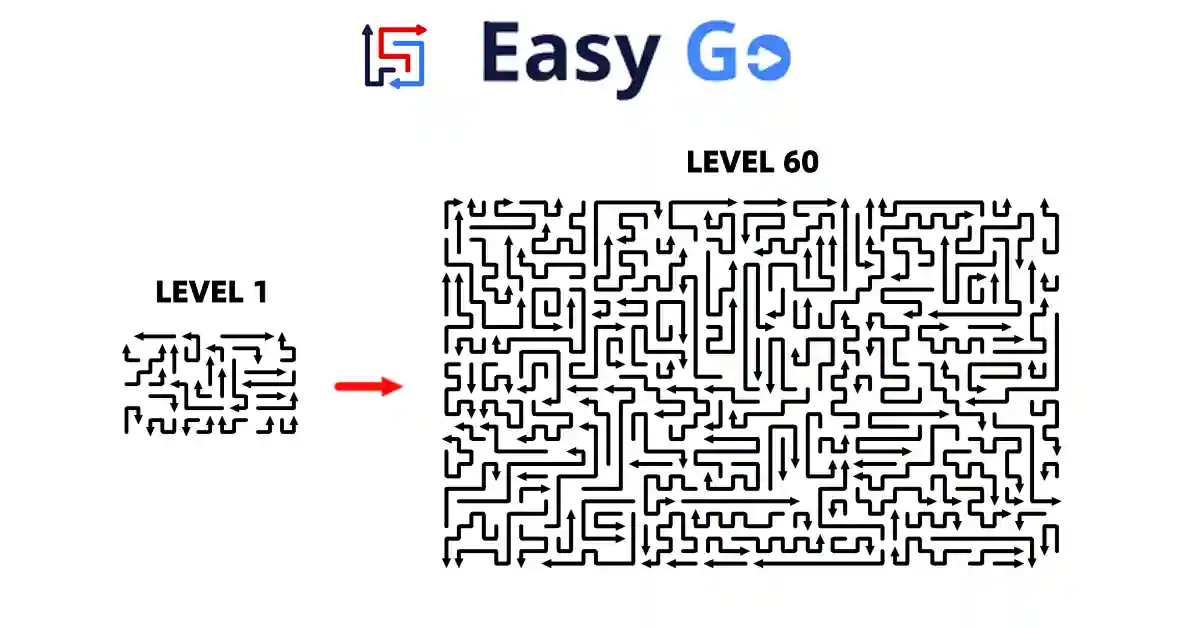
The Japan lane. This landscape image — a “Level 1→Level 60” difficulty comparison framed by the logo — ships with Japanese ad copy on a record set that includes at least six distinct images carrying the same localized description. The pictures stay language-neutral; the text around them is Japan’s. In a one-network buy with zero exclusive markets above 23 plans, this copy seam is the only place Japan gets special treatment, and it is enough to make Japan the number-two market in the book.
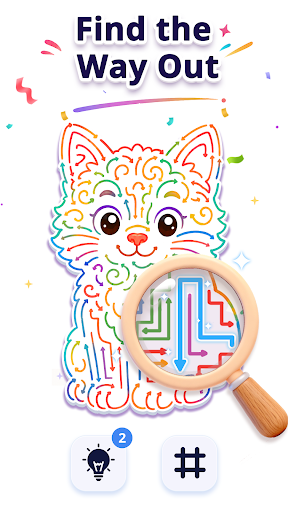
The reused one. “Find the Way Out”: a doodle-style cat rendered entirely in colored arrow strokes, a magnifying glass revealing the path mechanic inside it, hint and grid buttons below. The playable family is the only part of this record that behaves like a standing asset — its register grows from 4 to 7 to 20 entries across the window while image records churn daily underneath it. In a 9-plan reinvestment book, this is where all the compounding happens.
One big day, then a template treadmill
September 24 is the window’s event: 47 fresh creatives for 48 plans in a single day — 13.5% of the entire plan book dropped at once. September 11 adds 29 creatives for 30 plans, and September 23 follows with 25 for 27. After that the cadence flattens into something more interesting: on September 19 the record ships 19 creatives for exactly 19 plans, and on September 18, 14 for 14. One plan per creative is the AdMob app-campaign signature — assets are not being amplified, they are being trialed.
| Date | New creatives | Plans | Read |
|---|---|---|---|
| 09-24 | 47 | 48 | The window’s one big day |
| 09-11 | 29 | 30 | Secondary pulse |
| 09-23 | 25 | 27 | Lead-in to 09-24 |
| 09-13 | 23 | 28 | Trial batch |
| 09-19 | 19 | 19 | One plan per creative |
| 09-18 | 14 | 14 | One plan per creative |
| 09-22 | 11 | 22 | Two plans per creative |
Total reinvestment across the window is 9 plans — 2.5%. Everything else is freshly rendered. For a small publisher, that is a deliberate trade: skip the brand-building layer, feed the algorithm, and keep exactly one evergreen interactive asset alive.
What this data can and cannot tell you
Coverage shares are multi-attribution and overlap; the two AppLovin plans and one YouTube plan may intersect with AdMob coverage rather than sit beside it. Exclusive is a targeting definition, not an outcome, and at this scale the exclusive counts (4–23 plans) are too small to support any conclusion about market prioritization beyond “roughly even.” Estimated exposure is a global, lifetime figure per creative — not a window increment, not country-level, used here only as a scale signal. The store record carries no usable launch date, so the maturity reading rests on the download label and buy structure. All figures describe the 2026-09-09 to 2026-10-09 window as observed on the retrieval date and will drift as records update.
Key takeaways
- A single-network buy is a complete strategy, not a limitation: 353 of 355 plans on AdMob, with the format mix (90.5% images, near-zero reuse) reorganized around how app campaigns actually consume assets.
- The US can be optional: the top ten markets run Germany 217, Japan 197, Spain 184, France 177 — and no United States. Google’s auction found 119 markets worth buying before it found the obvious one.
- Localization survived anyway: a six-plus-image lane with Japanese ad copy lifted Japan to the number-two market, even with zero meaningful exclusives anywhere.
- Reuse concentrates where the format compounds: 9 reinvested plans in the whole window, but the “Find the Way Out” playable register grew 4 → 7 → 20 — the one asset class this team keeps.
Related reading
- Crownstone Survival Ads: 809 Plans That See Only Indonesia or the US — the opposite shape of focus: one network family carrying the buy, two markets walled off.
- Tiles Survive! Ad Creatives: An ad themed around AI and strategic management — a 4X record that spreads 10,758 plans evenly across 197 markets with just two exceptions.
- Marble Sort Ads: One of Voodoo’s New Three Horses Sells With a 98% Fail Hook — another casual record rebuilt around what its network rewards, this time Meta’s failure-hook economy.
- H1 2026 Casual Puzzle Games: Match-3 vs Merge-2 — how casual puzzle’s two biggest sub-genres split their ad budgets in the first half of the year, the shelf Easy Go’s arrow format now sits beside.
Want the raw structure behind this breakdown — every plan, creative and network for Easy Go: Arrow Puzzle Games and 4,000+ other tracked games? Explore the data at creativescope.ai/mcp.
FAQ
What is Easy Go: Arrow Puzzle Games?It is a minimalist mobile path puzzle: grids of one-way arrow segments that must be traced in the right order, presented in a cream-paper style with a red-white-blue arrow icon. The store listing sits under the publisher name Wood Puzzle Sudoku Games with a 50K+ downloads label.
Why does running on one network matter?Because the network dictates the creative operation. AdMob app campaigns reward high volumes of small, cheap assets with broad targeting — which is exactly what this record shows: 304 creatives for 355 plans, 90.5% images, near-zero reuse. A Meta-first or TikTok-first buy of the same size would look nothing like this.
How can AdMob cover 99.44% if three networks appear?Coverage is multi-attribution: a plan can touch more than one network. The 2 AppLovin plans and 1 YouTube plan are slivers that may overlap with AdMob coverage rather than sit outside it; either way, 353 of 355 plans run through AdMob.
Is Easy Go a new game?The store record carries no usable launch date. The 50K+ downloads label and the steady, template-driven buy pattern both point to a small live product in ongoing acquisition rather than a launch window.
Why Germany and Japan instead of the US?The dataset shows the outcome, not the reasoning: Germany (217 plans) and Japan (197) lead a 119-market spread in which the US does not make the top ten. Google’s auction, fed by a broad-targeting one-network buy, simply found better economics elsewhere.
Why so many images and so few videos?Images are the cheapest unit an app campaign can consume, and the record treats them that way: dozens of one-day image records with identical low exposure indicate a template being re-rendered daily. The 25 videos carry the highest single exposures, but they are the exception, not the system.
Data notes
Source: CreativeScope ad-intelligence dataset (retrieved 2026-10-09), window 2026-09-09 to 2026-10-09, store publisher listing Wood Puzzle Sudoku Games. “Coverage” is the share of the window’s 355 ad plans whose target-country or network list includes the item in question, computed with multi-attribution; overlapping shares do not sum to 100%. “Exclusive” requires a plan’s target-country list to contain exactly one market. “Estimated exposure” is CreativeScope’s global lifetime estimate per creative, used only as a relative scale signal. Creative, format and network counts use network attribution (305 records); the headline count of 304 is deduplicated.
Creative descriptions in the spotlight section are based on frame-by-frame visual inspection of the delivered files, plus direct inspection of the image and playable preview assets. Live windows, family counts and exposure figures per spotlight come from the same dataset. The Japanese-language ad copy referenced in the market section is quoted by translation; the underlying creatives remain language-neutral images. Nothing in this article should be read as an endorsement of the buying practices described; single-network concentration is an observed behavior, not a recommendation.
Get this live in your agent
These rankings come from a single MCP tool. Free key, ask in plain English.
Full genre × market grid?
Team plan unlocks every genre and market cut, plus AI teardowns.