
Marble Sort Ads: One of Voodoo's New Three Horses Sells With a 98% Fail Hook
Marble Sort!, one of Voodoo's new three growth engines, ran 700 ad plans and 315 creatives in the 31 days to September 28, 2026. One Meta placement package at an identical 47.86%, a 117-plan US-exclusive band, and a TikTok copy line that does the selling: 98% of players fail level 20.
Daniel Brooks
Creative Strategy Analyst
Published
Updated
Marble Sort! is one of the three titles industry coverage now groups as Voodoo’s new growth engines, alongside Castle Busters and Sand Loop. Its tracked ad record reads like a machine that never dramatizes itself: 700 ad plans in the 31 days to September 28, 2026, with Facebook, Instagram, Threads and Audience Network each carrying an identical 47.86% of them, and 117 plans targeting nothing but the United States. One line of copy does the selling: “98% of players fail level 20. Are you smart enough to solve this?”
Key takeaways
- Marble Sort! is a physics conveyor-belt sorting puzzle published by Voodoo, live on Google Play since October 2025 under the listing Marble Sort! - Color Puzzle (package
com.microdose.balljam). Industry coverage built on AppMagic estimates groups it with Castle Busters and Sand Loop as Voodoo’s new three growth engines. - The plan structure is a two-part machine. One part is a Meta placement package: Facebook, Instagram, Threads and Audience Network each cover exactly 335 of the 700 plans (47.86%), with Messenger right behind at 44.00%. The other part is a US-exclusive band: 349 plans cover the United States, and 117 of them target no other country.
- Outside Meta the record thins out fast: AppLovin 14.86%, Admob 13.00%, TikTok 11.43%, Mintegral 5.14%, Unity 4.71%, plus thin Vungle and YouTube layers. One AppLovin playable sits in the record.
- The creative library splits by register. TikTok cuts sell the fail-gate (“98% of players fail level 20. Are you smart enough to solve this?”) and an ASMR calm line (“Clear your head and sort the colors.”); Meta ships dozens of near-identical gameplay cuts under plain “Play Marble Sort now” body copy; a single reinvested video carries the Google-side layer.
- Cadence is a steady burn with one spike: 109 new plans and 25 creatives land on September 24, the largest single day in the window, after which the record settles back into daily small replenishment.
Data scope
This breakdown uses CreativeScope’s advertising record for the Marble Sort! listing over August 29 – September 28, 2026 (31 days): 315 creatives, 700 ad plans, 84 reinvested creatives, and a 208,575,307 lifetime estimated exposure for the creatives active in the window. Every count is deduplicated: one creative, one plan, counted once.
Three limits apply to every figure here. Country and network shares are target-coverage shares under multi-attribution: one plan can list several countries, so shares overlap and never sum to 100%. “Exclusive” means a plan whose delivery-country set contains exactly one market. It describes a targeting decision, not a result. Lifetime estimated exposure is a relative delivery-scale signal for creatives active in the window, not an impression count, and several of the largest TikTok cuts have been live since well before this window. The record carries no spend, installs, conversions or revenue, and no country-level exposure.
One listing note. The intelligence provider tracks the game’s Google Play listing, Marble Sort! - Color Puzzle, as a separate record from the Marble Sort! listing read here; the two are never added together in this article, and every figure above describes the Marble Sort! record only.
The game, and the three horses around it
Marble Sort! is a conveyor-belt sorting puzzle: marbles drop from top trays onto a moving belt, and the player routes them into matching containers before the belt fills up. The Google Play listing, Marble Sort! - Color Puzzle (package com.microdose.balljam), has been live since October 2025, carries a 4.69-star rating from about 67,000 ratings, and is published by Voodoo; industry and community sources attribute the development to Microdose Oy, which we report as attributed, not confirmed.
The context around the game comes from industry coverage, not from our record. AppMagic-based analysis published in July 2026 grouped three Voodoo titles as the company’s new growth engines: Castle Busters (midcore PvP), Sand Loop (sand-filling sort puzzle) and Marble Sort!, with April–May 2026 in-app revenue of roughly $10M+, $5M+ and $9M respectively, and lifetime figures for Marble Sort! of about 13.7M downloads and $10.8M in in-app revenue, led by a single bundle said to drive 85.5% of it. Those are external estimates and we cite them as such. The advertising structure behind the third horse is the part our record can speak to.
Market structure: half the record touches the US, and 117 plans touch only the US
Coverage reaches more than 160 countries, but the top of the market table is one long step down from the United States: 349 plans (49.86%) cover the US, Canada follows at 325 (46.43%), Japan at 289 (41.29%), Germany at 274 (39.14%) and the UK at 264 (37.71%). That shape alone would describe an ordinary global blanket. What makes it a structure is the exclusivity column:
| Market | Plans covering | Exclusive plans | Coverage share |
|---|---|---|---|
| United States | 349 | 117 | 49.86% |
| Canada | 325 | 7 | 46.43% |
| Japan | 289 | 9 | 41.29% |
| Germany | 274 | 17 | 39.14% |
| United Kingdom | 264 | 11 | 37.71% |
| Australia | 259 | 1 | 37.00% |
| Taiwan | 253 | 5 | 36.14% |
| South Korea | 238 | 1 | 34.00% |
The US exclusive band is the largest by an order of magnitude. Germany, the second-biggest exclusive market, has 17. Australia and South Korea have one each. The plan record treats the US as a market worth addressing on its own terms, 117 times over, while every other country is reached almost entirely by plans that also include other markets.
Network structure: one Meta machine, and everything else in single digits
The network table is unusually clean. Facebook, Instagram, Threads and Audience Network each cover exactly 335 of the 700 plans, an identical 47.86%. That is the signature of one Meta placement package delivered to four surfaces at once. Messenger covers 308 plans (44.00%), close enough to be the same family with one surface withheld. Everything else is a second tier:
Share of the 700 tracked ad plans covering each network; multi-attribution, shares overlap. Vungle and YouTube also appear in the record at trace levels.
The second tier does real work. AppLovin’s layer includes a playable ad alongside video; Admob and YouTube carry the single most-reused video in the record; TikTok, at 11.43% of plans, holds the creative register that gives the game its voice. Still, the plan machine belongs to Meta, and the record shows it twice: in the identical 47.86%s and in Messenger’s 44.00%.
Creative mix: video everywhere, portrait everywhere, sixty seconds deep
Among the 30 highest-heat creatives in the window, every one is a video except a single AppLovin playable. Both delivered orientations observed in the sample are portrait 9:16: a 720×1280 TikTok cut and 360×640 deliveries on the Google and Meta sides. All three delivered files run the full minute, so the selling unit here is a sixty-second loop of tray-tapping and belt-packing rather than a six-second flash.
Exposure concentrates in one place. The roughly ten TikTok cuts of the 98%-fail copy add up to about 120M in lifetime estimated exposure, more than half of the window’s 208.6M total, and the calm-line pair adds about 11M more. The Google-side reinvested workhorse carries about 30.7M. Meta’s four largest cuts reach only about 6.4M combined. Plan share and exposure share do not agree: TikTok holds 11.43% of plans but the largest creative footprints, because its cuts have been alive since spring while Meta keeps rotating small fresh variations.
The creative read: a fail-gate on TikTok, a workhorse on Google, a chorus on Meta
The library splits into three registers, and each register owns a different part of the machine.
- The TikTok register sells the fail-gate. The highest-exposure cuts in the record all carry one copy line: “98% of players fail level 20. Are you smart enough to solve this?” It runs across roughly ten distinct video cuts, several of them live since March and May, with lifetime estimated exposures from about 31.6M down to about 0.7M. A calmer sibling line, “Clear your head and sort the colors. Pure relaxation for your brain.”, adds two more cuts near 10M. One line of copy, many cuts, all pointing at the same challenge.
- The Google layer runs one workhorse. The Admob-and-YouTube side is dominated by a single video that the record flags as reinvested, with a similar-creative family of 53 and about 30.7M lifetime estimated exposure, the largest single creative footprint in the window after the TikTok family.
- The Meta layer runs a chorus. Individually these cuts are small, with the largest reaching about 1.8M lifetime estimated exposure, but they arrive in families: dozens of near-identical gameplay cuts, flagged as reinvested, with similar-count families of 4 to 20, almost all under plain “Play Marble Sort now” body copy. New Meta cuts land on September 4, 16, 24, 25 and 26, feeding the plan machine fresh variations.
AppLovin adds a playable ad to the mix alongside video, and the record also carries a September 24 Meta cut that ends on an explicit fail state: a red badge over a belt that did not get sorted. The ending points at the monetization: industry reporting counts fail-recovery offers among the game’s revenue components, and this cut rehearses that moment.
Creative Spotlight
Hook. At 0:02 the ad opens on three rounded pop-it trays with bubble counters reading 99, 98 and 99, a cartoon hand cursor tapping the yellow tray, and a stream of yellow marbles pouring down a chute toward the belt below. The “are you smart enough” challenge is set before a single marble lands.
Body. By 0:15 the counters have drained to 97, 97 and 99 and the oval conveyor ring is packed with yellow marbles rolling toward a grid of yellow, magenta and cyan pop-it boxes. Around 0:35 the palette flips to cyan and magenta marbles with counters at 98, 96 and 98, and a cyan box is slotted into the grid. The sixty-second loop keeps resetting the same satisfy-and-clear beat.
End sequence. At 0:55 the ad closes on a MARBLE SORT end card with six level previews and a yellow “Play Now” button. The interface is ad-rendered rather than the native game HUD; English on-screen text appears on the end card, while the 98%-fail line is the ad’s tracked copy rather than a caption inside the frames.
Takeaway. A pure IQ-gate wrapped in ASMR: the same copy line spans roughly ten cuts whose combined lifetime estimated exposure is about 120M, making it the loudest voice in the record.
Hook. At 0:02 the same pop-it tray layout appears with counters at 99, 99 and 98, a hand cursor over the magenta tray, and cyan marbles flowing onto the oval belt. There is no copy line here: the gameplay is the hook.
Body. Around 0:15 a cyan tray discharges its marbles mid-air toward counter 97 while pink and cyan marbles ride the belt past a white sparkle effect; by 0:35 a hand pulls a yellow tray overflowing with marbles, counters down to 98, 94 and 95.
End sequence. At 0:55 the MARBLE SORT end card and “Play Now” button close the cut, mirroring the TikTok register’s ending.
Takeaway. The delivered file is 360×640 and the master metadata records the same 9:16 orientation at higher dimensions, which is a normal transcoding difference. A single reinvested cut with a 53-strong similar family carries the Google-side layer at about 30.7M lifetime estimated exposure.
Hook. At 0:02 the cut swaps the pastel palette for black, white and neon green: three stacked tile towers replace the trays, a hand cursor hovers over the right tower, and green marbles pour from the left tower onto the belt above a grid of black, green and white boxes.
Body. Around 0:15 the hand moves to the middle tower and the belt mixes green and white marbles; by 0:35 white marbles pour down and the belt is packed solid green under a sparkle effect. It fills fast and the pacing never slows.
End sequence. At 0:55 a large red FAIL badge covers the packed belt. The ad ends on the failure moment rather than the win, which is the moment industry reporting describes as one of the game’s monetization levers: the fail-recovery offer.
Takeaway. A fresh September 24 variation in the Meta chorus, and the clearest case of the ad library rehearsing the monetization beat, with the advertising and the monetization telling the same story.
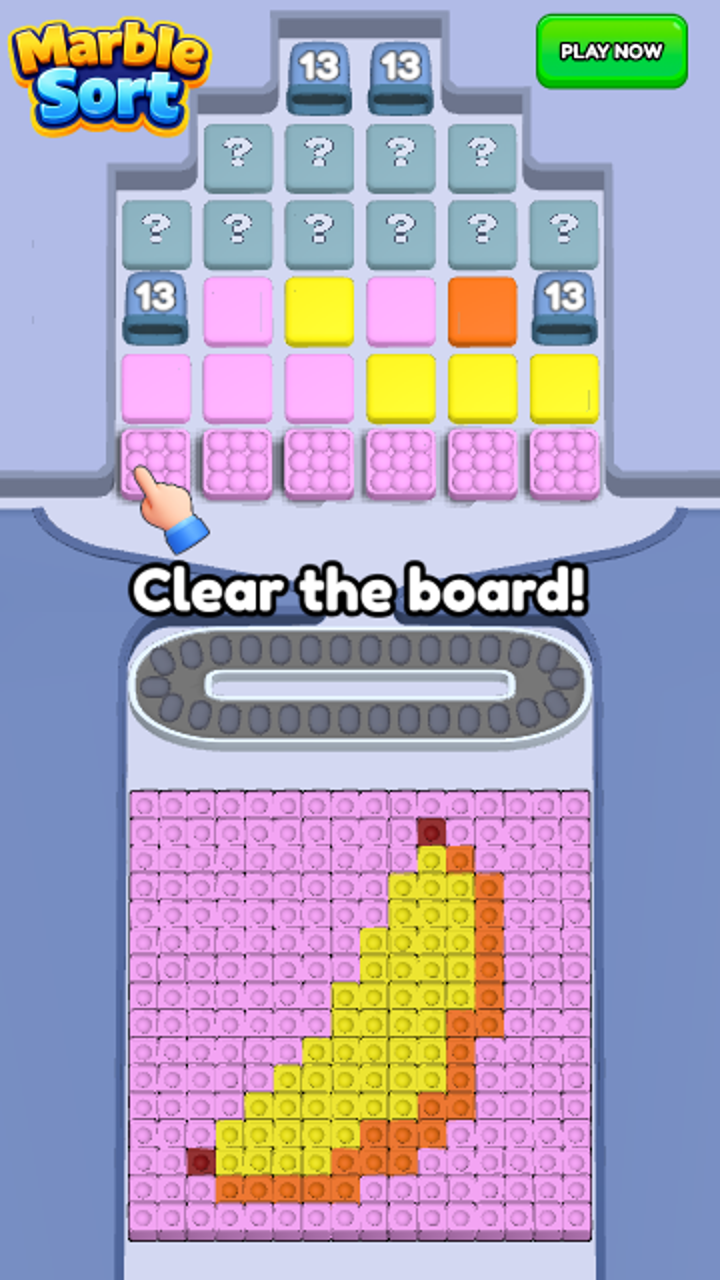
The playable sits in the AppLovin layer next to video: a small, complete format bet, with interactive try-before-install on one network, fail-gate video on another and a plan machine on Meta.
Cadence: one spike, then back to the drip
The window opens with the machine already running. New-plan activity stays in the double digits through most of September (26 plans on August 31, 43 on September 4, 35 on September 16) before spiking on September 24: 109 new plans with 25 new creatives, the largest single day in the record. The next day adds 25 more plans on 23 creatives, and after that the record settles back into a daily drip. The 84 reinvested creatives, just over a quarter of the library, keep older cuts alive while the drip adds variations, which matches what the Meta families are: the same idea, cut again.
What the record adds to the three-horses story
The industry narrative about Voodoo’s new growth engines is about revenue mix and genre movement: a hypercasual publisher learning to earn most of its money from in-app purchases, in sort-puzzle and midcore categories, with a conveyor-belt formula it can reuse. That story is built on external estimates. Our record cannot confirm or deny any revenue figure, but it can show what the advertising half of the machine looks like from the outside. For Marble Sort! that means a Meta placement package doing the bulk coverage, a 117-plan US-exclusive band on top, a second tier of networks each with one job, and a creative system where a single fail-gate line of copy does the persuasion while everything else stays plain.
Two details generalize beyond this game. First, plan share and creative exposure do not have to agree: TikTok holds 11.43% of plans but the largest exposure concentrations in the record, because its cuts have been alive since spring. Second, the ad library rehearses the monetization: the September 24 Meta cut that ends on a red FAIL badge is selling the exact moment, the failed level, that industry reporting describes as one of the game’s revenue components. For the third of Voodoo’s new three horses, that advertising looks like infrastructure.
What the record cannot say
The tracked record carries no spend, budget, install or conversion data, so nothing here is a performance claim; the revenue, download and rating figures quoted from industry coverage and public store data are external estimates and are labeled as such. Coverage and exclusivity describe targeting decisions, not outcomes. Lifetime estimated exposure is a relative delivery-scale signal, not an impression count, and it is biased toward creatives that have been running longest, which is why the spring-launched TikTok cuts dominate it. And the sibling Marble Sort! - Color Puzzle listing is tracked separately, so the Google Play half of the game’s advertising is not in these numbers.
CreativeScope take. Marble Sort!’s ad record is the least dramatic kind of impressive: no launch pulse, no market-by-market language switching, no format experiments beyond one playable. One Meta package covers half the plan record at four identical percentages, 117 plans keep a dedicated lane to the US, and one line of copy, “98% of players fail level 20”, carries the persuasion across roughly ten TikTok cuts while Meta’s chorus keeps the belt supplied.
Related reading
- Shelter Defense Ads: The Zombie Tide Does the Selling, a launch buy that puts 87 of 100 plans in two markets.
- Magic Defense Ads: The Co-op Hook, Market by Market, five countries, one language per market, one Meta package.
Want the raw structure behind this breakdown: every plan, creative and network for Marble Sort! and thousands of other tracked games? Explore the data at creativescope.ai/mcp.
FAQ
What is Marble Sort?Marble Sort! is a physics conveyor-belt sorting puzzle published by Voodoo: marbles drop from top trays onto a moving belt and the player routes them into matching containers before the belt fills. The Google Play listing is Marble Sort! - Color Puzzle (package com.microdose.balljam), live since October 2025.
Why is it called one of Voodoo’s new three horses?Industry coverage based on AppMagic estimates groups Marble Sort! with Castle Busters and Sand Loop as the three titles behind Voodoo’s shift toward in-app-revenue-driven hybrid and midcore products, with a combined $24M+ in in-app revenue across April and May 2026. We cite that framing as industry reporting, not as our own measurement.
How many ads did Marble Sort run in the last 30 days?In CreativeScope’s tracked record for the Marble Sort! listing, the window August 29 – September 28, 2026 contains 700 deduplicated ad plans and 315 deduplicated creatives, with 84 creatives still being reinvested. The sibling Google Play listing is counted separately and is not included.
Which markets get exclusive plans?The United States, by a wide margin: 117 plans target the US and no other country. Germany follows with 17 exclusive plans, the UK with 11, Japan with 9, Canada with 7; Australia and South Korea have one each. Every other market is reached mainly through plans that also cover other countries.
Which ad platforms does Marble Sort use?Facebook, Instagram, Threads and Audience Network each carry an identical 47.86% of plans, one Meta placement package, with Messenger at 44.00%. Below Meta sit AppLovin (14.86%), Admob (13.00%), TikTok (11.43%), Mintegral (5.14%) and Unity (4.71%), plus trace Vungle and YouTube, and one playable ad on AppLovin.
What copy does the advertising use?The persuasive voice of the record is a single fail-gate line (“98% of players fail level 20. Are you smart enough to solve this?”) across roughly ten TikTok cuts, plus a calm ASMR variant (“Clear your head and sort the colors.”). Meta’s many cuts mostly run plain “Play Marble Sort now” body copy, and one September 24 cut ends on a red FAIL badge.
Data notes
- Advertising figures: CreativeScope record for the Marble Sort! listing, window August 29 – September 28, 2026, deduplicated by plan and creative: 315 creatives, 700 ad plans, 84 reinvested creatives, 208,575,307 lifetime estimated exposure. Coverage and platform shares are overlapping target-coverage shares under multi-attribution and do not sum to 100%. “Exclusive” = a plan whose delivery-country set contains exactly one market. Lifetime estimated exposure is a delivery-scale reference for creatives active in the window, not an impression count; the record contains no spend, install, conversion or revenue data and no country-level exposure. The sibling Marble Sort! - Color Puzzle listing is a separate record and the two are never combined.
- Store and industry context: package name, October 2025 Google Play availability, rating count and publisher name are read from the public Google Play listing and public store-intelligence pages; the development attribution to Microdose Oy is reported as attributed. Revenue, download and monetization-mix figures attributed to AppMagic come from industry coverage published in July 2026 and are external estimates. Creative descriptions are drawn from the delivered ad files; the article cover is an AI-generated illustration in the game’s art style, not a tracked ad frame.
Get this live in your agent
These rankings come from a single MCP tool. Free key, ask in plain English.
Full genre × market grid?
Team plan unlocks every genre and market cut, plus AI teardowns.