
Bulldozer Master Ads: Unlock Epic Bulldozers, Aimed at the US
Supercent's demolition-miner ran 243 creatives and 389 ad plans across 126 countries in 31 days, and 47 of its 115 US-covering plans name no other country.
Daniel Brooks
Creative Strategy Analyst
Published
Updated
Bulldozer Master: Crush & Mine is what Supercent’s machine looks like when it points at a wrecking-ball niche instead of a restaurant. In the 31 days to September 29, 2026, the title’s iOS advertising record carries 243 creatives and 389 ad plans spread over 126 countries, one copy line — “Unlock epic bulldozers!” — carries the Meta side, and the sharpest targeting decision in the record is American: of the 115 plans that touch the United States, 47 name no other country. That single-country pool is larger than the next nine markets’ exclusives combined.
Key takeaways
- Bulldozer Master: Crush & Mine is an arcade demolition-and-mining sim by Supercent, Inc., the Seoul publisher behind Pizza Ready!, Burger Please! and Snake Clash!. It is a mature product — the Google Play listing has been live since April 6, 2025 with a 1M+ installs label — and this breakdown reads its iOS advertising record, which the tracker carries as a separate listing.
- Coverage is wide but flat: 126 countries are named somewhere in the record, and the top ten markets all sit inside a narrow 29–36% coverage band. What breaks the flatness is the exclusivity column: 47 of the 115 US-covering plans are US-only, while runner-up Japan holds 12 exclusives. The next nine markets’ single-country plans add up to 45 — fewer than the American pool alone.
- Delivery splits into two Meta packages and one video-network lane. Facebook, Instagram, Threads and Messenger each cover an identical 188 plans (48.33%), Audience Network adds 97 (24.94%), and AppLovin carries 128 plans (32.90%) — the strongest non-Meta lane we have measured on this site, with Admob at 43 (11.05%) behind it.
- The creative library runs on two art worlds. AppLovin ships photoreal heavy-machinery driving clips that end on the Bulldozer Master logo card, each a single fresh cut; Meta recycles a low-poly isometric mining base under two copy lines (“Unlock epic bulldozers!” / “Build your mining empire!”), and 13 of its 19 top-30 entries still carry unfilled template variables — “{{product.name}}” and “{{product.brand}}” — as their headline text.
- Cadence is a drip with one spike: 41 new plans and 20 new creatives land on September 3, the busiest day of the window, after which the record settles into daily replenishment of roughly ten plans at a time. Sixty-seven creatives, just over a quarter of the library, stay in reinvestment throughout.
Data scope
This breakdown uses CreativeScope’s advertising record for the iOS App Store listing of Bulldozer Master: Crush & Mine (Apple ID 6747710694), over August 30 – September 29, 2026 (31 days): 243 creatives, 389 ad plans, 67 reinvested creatives, and a 33,114,135 lifetime estimated exposure for the creatives active in the window. Every count is deduplicated — one creative, one plan, counted once.
Three limits apply to every figure here. Country and network shares are target-coverage shares under multi-attribution: one plan can list several countries and several platforms, so shares overlap and never sum to 100%. “Exclusive” means a plan whose delivery-country set contains exactly one market — a targeting decision, not evidence of results. Lifetime estimated exposure is a relative delivery-scale signal for creatives active in the window, not an impression count. The record carries no spend, installs, conversions or revenue, and no country-level exposure.
One listing note. The tracker also carries a separate record for the game’s Google Play listing (io.supercent.bulldozermasters), which is larger in every count (518 creatives, 751 plans). The two storefronts are tracked separately and never added together anywhere in this article; every figure below is the iOS record unless a paragraph says otherwise.
The game, and the publisher behind it
Bulldozer Master: Crush & Mine sells one fantasy with two verbs: demolish and mine. You drive heavy machinery, smash through rock and ruined buildings, haul ore back to a refining yard, and sell it for cash that buys bigger machines. The store description calls it a destruction simulator; the ads call it something simpler, which we will get to.
The publisher is the more interesting nameplate. Supercent, Inc. is a Seoul-based mobile game publisher founded in 2021, known for Pizza Ready!, Burger Please! and Snake Clash! — titles that company statements and investment-press coverage credit with helping the publisher pass roughly 1.5 billion cumulative downloads and a top-five position among global publishers by download volume. That is external reporting about the company, not a claim about this game, but it frames what kind of organization is buying these ads: a hyper-casual and hybrid-casual factory that treats user acquisition as infrastructure.
Store facts worth keeping separate from ad facts: the Google Play listing has been live since April 6, 2025 per multiple store trackers, shows a 1M+ installs label and a rating in the 4.4–4.5 range from tens of thousands of reviews, and the game currently sits high in the US top-free Arcade chart — which is how it entered our radar. The iOS listing this article tracks is younger but no longer new, so nothing here is a launch story.
The structure: a flat map with one American spike
Coverage reaches 126 countries, and at first glance the map looks deliberately even. The ten largest markets by plan coverage all land within a seven-point band:
| Market | Plans covering | Single-country plans | Share of 389 plans |
|---|---|---|---|
| Japan | 139 | 12 | 35.73% |
| Singapore | 129 | 6 | 33.16% |
| France | 126 | 4 | 32.39% |
| Thailand | 118 | 8 | 30.33% |
| South Africa | 117 | 4 | 30.08% |
| Mexico | 116 | 4 | 29.82% |
| United States | 115 | 47 | 29.56% |
| United Kingdom | 115 | 1 | 29.56% |
| Canada | 114 | 4 | 29.31% |
| Germany | 114 | 2 | 29.31% |
Orange bars: markets carrying meaningful single-country pools. Bar length reflects plans covering the market; the second number is the exclusive count.
Now read the exclusivity column instead of the coverage column. The US is only seventh by coverage, but 47 of its 115 plans are US-only — 41% of everything touching the American market, and 12% of the entire plan record. Japan, the coverage leader, holds 12 exclusives. Add up the single-country plans of the next nine markets and you get 45. The United States pool beats all of them combined.
That is the signature of a two-layer buy: a broad shared layer that paints 126 countries with the same plans, and a dedicated American layer that is set up to be measured, tuned and scaled on its own terms. The record cannot say which layer performs. It can say that the US is the only market this advertiser treats as worth addressing alone, nearly fifty times over.
Distribution: two Meta packages and one strong AppLovin lane
Ten delivery platforms appear in the window, and they divide into three tiers.
Plan-coverage share under multi-attribution; overlapping shares do not sum to 100%. Four Meta surfaces reporting an identical 188 plans is the signature of a single placement package rather than four separate buys.
The Meta side has a wrinkle worth naming. Facebook, Instagram, Threads and Messenger each report exactly 188 plans — one package placed across four surfaces. Audience Network reports 97, a strict subset, and the creative records show why: individual Meta creatives are logged on all five surfaces at once, which means the buy is really a four-surface package with a five-surface variant on top of it.
The non-Meta story is unusual for this site’s breakdowns. AppLovin carries 128 plans at 32.90% — not a trace-tier network but a genuine second engine, ahead of Admob’s 43 and far ahead of Mintegral, YouTube and Unity. On comparable records we usually find Meta running at 60–85% with one or two networks trailing. Here the video-network lane is close to half the Meta package’s size, and it is where the freshest creative supply lands, as the next section shows.
The creative read: two art worlds split by network
The library divides by placement so cleanly that you could reconstruct the media plan from the art style alone.
- Photoreal machinery (AppLovin). The AppLovin lane ships portrait video of a bulldozer on a wrecked mountain highway — dust, crushed asphalt, a log-screw attachment grinding through rock — cut like a driving-simulator trailer and closing on the Bulldozer Master logo over a demolition scene. Every one we opened is a single fresh cut with no similar-creative family attached, and the lane also carries the record’s playable ads.
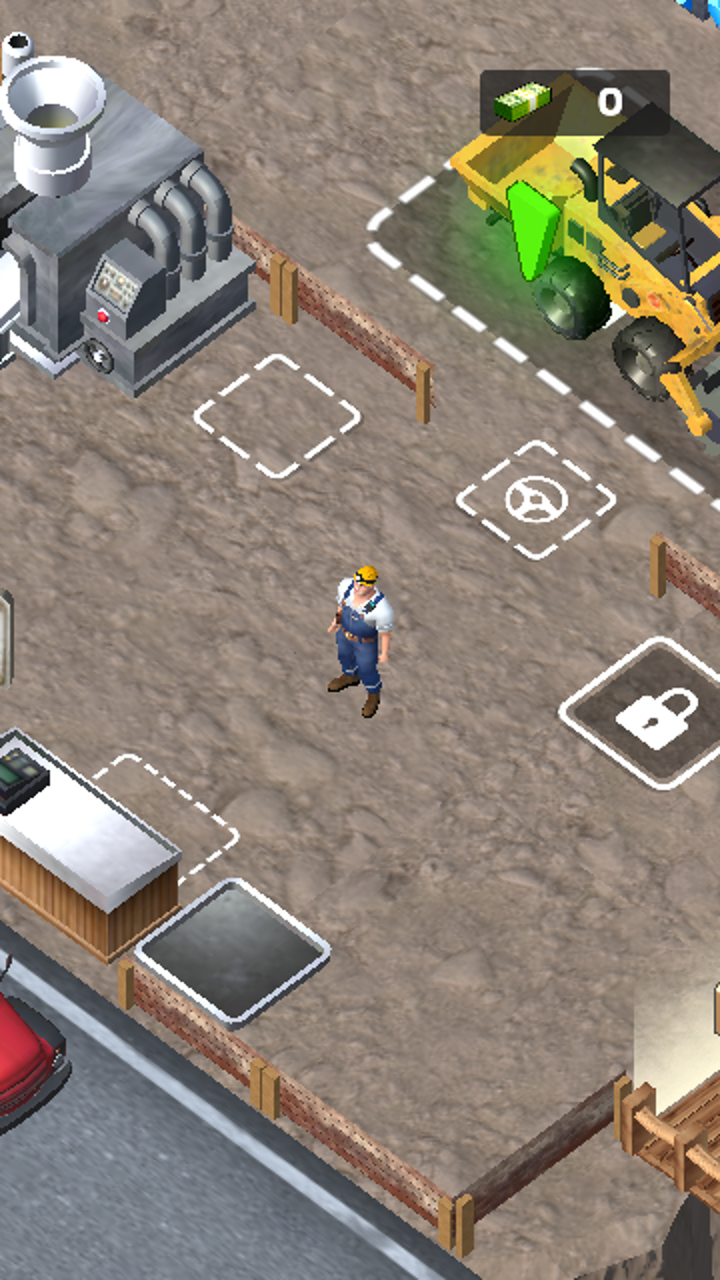
- Low-poly mining base (Meta). The Meta lane recycles gameplay from the isometric mining yard: crush ore, refine it, load trucks, collect cash. The copy system is two lines — a body, “Unlock epic bulldozers!”, and a title, “Build your mining empire!” — reused across families of near-identical cuts rather than refreshed.
- The template problem. A striking share of the Meta library ships with its headline fields never filled in: the ad’s title literally reads
{{product.name}}and its body{{product.brand}}. Thirteen of the nineteen Meta entries in the top-30 heat list carry those unfilled variables, in families of up to sixteen similar cuts. - Admob statics. The Google-side lane is a small set of static images, partly reinvested, with no copy line of its own.
Read together, the split is a division of labor: AppLovin gets the new production — fresh single cuts plus interactives — while Meta runs the recycling program, re-cutting one mining-yard loop under two copy lines. Whether the unfilled template variables render as literal {{product.name}} text to real users or get substituted at delivery is not visible in the record. That live ads are being uploaded with the placeholders still in them is the part that is visible, and it is rare enough to be worth circling.
Creative Spotlight
Spotlight 1 — The line that does the selling (Meta)
“Unlock epic bulldozers!” is the closest thing this record has to a slogan. This cut sits at the head of an 88-clip family, reinvested, with 474,125 lifetime estimated exposure — the mining loop, sold in five words.
Spotlight 2 — The ad that still says {{product.name}} (Meta)
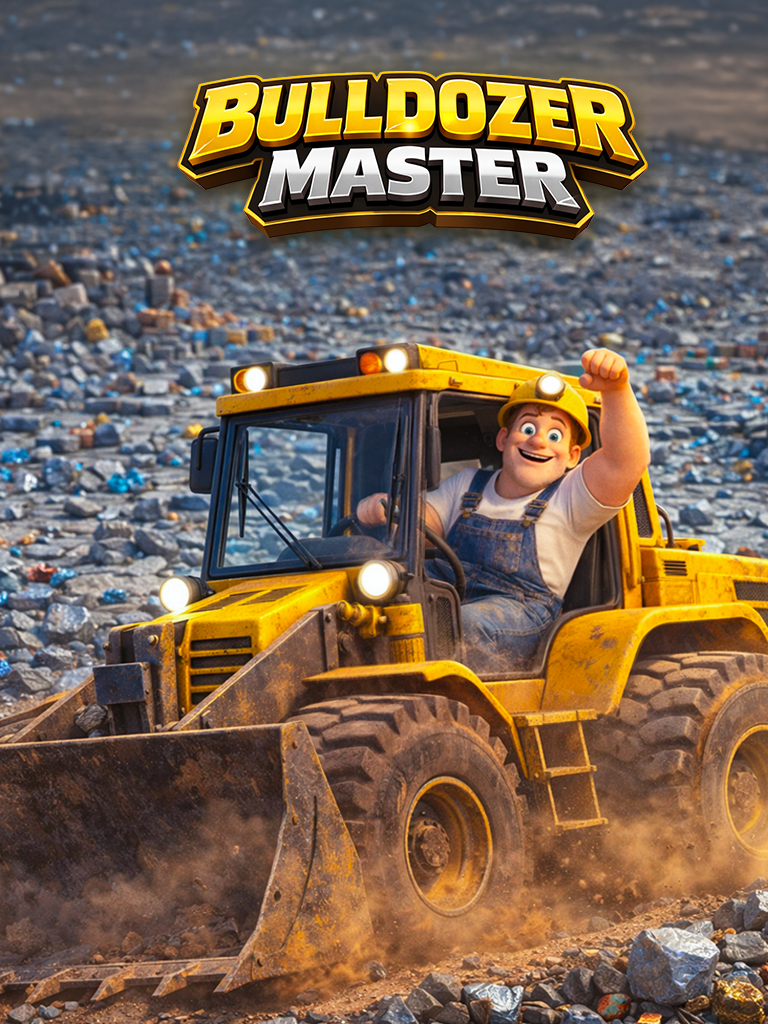
The template problem is not a video bug. This character poster — 302,583 lifetime estimated exposure, up for the entire window — also ships with no headline: its title and body fields are the raw template variables. It is one of thirteen top-30 Meta entries in that state, which turns a QA miss into a measurable pattern.
Spotlight 3 — The other art world (AppLovin)
Photoreal machinery, a mountain highway, a driver’s-eye joystick and pedal — and none of the mining yard. The AppLovin lane buys new production for every cut: this asset stands alone, no family attached, and ends on the logo card over a demolition site.
Spotlight 4 — The playable on top (AppLovin)
The single hottest creative in the record is not a video but an interactive build: an AppLovin playable of the mining-yard onboarding, at 742,904 lifetime estimated exposure. The lane carries at least six playables in the window, all single builds.
Cadence: one spike, then a working drip
| Date (2026) | New creatives | New ad plans | Read |
|---|---|---|---|
| August 31 | 10 | 10 | Baseline drip, one-to-one |
| September 3 | 20 | 41 | The spike: the window’s largest day on both counts |
| September 4 | 13 | 14 | Follow-through |
| September 16 | 15 | 25 | Second pulse |
| September 25 | 10 | 10 | Back to the drip, three weeks later |
There is no launch in this window — the game has been selling itself since April 2025 — so the cadence reads like operations rather than opening. September 3 is a genuine spike: 41 new plans and 20 new creatives in one day, the kind of day that usually marks a new creative batch or a targeting change. Then the record returns to its resting heartbeat of about ten plans and ten creatives a day, all the way to the window’s end.
The reinvestment number is the other half of the story. Sixty-seven creatives — 28% of the library — stay in active reinvestment across the whole month, which is what keeps the Meta families alive while the drip feeds them variations. Old cuts do not die here; they get re-cut.
The Android listing next door runs a different shape
Supercent also buys heavily for the Google Play listing, and the tracker carries it as a separate record. Same game, same publisher, same window — a different machine.
The Android record is larger across the board: 518 creatives and 751 plans, with 81 in reinvestment and 44.7 million in lifetime estimated exposure. More interesting is the ranking. There, AppLovin leads at 220 plans (29.29%) while the Meta quartet drops to 183 each (24.37%), Admob rises to 169 (22.50%), and two networks the iOS record never touches — ironSource and Vungle — appear. The exclusive geography is more American too: the US leads coverage at 282 plans with 135 exclusives, ahead of Japan at 254 with 29.
So the storefront split is also a strategy split: Meta-first on iOS, AppLovin-first on Android, with the US holding the largest single-country pool on both. We report the two records side by side here and never sum them; if you quote one of these numbers, quote it with its listing attached.
What the record cannot say
Three claims sit just outside the evidence, and are worth refusing out loud.
- It cannot rank the storefronts. The iOS and Android records differ in size and shape, but neither number is a result. The splits are targeting and placement decisions made by the advertiser, not outcomes we can measure.
- It cannot score the creatives. Lifetime estimated exposure measures delivery scale for assets active in the window, not response. The unfilled-template Meta cut and the polished AppLovin trailer could be doing very different jobs at very different prices.
- It cannot date the product’s maintenance. Store trackers disagree on this title’s most recent version update — their records name different dates in August and September 2026 — so we make no claim about the update cadence or any gap between product and advertising rhythm. The advertising cadence in the section above is measured; the product cadence is not.
CreativeScope take
Most breakdowns on this site describe a launch or a concentrated bet. This one describes maintenance at scale — a mature arcade title whose record shows no launch, no silence and no drama, just a daily drip, two Meta packages and a video-network lane running in parallel for a month straight.
The transferable details are three. First, exclusivity as an instrument: 126 countries share one broad layer while a 47-plan American pool runs alone, and the two layers do not blur into each other. Second, a non-Meta lane with real weight — AppLovin at a third of the plan record, carrying the fresh production and the playables while Meta recycles. Third, the template variables: a reminder that inside even a top-five publisher’s machine, some share of the live library is running with the merge tags still showing. Whatever your stack is, that is a QA report worth running on your own ad account this week.
Related reading
- Marble Sort Ads: One of Voodoo’s New Three Horses Sells With a 98% Fail Hook — the other publisher-machine record, where four Meta surfaces also reported an identical plan count.
- Magic Defense Ads: The Co-op Hook, Market by Market — a co-op seller that split its message one country at a time, without a US-exclusive layer.
- Shelter Defense Ads: The Zombie Tide Does the Selling — the narrow end of the spectrum: two markets, one Meta package, nothing else turned on.
Want the raw structure behind this breakdown — every plan, creative and network for Bulldozer Master: Crush & Mine and 4,000+ other tracked games? Explore the data at creativescope.ai/mcp.
FAQ
What is Bulldozer Master: Crush & Mine?Bulldozer Master: Crush & Mine is a mobile arcade game that combines demolition driving with idle mining. Players operate heavy machinery to smash rock and ruined buildings, haul ore to a refining yard, and sell resources to unlock bigger machines. The Google Play listing has been live since April 6, 2025.
Who publishes Bulldozer Master: Crush & Mine?Supercent, Inc., a Seoul-based mobile game publisher founded in 2021. Company statements and investment-press coverage credit the publisher with titles such as Pizza Ready!, Burger Please! and Snake Clash!, roughly 1.5 billion cumulative downloads, and a position among the top global publishers by download volume.
How many ad plans does Bulldozer Master run?In the tracked window of August 30 to September 29, 2026, CreativeScope recorded 389 ad plans and 243 creatives on the game’s iOS listing, with 67 creatives still in reinvestment. The Google Play listing is tracked as a separate, larger record (751 plans, 518 creatives) and the two are never added together in our breakdowns.
Why does the US get its own ad plans?Of the 115 tracked plans whose targeting includes the United States, 47 name no other country — the largest single-country pool in the record, larger than the next nine markets’ exclusives combined. The record shows where plans point, not why; a dedicated pool of this size reads as a targeting decision to measure and tune the US market on its own terms.
Which ad platforms does Bulldozer Master use?Ten platforms appear on the iOS listing in the window: Facebook, Instagram, Threads and Messenger each cover an identical 188 plans (48.33%), AppLovin carries 128 (32.90%), Audience Network 97 (24.94%), Admob 43 (11.05%), plus Mintegral, YouTube and Unity. Shares overlap under multi-attribution and do not sum to 100%.
What is unusual about its ad creatives?Two things. The library splits by network into two art worlds: photoreal heavy-machinery driving clips with playable ads on AppLovin, and a recycled low-poly mining-yard loop on Meta. And a large share of the top Meta creatives ship with unfilled template variables — the title field literally reads {{product.name}} and the body {{product.brand}} — across families of up to 88 similar cuts.
Data notes
- Advertising figures: CreativeScope record for the iOS App Store listing of Bulldozer Master: Crush & Mine (Apple ID
6747710694), window August 30 – September 29, 2026, deduplicated by plan and creative: 243 creatives, 389 ad plans, 67 reinvested creatives, 33,114,135 lifetime estimated exposure, 10 delivery platforms, 126 countries named anywhere in the record. Coverage and platform shares are overlapping target-coverage shares under multi-attribution and do not sum to 100%. “Exclusive” = a plan whose delivery-country set contains exactly one market. Lifetime estimated exposure is a delivery-scale reference for creatives active in the window, not an impression count; the record contains no spend, install, conversion or revenue data and no country-level exposure. - Dual-listing disclosure: the Google Play listing (
io.supercent.bulldozermasters) is tracked as a separate record — 518 creatives, 751 ad plans, 81 reinvested, 44,690,693 lifetime estimated exposure, AppLovin 220 (29.29%) leading, US 282 plans with 135 exclusives. The two listings are never combined or cross-summed in this article. - Store facts: Google Play release date April 6, 2025 and install label as shown by public store trackers at the time of writing. Store trackers disagree on the listing’s most recent version-update date, so no update-cadence claim is made anywhere in this article.
- Publisher context: Supercent’s portfolio and scale figures (Pizza Ready!, Burger Please!, Snake Clash!, cumulative downloads, global publisher ranking) come from company statements and investment-press reporting, cited as context about the publisher rather than as claims about this game.
- Creative observations: copy lines (“Unlock epic bulldozers!”, “Build your mining empire!”), template variables and similar-creative family sizes are read directly from the tracked creative records; whether template variables are substituted at delivery is not visible in the record and is stated as unknown.
Get this live in your agent
These rankings come from a single MCP tool. Free key, ask in plain English.
Full genre × market grid?
Team plan unlocks every genre and market cut, plus AI teardowns.