
Supercell Has Completed Its Acquisition of Merge Mansion Maker Metacore
Supercell closed its full acquisition of Metacore on October 19. Thirty days of ad plan data shows the merge game it bought and the ad machine it already runs.
Maya Chen
Content Editor, Mobile Game UA
Published
Updated
CreativeScope · UA & Creative Strategy
Key takeaways
- The deal closed on October 19, 2026. Terms were not disclosed; Supercell had been Metacore's largest shareholder since 2020 and says Merge Mansion now sits in its live games portfolio.
- Merge Mansion tests wide and scales little. 5.0% of the creatives in its window were reused, against 32.9% to 49.9% across the four Supercell titles we tracked the same way.
- The two machines buy different pipes. AdMob carries 50.5% of Merge Mansion's plans; every Supercell title runs Meta surfaces first, and on the Clash of Clans record the same plan footprint appears on Facebook, Instagram, Audience Network and Threads at once.
- The maps barely overlap. Merge Mansion's ten largest coverage markets are high-income markets across Western Europe, North America, Oceania and Japan; Clash of Clans leads in the Philippines, Thailand, Mexico, Malaysia and Turkey.
- One cut outweighs a library. A six-second Clash of Clans creative carries more estimated exposure than Merge Mansion's entire active set in the window.
Supercell completed its full acquisition of Metacore on October 19, 2026, and Merge Mansion moved into Supercell's live games portfolio. The terms were not disclosed. The two companies signaled the deal in May, signed the agreement on August 31 with a close expected by the end of September, and the close landed in mid-October. Supercell had backed the studio for years before any of that: an equity investment in 2020 followed by a $180 million credit line in 2021, per trade press reporting at the time, which made it Metacore's largest shareholder long before this purchase.
Metacore announced a restructuring alongside the deal, with up to 160 roles cut in Finland and its Germany and Sweden operations wound down.
CEO Mika Tammenkoski said the game's growth had plateaued, that the studio's new game investments had not launched anything globally, and that competition in the merge-2 category had intensified every year since 2020, naming Gossip Harbor and Travel Town as the titles that proved particularly successful. Supercell CEO Ilkka Paananen framed the purchase as a turnaround: Merge Mansion has "a strong core that players have genuinely loved for over five years", and Supercell's "capabilities in live operations and user acquisition" can help it "climb back to the top of its category".
That last sentence is the testable part. Promises about live ops are hard to check from the outside, but user acquisition leaves records: every active ad plan is observable. So we put Merge Mansion's ad account next to the strongest buying operation in Supercell's own portfolio and read both the same way, over the same 30 days.
Where the two games stand right now
Merge Mansion launched in September 2020 as Metacore's first title, and Supercell President Sara Bach described it as having created a completely new genre. The studio's own site puts it at more than 70 million players and more than $850 million in lifetime revenue. By the studio's own account, growth has stopped too: Tammenkoski said Merge Mansion has plateaued over the past few years and that Metacore's new game investments had not launched anything globally.
The advertising has not stopped with it. The game is still carried by a scripted mystery universe told in produced live-action spots, from Kathy Bates playing Grandma Ursula to Pedro Pascal as the detective on her trail, and that canon is still feeding new variants every day: 62 new creatives arrived on October 9, the busiest production day of the window, against 39 on October 5.
For a UA reader the shape is both familiar and uncomfortable: the account is still producing at volume, it is just not compounding, because almost none of what it makes gets pulled back into rotation. Everything measured below is Metacore's buying, not Supercell's. The deal closed on October 19, two days before the window ended.
Clash of Clans is the other kind of asset: a 2012 release that is still buying at full scale. Supercell ran a second WWE crossover with it in September 2026, the kind of content drop that keeps a fourteen-year-old title in circulation without changing its systems, and it is the Supercell title carrying the most ad plans in this window.
Its buying runs at both ends of the length scale at the same time. The single most-exposed creative in this comparison is a six-second creator-style clip; the second is a 59-second base-building cut first tracked in October 2025 that was still serving into February 2026 with 11 near-identical variants. Half the creatives in rotation are reused stock. For a UA reader it fits in one line: short, cheap, variant-heavy cuts on top, older workhorse cuts underneath, and a plan structure that carries each of them into more markets.
Which Supercell title is the right benchmark
Supercell's hottest title by our measure is Clash of Clans. Across the window its primary record carried an estimated exposure of 2.37 billion, ahead of Hay Day at 1.02 billion, with Brawl Stars at 346 million and Clash Royale at 220 million. It is also the title the new arrival now has to live next to. If Supercell's machine has a flagship, this is the one to compare against.
| Top store record per title | Creatives | Ad plans | Reused | Reuse share | Est. exposure |
|---|---|---|---|---|---|
| Clash of Clans | 886 | 2,660 | 442 | 49.9% | 2.37B |
| Hay Day | 1,001 | 2,416 | 329 | 32.9% | 1.02B |
| Merge Mansion | 1,015 | 1,277 | 51 | 5.0% | 541M |
| Brawl Stars | 578 | 1,681 | 265 | 45.9% | 346M |
| Clash Royale | 671 | 2,804 | 295 | 44.0% | 220M |
Want the same table for any set of titles you track? CreativeScope MCP returns creatives, ad plans, reuse and estimated exposure per record in one query.
Window: September 21 to October 20, 2026. Each row is one store record, and each title also has a second record that is described once in the data notes and never merged in. Exposure is a lifetime estimate for the creatives active in the window, so read it as scale of delivery rather than a monthly increment.
The gap that stands out: what happens after a creative wins
One column separates Merge Mansion from everything Supercell runs itself. Between 32.9% and 49.9% of the creatives in rotation on Supercell's own titles are reused stock, cuts that were already tracked before the window and are still being re-run. On the Merge Mansion record the figure is 5.0%: 51 creatives out of 1,015. The account ships a steady stream of new narrative variants, as the Spotlight section shows, and then lets almost all of them end. Plans per creative point the same way: 1.26 plans per creative for Merge Mansion against 3.0 for Clash of Clans.
This is exactly the part of the acquisition story that data can test. "Live operations and user acquisition" is, in ad-plan terms, the discipline of taking a creative that works and extracting more from it: more variants, more markets, more weeks in rotation. By that measure the distance between the asset and the machine is wide, specific, and fixable without touching the game itself.
Different pipes: AdMob-heavy versus Meta-first
Merge Mansion's plan volume runs through Google's network first: 50.5% of its plans carry AdMob, against Facebook at 34.0% and Instagram at 14.8%. Every Supercell title inverts that. On the Clash of Clans record, Facebook, Instagram, Audience Network and Threads each carry 80.5% of plans, an identical footprint that suggests plan lists are built once and mirrored across the Meta family. Messenger adds 73.9% of plans. AdMob carries 5.7%.
The second store record for Merge Mansion is the only place AppLovin leads for the brand, at 40.9% of its 330 plans, so the account is not locked to a single network. But nothing in its buying looks like the mirrored Meta footprint Supercell runs. TikTok, which carries a small line of plans for all four Supercell titles, carries none for the Merge Mansion record in this window.
Two different maps
The geography does not overlap either. Merge Mansion's ten largest coverage markets are France (39.8% of plans), the United States (37.0%), Australia, Germany, Japan, Canada, Great Britain, Spain, Switzerland and South Africa: high-income markets across Western Europe, North America, Oceania and Japan. Its only sizable exclusive pool is the United States, with 154 plans that cover the US and nothing else.
Clash of Clans leads in the Philippines (24.1%), Thailand, Mexico, Malaysia and Turkey, with Germany and France also in its top ten. Its coverage shares are flatter, from 20.6% to 24.1%, meaning its plan lists sweep even more countries per plan.
None of this says one map is wrong. It says the acquirer and the asset have been buying different audiences in different places, which is the practical challenge behind any promise to scale the game globally.
One creative versus a whole library
The clearest single number in the comparison: the top Clash of Clans creative in the window carries an estimated exposure of 801.8 million, while Merge Mansion's entire active set in the same window sums to 541 million. One six-second creator-style cut carries more estimated exposure than the acquired game's whole measured library.
Merge Mansion's own top creative, an 86-second mystery teaser, carries 32.2 million, roughly 4% of the Supercell figure. Exposure is a delivery-scale estimate and not a spend or efficiency measure, so treat this as a statement about what each machine keeps in rotation, not about return.
Creative exposure, reuse status and variant families are all queryable per creative. CreativeScope MCP returns them without any scraping.
Spotlight: six ads from the two accounts
Four cuts from the Merge Mansion record and two from the Clash of Clans record, drawn from the same window, show how different the two creative systems are in practice.
The long teaser: a mystery film before any gameplay
This is the account's most-exposed cut and it holds gameplay back for over a minute. At 0:07 a pie rides a green-lit industrial conveyor, played as a thriller beat rather than a feature demo. A title card lands at 0:22, then the grandmother character peers over an attic edge at 0:36 under warm light.
The second half moves between unrenovated interiors: a dim bookcase wall at 0:50, a dusk shot of the gated garden with a glowing puzzle piece at 1:05, and finally the finished pool garden at 1:19. The arc is before-and-after renovation wrapped in a mystery mood, and the board itself never appears.
Takeaway: the top asset sells tone, not mechanics, and it is long-form by the standards of app ads.
The October Meta batch: a cartoon arrival story
One of many near-twin cuts the account opened on Meta in the final days of the window. A red-haired woman in a yellow sweater reads a letter at 0:02 and again at 0:06, laughs, and the scene jumps to her at an airplane window at 0:10. A grandmother with a red suitcase waits on a platform at 0:13 and the two meet over luggage at 0:17, before a night shot of the mansion gate with a green install button at 0:21. The same preview art recurs across a stack of sibling cuts opened the same day, which is why the account's creative count grows fast while its reuse count barely moves.
Takeaway: fresh narrative variants ship daily, each with tiny individual exposure, and almost none come back for a second run.
The library door, localized
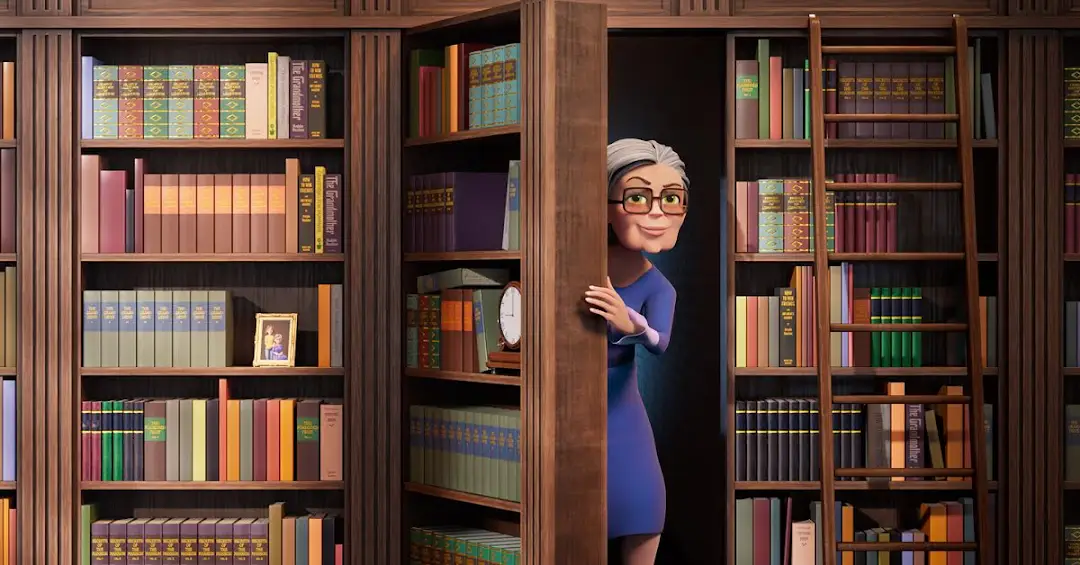
A photorealistic rendered library wall with one bookcase door ajar and the grandmother peeking through, one eyebrow raised. No interface, no merge board, no call to action beyond the copy line, which is written in the grandmother's voice and in Spanish. Its siblings repeat the same joke in Italian, Japanese and other store languages, which is how a single key art frame turns into a family of plans.
Takeaway: one visual idea, many language shells - localization is the account's main scaling lever.
The gameplay cut: board, progress, win
One of the few cuts that shows the actual game. It opens on an isometric garden with two characters and a dialog box at 0:04, then moves to the merge board with a hand placing and combining items at 0:11 and 0:18 under an instruction overlay. A build site advances across 0:26 and 0:33, and a green win bubble closes the loop at 0:40. Against the cinematic teasers this is the plain, mechanics-first ad, and it sits far down the exposure ranking.
Takeaway: mechanics-first cuts exist but the account's exposure sits on story-first work.
Clash of Clans, at full scale: a six-second creator gag
The single most-exposed creative in this whole comparison is six seconds long. It opens with a marker drawing on an open palm at 0:01 and 0:02, a hand-with-phone reveal at 0:03, and from 0:04 to the end the phone screen shows the village, with a short caption line over the top. No cinematics, no voice track, no brand framing beyond the game UI. It is creator-style output: cheap to make, trivial to cut into variants, and it carries more estimated exposure than the entire Merge Mansion active library in this window.
Takeaway: the machine that buys scale runs on short, meme-shaped, endlessly variant-friendly cuts.
Clash of Clans, second place: the ASMR build cut
A 59-second English-language base-building cut labeled like an internal asset line. Caption cards play over builder-base footage: a wall gets placed at 0:05 under the line “PEACE A TILE”, a thumbs-up beat at 0:15 reads “SOUNDS LIKE”, a village-wide shot at 0:25, an attack montage through 0:34 and 0:44 with a player-name joke card, and the builder sips from a mug at 0:54 under “PEACE IS ETERNAL”. It was first tracked nearly a year before the window and it is still the account's second asset by exposure.
Takeaway: winners stay in rotation for months, get cut into variant families, and keep carrying exposure.
What you can conclude from this piece
The conclusions in this piece do not all carry the same weight. Sorted by strength of evidence:
- Confirmed by the companies: the deal and its timeline, the undisclosed terms, the restructuring with up to 160 roles cut, and both CEOs' public statements. These rest on official announcements and are not in dispute.
- Measured by us, window-limited: the 5.0% reuse share against 32.9% to 49.9%, the AdMob-first split against the mirrored Meta footprint, the two barely overlapping market maps, and the 801.8 million single cut. Same window, same method for both records - but a 30-day read, and all of it Metacore-era buying, since the deal closed two days before the window ended.
- Our interpretation, flagged as such: that Supercell bought a strong product whose reuse-and-scale layer is the fixable gap. The data supports the structural gap; whether Supercell's machine can close it is unproven in either direction.
- Not supported by the numbers: that low reuse means the ads underperform, that anything here already measures Supercell's own buying, or that estimated exposure says anything about return.
One caveat belongs on the second and third items at once: a scripted mystery universe with produced cast campaigns does not invite the same re-cutting that a meme-shaped gameplay cut does, and Merge Mansion's localization families show its own way of extending one idea across many plans.
Two more limits frame every number above: a 30-day window cannot capture seasonal pushes, and exposure is a lifetime estimate rather than a measure of efficiency, spend or conversion. Treat the reuse gap as a description of where the two operations differ, not a verdict on which approach converts better.
What to watch next
- Whether the reuse share moves toward the portfolio's 32.9% to 49.9% range as Supercell's UA teams take over plan management.
- Whether the platform mix rebalances toward the mirrored Meta family footprint, and whether TikTok appears at all.
- Whether the market map widens beyond the Western top ten, or stays deliberately premium-market.
- Whether the long mystery-teaser format survives contact with a machine optimized for six-second cuts.
FAQ
When did Supercell complete the Metacore acquisition?October 19, 2026. The plan was announced on May 5, the agreement was signed on August 31, and terms were not disclosed. Merge Mansion now sits in Supercell's live games portfolio and the team continues as part of Supercell.
How much had Supercell invested before the full buyout?Per trade press reporting, an equity investment in 2020 followed by a $180 million credit line in 2021, which made Supercell Metacore's largest shareholder. The final purchase price has not been published.
What does the ad data show about Merge Mansion right now?Over the 30-day window the primary record tracked 1,015 creatives, 1,277 ad plans and 5.0% creative reuse, with 541 million in estimated exposure. Buying leans on AdMob (50.5% of plans) and concentrates on Western markets plus Japan.
Why compare it with Clash of Clans?Because it is the hottest title in Supercell's own portfolio by our measure: the largest estimated exposure of the four live titles in the window, at 2.37 billion, and one of the highest plan counts. It is the clearest picture of the machine the new asset just joined.
Does 5% reuse mean Merge Mansion's ads are bad?No. Reuse share is a structural measurement, not a quality score. Story-led produced campaigns may be designed for short lives, and the account extends its ideas through localization families instead. The gap describes how the two systems work, not which one converts better.
Will the game change for players?Both companies say the game continues as normal and the same team keeps developing it. The stated goal is to return the game to the top of its category using Supercell's live operations and user acquisition experience.
Data scope and notes
Window. September 21 to October 20, 2026, Asia/Shanghai time, queried October 21, 2026.
Records. Merge Mansion appears under two store records. Figures use the primary record: 1,015 creatives, 1,277 ad plans, 51 reused, 541 million estimated exposure. The second record adds 268 creatives, 330 plans, 6.7% reuse and 58.8 million, with AppLovin leading at 40.9% of its plans. Clash of Clans also has a second record: 1,687 creatives, 4,538 plans, 31.6% reuse, 1.54 billion. Second records are never merged into primary figures anywhere in this article.
Definitions. A creative is counted once per record; an ad plan is one tracked buying configuration. Market coverage means a plan's target-country list includes that market; lists overlap, so shares need not sum to 100%. Reused creatives were already tracked before the window and active within it.
Exposure. Estimated exposure is a lifetime figure for the creatives active in the window, not a 30-day increment. It is not spend, CPI, ROAS or conversion, and no such data is used or implied.
News facts. The deal timeline, quotes, restructuring figures and product stats come from company announcements by Supercell and Metacore and from trade press reporting. The studio's own site puts Merge Mansion at more than 70 million players and more than $850 million in lifetime revenue. Supercell ran a second WWE crossover with Clash of Clans in September 2026, per its own announcement.
Trademarks. Merge Mansion, Clash of Clans, Hay Day, Brawl Stars and Clash Royale are trademarks of their respective owners. CreativeScope is unaffiliated with Supercell or Metacore.
Related reading
See the reuse and scale gap for any portfolio
CreativeScope tracks creatives, ad plans, markets and platforms across the titles in this piece, including the window-level reuse share that separates a testing account from a scaling one.
Explore CreativeScope MCP Read More UA AnalysisGet this live in your agent
These rankings come from a single MCP tool. Free key, ask in plain English.
Full genre × market grid?
Team plan unlocks every genre and market cut, plus AI teardowns.