
Obsidian Knight Ads: Early-2000s Browser RPG Aesthetics
Obsidian Knight RPG's ads borrow the visual grammar of early-2000s browser RPGs — and a Swedish studio runs them across nine networks: 242 plans in 30 days.
Maya Chen
Content Editor, Mobile Game UA
Published
Updated
The ads for Obsidian Knight RPG are built in the visual grammar of the early-2000s browser RPG — painted class-select banners, caption-card montages, stat-bar choices — and a small Swedish studio with no publisher runs them across nine ad networks at once: 242 ad plans in 30 days, spread over 100+ markets instead of concentrated in one.
Key takeaways
- Obsidian Knight RPG is a two-year-old idle roguelike RPG from ActFirst Games AB, a small Stockholm studio that publishes it alone. In late September 2026 it resurfaced on the US iPhone Adventure top-grossing chart (CreativeScope’s store-rank feed first logged the appearance on September 20, alongside entries in the UK and Germany) — and the advertising behind it is anything but a small-studio afterthought.
- The creative library itself reads like a time capsule: the account’s top static is a painted “Choose your class. Dominate your world” triptych, and its top montages pace stock dark-fantasy art with caption cards and faux button prompts — the visual grammar of early-2000s browser RPGs, rebuilt for mobile ad inventory.
- On the App Store record, nine networks carried plans in the 30-day window: Meta’s five surfaces (Audience Network, Facebook, Instagram, Messenger, Threads) each covered 51.24% of the 242 plans, with Mintegral at 20.25%, Admob at 15.29%, AppLovin at 13.22% and YouTube at 5.37%.
- The division of labor is clean. Meta does reach: one pool of 45 video-and-image creatives replicated across five surfaces and 124 plans each. The independent networks do breadth: Mintegral actually holds the largest single-network creative pool (47 creatives), plus every playable ad in the window (split with AppLovin).
- Coverage is wide and shallow by design: 106 markets in the delivery footprint, ten markets above 40% plan coverage, yet only seven plans across those ten markets target a single country. Nothing here is a one-market bet.
Data scope
All delivery figures in this breakdown come from CreativeScope and describe Obsidian Knight RPG between August 23 and September 22, 2026, on a rolling 30-day window, on the game’s App Store record (iOS app ID 6505061490). Counts describe tracked ad plans and creatives — not spend, installs or conversions. Exposure figures are lifetime estimates for creatives active in the window, used as a delivery-scale reference.
One scope note matters before the numbers: CreativeScope tracks the game as two store records, and they are not the same buy. This breakdown covers the App Store record, where the nine-network structure lives. The Google Play record runs a larger and even wider campaign — covered in its own section below.
One studio, two store records
ActFirst Games AB releases Obsidian Knight RPG on both stores, and each storefront carries its own delivery account in our data. Put the same 30-day window across both and the studio is running two differently-shaped machines:
| Record (same window) | Ad plans | Creatives | Networks | Lifetime est. exposure |
|---|---|---|---|---|
| App Store (6505061490) | 242 | 135 | 9 | 65.6M |
| Google Play (com.actfirstgames.seven) | 1,676 | 373 | 12 | 86.9M |
The Google Play account adds TikTok, Unity and ironSource on top of the App Store lineup and runs nearly seven times the plan volume — a reminder that “small studio” describes the org chart, not the media plan. The nine-network structure below is the App Store story; the wider Google Play numbers appear here only to size the studio, and the two records’ figures are never mixed.
Creative observations: an early-2000s browser-RPG look
Spend a few minutes with the library’s top creatives and a specific reference point surfaces: the ad art is built in the visual grammar of the early-2000s browser RPG — the portal-era look of hand-painted fantasy portraits, class-select banners and caption-card pitches.
The clearest signal is the account’s top static image (Spotlight 2 below): three painted class portraits — a gold-armored knight, a green-skinned mage, a hooded archer — split by cracks of fire under the line “Choose your class. Dominate your world.” The composition, the class labels and the second-person promise are the exact format browser-game portals used to funnel clicks two decades ago. The gear-choice video (Spotlight 1) speaks the same dialect: a stat-sheet choice of strength, agility and defense framed as “Choose the best gear.”
The video templates lean on the era’s other signature: caption-card montages. Spotlight 3 needs no gameplay capture at all — four text overlays (“Equip your hero”, “and gain power”, “Choose your world”, “Challenge the Boss”) paced over stock dark-fantasy paintings — and Spotlight 4 opens on a button-style “help the village” prompt superimposed on a burning village: fake UI as a visual hook.
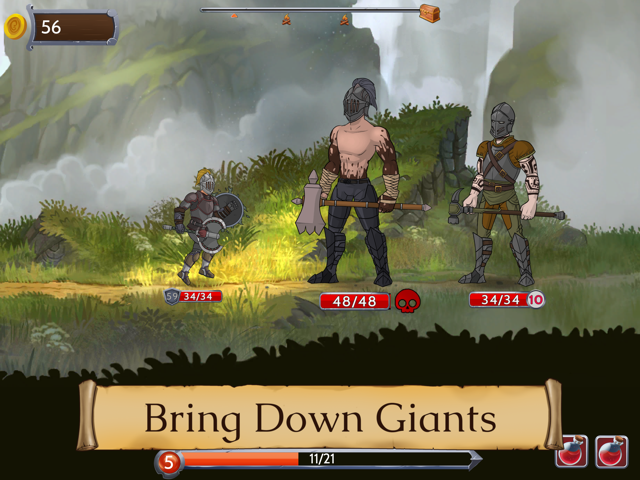
The most literal throwback sits in the playables. All 15 playable ads in the window run on the independent networks — nine on AppLovin, six on Mintegral, none on Meta — and the delivered frame above shows what one of them opens on: a hand-drawn side-scrolling arena, three fighters lined up on a grass platform, health bars with level tags, and a parchment banner that has to be tapped or clicked to advance. Take away the storefront’s overlay and it reads like a portal-era browser fighting game — which, as an HTML5 playable, it more or less is.
The aesthetic also holds across the whole account rather than in one lane: the same painted dark-fantasy art and the same caption-card grammar carry the highest-exposure Meta cut, Mintegral’s flagship montage and the AppLovin playables alike. That consistency is what makes the nine-network structure below affordable — one visual language, one production line, several shelves.
Worth being precise about what this is and is not: Obsidian Knight RPG is a 2024 mobile app, and nothing in the tracked data describes the game itself as a browser game. The observation is about the ad library — the buy leans on aesthetics mobile audiences first learned to click two decades ago, and it runs them at a scale (65.6M lifetime estimated exposure across the window’s creative pool) where the choice looks deliberate rather than nostalgic.
Channel structure: nine networks, Meta for reach
Plan coverage across the window’s nine active delivery surfaces:
Overlapping plan-target coverage; shares do not sum to 100%. “Meta five surfaces” = Audience Network, Facebook, Instagram, Messenger and Threads, which post identical coverage. Bar length scaled to Meta’s 51.24%.
The creative counts under the plan counts are what make the structure legible. Meta’s five surfaces share a single pool of 45 creatives, replicated across 124 plans each — one buy, five shelves. Mintegral runs the opposite shape: 47 creatives (the largest single-network pool in the window, one more than Meta’s shared pool) spread across just 49 plans, roughly one plan per creative. AppLovin holds 31 creatives on 32 plans; Admob 20 on 37; YouTube 8 on 13.
The exposure ranking follows the same split. Every creative in the top ten of the window’s heat table sits either on the Meta five-surface pool or on Mintegral; the highest-exposure AppLovin creative tops out near 468,000 in lifetime estimated exposure, about a fifth of the Meta pool’s leader. Meta buys the audience; the independent networks host the experiment bench.
Markets: wide coverage, almost no exclusives
The record’s delivery footprint spans 106 markets; 76 of them see plans inside the window. Ten markets are covered by at least 40% of plans:
Bar length scaled to US coverage share. Coverage is multi-attribution and overlapping; “exclusive” counts plans whose delivery-country set equals that single market.
Across those ten deepest markets, exclusive single-country plans total just seven. That is the anti-pattern to the current fashion for one-market bets: no geo pool is being reserved, no market is being tested in isolation. The studio runs the same broad target lists everywhere and lets the networks sort out the inventory — consistent with a two-year-old product buying reach wherever it is cheap rather than proving a new market.
Creative formats: video-led, with a playable side channel
Of the 135 creatives in the window, 105 (78%) are video, 23 (17%) are static images and 15 (11%) are playable ads. The video mix leans portrait: 52 portrait cuts against 35 landscape and 18 square. Duration clusters in the 15–30 second band (56 creatives), with 44 in the 30–60 second range, five longer than a minute and not a single cut under 15 seconds.
The format-to-network mapping is the quietly deliberate part. Meta’s surfaces carry video and images only. Every playable in the window runs on the independent-network side — nine on AppLovin, six on Mintegral, zero on Meta — and most of Admob’s 20 creatives are static images (11 of the window’s 23 images carry an Admob attribution). Each network gets the format its inventory is built for, from the same small production line.
The reinvestment rate frames the library’s age: 53 of 135 creatives (39%) are flagged as reinvested. This is not a fresh test batch like a pre-launch buy; it is a working library with a proven core being re-run while new cuts filter in around it — consistent with a mature product that restarted its charts climb rather than discovered one.
Delivery cadence: two bursts, then a steady hum
New material arrives in waves rather than a daily drip. Seven days in the window each added five or more creatives:
| Activity day | New creatives | New ad plans |
|---|---|---|
| Aug 23 | 15 | 50 |
| Sep 16 | 15 | 16 |
| Sep 15 | 8 | 10 |
| Aug 25 | 7 | 7 |
| Sep 18 | 6 | 6 |
| Sep 17 | 5 | 5 |
| Aug 29 | 4 | 4 |
The August 23 burst is the loudest signal: 15 new creatives and 50 new plans in a single day — plans arriving at more than three times the creative rate, the signature of an existing library being re-planned rather than new footage being shot. The mid-September wave (Sep 15–18) is more evenly matched, which reads as a fresh creative batch entering rotation in the week the game resurfaced on the charts.
Creative Spotlight: five cuts, three network families
The five creatives below were verified frame by frame against the delivered files. Together they cover all three network families in the window — the Meta five-surface pool, Mintegral and AppLovin — and three distinct templates.
Spotlight 1 — The gear-choice run (highest exposure, Meta pool)
Hook (0:02–0:09). After a brief forest skirmish at 0:02, the ad cuts to a wooden gear-selection card at 0:05 under the on-screen line “Choose the best gear” — a stat-bar choice (strength, agility, defense) framed as a decision the viewer would make differently.
Body (0:12–0:15). Combat interludes carry the progression fantasy: a torch-lit cave fight against skeleton warriors at 0:12 with damage counters on screen, then a torch-bearer wading through a green swamp at 0:15 — each scene a darker, deeper biome than the last.
End card (0:19–0:24). The Obsidian Knight forest logo with App Store and Google Play badges at 0:19, held to the end.
Takeaway. The account’s highest-exposure creative is also its most replicated: a 50-ad cluster running as one square master across all five Meta surfaces. The gear-choice hook is the genre’s “build your own power” pitch compressed into two cuts, and the square delivery means one asset feeds every Meta placement without re-editing.
Spotlight 2 — The class-trio banner (top image, Meta pool)
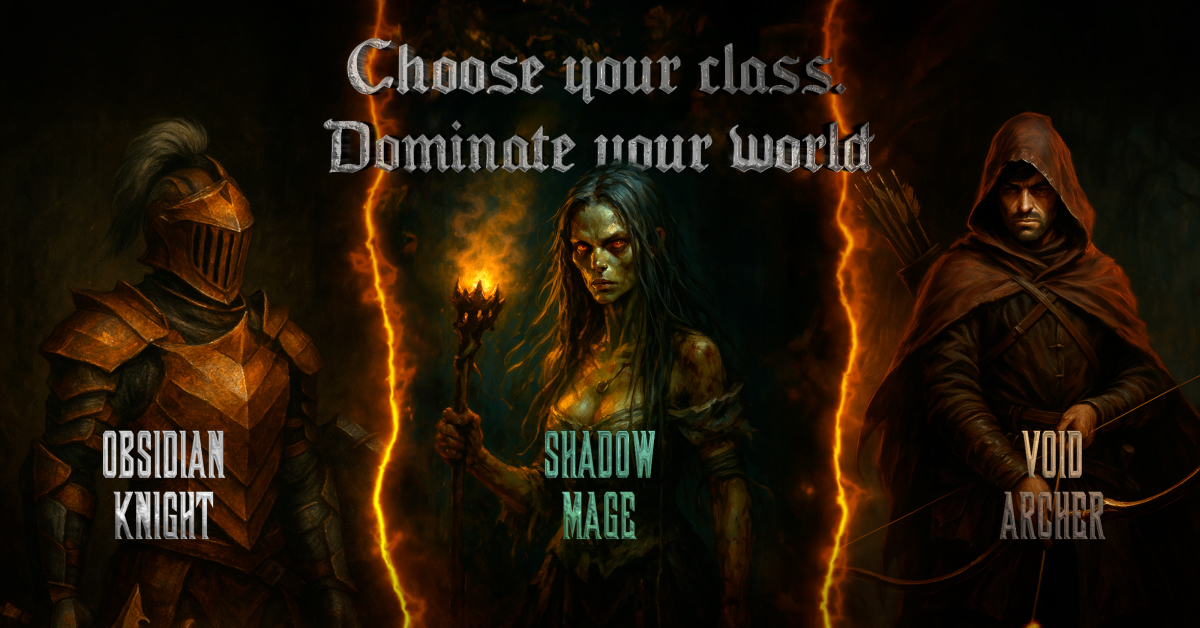
What it shows. A painted triptych split by cracks of fire: a gold-armored knight labeled “Obsidian Knight” on the left, a green-skinned staff-wielding “Shadow Mage” in the center, and a hooded “Void Archer” on the right, under the line “Choose your class. Dominate your world.”
Takeaway. The top static image sells the same decision the top video dramatizes — pick your build — in a single frame, and it is the library’s most explicit nod to the early-2000s browser-RPG look described above. Alongside Spotlight 1, two of the account’s three highest-exposure creatives are choice-framed, which is about as clean a signal as a 135-creative library gives about what the studio believes converts.
Spotlight 3 — The caption-card montage (Mintegral’s biggest cut)
Hook (0:02–0:09). Caption cards pace the pitch: “Equip your hero” over a row of equipment icons at 0:02, then “and gain power” over a flame-sword knight at 0:05.
Body (0:09–0:19). “Choose your world” over twin portals at 0:09, a blue-lit cave mouth beneath a horned silhouette at 0:12, and “Challenge the Boss” over an ice-ruins troll at 0:15 — the whole progression arc in four captions.
End card (0:22–0:24). A treasure-chest scene: “OBSIDIAN KNIGHT — Forge the Knight Within — Download Now” with both store badges.
Takeaway. This is Mintegral’s flagship: the largest single-network creative pool in the window (47 creatives) led by a caption-card montage that needs no gameplay capture — stock dark-fantasy art plus four text overlays. Notably, the indexed ad copy is Swedish while the footage stays English: the localization happens in the listing, not the asset, which is one more way a tiny studio stretches one master across markets.
Spotlight 4 — The cinematic destiny cut (Meta pool)
Hook (0:01–0:07). A burning village seen from above with a button-style prompt reading “help the village” at 0:01, then a moonlit black knight whose hooded eyes glow red at 0:04 — atmosphere before mechanics.
Body (0:07–0:12). A rain-soaked ruins caption “Deliver the battle.” at 0:07, a golden backlit standoff at 0:09, and a dungeon relic scene captioned “Every choice shapes your adventure” at 0:12 (the second caption line is partially legible in the delivered file).
End card (0:15–0:19). The Obsidian Knight forest logo with store badges.
Takeaway. The library’s trailer-tone cut: no stat bars, no gameplay counters, just mood and a promise. That a 22-ad cluster of this has been re-running since April says the studio keeps a cinematic lane alive inside an otherwise mechanics-led pool — likely as the upper-fresher creative for broad audiences.
Spotlight 5 — The seven-masters narrative (AppLovin)
Hook (0:04). A rider crosses a dusk wasteland under the caption “Seven legendary Masters stands between you and victory” — the ad announces a gauntlet, not a feature list.
Body (0:13–0:47). The masters arrive as captioned portraits: a witch over a green summoning circle at 0:13, a throne-keeping prince at 0:21, a storm-summoning barbarian at 0:30, and an undead lord at 0:39 — before one snow-field combat beat with damage numbers lands at 0:47.
End card (0:56). The flame-lit Obsidian Knight logo with a “Play Now!” button.
Takeaway. The AppLovin bench works differently from Meta’s: lower heat (this is the surface’s near-top at 339K), portrait-first, and built for long rewarded-video attention — a full minute of narrative for an audience that opted in. It is the clearest example of the independent networks carrying formats and rhythms the Meta pool never touches.
CreativeScope take
Two things are happening at once in this account: the creative leans on the visual grammar of the early-2000s browser RPG, and the media plan spreads it thin and wide. That pairing is the account’s actual edge — a visual language older than the app stores, pointed at nine networks and 106 markets at once. Obsidian Knight RPG’s App Store account is a study in small-team leverage: nine networks held open at once, Meta’s five surfaces sharing one 45-creative pool for reach, Mintegral and AppLovin hosting the volume formats and the playables, Admob quietly absorbing the static images, and a 106-market footprint with only seven exclusive plans across its ten deepest markets. Nothing is concentrated, so nothing is fragile — and with 39% of the library reinvested, the structure has clearly been paying for its upkeep. The number worth watching next is whether the September chart re-entry pulls the Google Play account’s much larger buy (1,676 plans across twelve networks in the same window) toward the App Store record’s shape, or whether the two machines keep running their separate playbooks.
Related reading
- Aniimo ads breakdown — the opposite structure: 99.76% of 2,056 pre-launch plans on a single network.
- Last Asylum: Plague ads breakdown — a $3.8M revenue week built on just two deeply-targeted markets, against this 106-market spread.
- The War for Survival ads breakdown — where coverage and exposure diverge: four networks share the plans while one takes the impressions.
Every number in this breakdown is queryable in CreativeScope. Pull the live plan and creative counts for Obsidian Knight RPG, split them by network or market, and watch whether the chart re-entry changes the nine-network shape — the data refreshes hourly.
FAQ
How many ad plans is Obsidian Knight RPG running?CreativeScope tracked 242 active ad plans and 135 creatives on the game’s App Store record between August 23 and September 22, 2026, with 53 of those creatives (39%) flagged as reinvested. The game’s separate Google Play record carried 1,676 plans and 373 creatives in the same window.
Which ad networks does it use?Nine networks carried plans in the 30-day window: Meta’s five surfaces (Audience Network, Facebook, Instagram, Messenger and Threads) each covered 51.24% of plans, Mintegral 20.25%, Admob 15.29%, AppLovin 13.22% and YouTube 5.37%. The Google Play record adds TikTok, Unity and ironSource for a twelve-network footprint.
Which markets does the campaign cover?The App Store record’s delivery footprint spans 106 markets, 76 of which see plans in the window. The US leads with 60.74% plan coverage, followed by Canada (55.37%), Thailand (49.59%) and Mexico (45.87%). Exclusive single-country plans are rare: seven across the ten deepest markets combined.
Who makes Obsidian Knight RPG?ActFirst Games AB, a small studio based in Stockholm, Sweden, develops and publishes the game without an external publisher. CreativeScope’s record lists the iOS release date as November 27, 2024, and the app supports 22 languages.
Is this a new game?No. The game launched in late November 2024, making it a mature title by this window. What is new is its chart presence: CreativeScope’s store-rank feed first logged it on the US iPhone Adventure top-grossing chart on September 20, 2026, with UK and Germany chart entries in the same wave — which is what makes a two-year-old product’s nine-network buy worth reading now.
What do its top ads look like?Three templates dominate: a gear-choice gameplay cut (the highest-exposure creative, running as a 50-ad cluster across all five Meta surfaces), a painted class-selection banner, and caption-card montages that need no gameplay capture. The overall look borrows the visual grammar of the early-2000s browser RPG — painted class-select banners, caption cards over stock dark-fantasy art, faux button prompts, and playables that open on hand-drawn side-scrolling arenas with parchment banners. About 78% of window creatives are video, and every playable ad in the window runs on AppLovin or Mintegral rather than Meta.
Data notes
All plan, creative, network and market figures come from CreativeScope and cover August 23 – September 22, 2026 on the game’s App Store record (iOS app ID 6505061490); the Google Play figures in “One studio, two store records” come from the same window and platform record (package com.actfirstgames.seven) and are never mixed with the App Store numbers. Country and network shares describe ad-plan target coverage under multi-attribution, so they overlap and do not sum to 100%; “exclusive” means a plan’s delivery-country set equals a single market. Lifetime estimated exposure is a relative delivery-scale signal for creatives active in the window, not a platform-reported impression count, and nothing in the tracked data describes spend, installs, conversions or revenue.
The chart first-seen date, release date, developer name and language count come from CreativeScope’s store-rank and store-record data. Spotlight descriptions are based on frame-by-frame review of the delivered creative files; quoted on-screen text is transcribed as delivered, including one caption line that is partially legible. The featured cover is an AI-generated illustration with no in-game assets or text.
Get this live in your agent
These rankings come from a single MCP tool. Free key, ask in plain English.
Full genre × market grid?
Team plan unlocks every genre and market cut, plus AI teardowns.