
Puzzle's Arms Race Is Editing One Skeleton
Six puzzle games, one shared layout: canvas, five slots, color panel. Four edit only the middle band. What each edit costs, and why the last two stay thin.
Maya Chen
Content Editor, Mobile Game UA
Published
Updated
Puzzle's Arms Race Is Editing One Skeleton
Six puzzle games, one shared skeleton, four different variables. The edits get more expensive as you go down the list, and that price gap is what the crowding actually looks like from the inside.
Key takeaways
- Four of these games share one layout. Canvas on top, five slots in the middle, color panel below. Pixel Flow!, Colony Flow!, Food Hunt and Jelly Busters differ in the middle layer only.
- The cheapest edit swaps the worker. Pigs on a belt, ants out of a hole, food that falls, jelly that bursts. The rule is untouched, so players carry over from one game to the next.
- Sand Loop changes the material's behavior, not its look. Sand collapses under gravity, so the picture you start with is not the picture you finish. That uncertainty is the product.
- Cube Land Puzzle Game adds a third axis. Occlusion and structural collapse raise both difficulty and delight, and they also make the game much harder to explain in a thirty-second creative.
Data scope
This piece looks at six puzzle titles that were buying traffic between 23 September and 22 October 2026: Pixel Flow!, Colony Flow!, Food Hunt: Pixel Puzzle, Jelly Busters: Puzzle Game, Sand Loop and Cube Land Puzzle Game. Creative and ad plan counts come from CreativeScope and are used here only to confirm that all six were live at the same time. An ad plan is one buying configuration: a channel, a set of markets, a language. It is not a budget figure.
The analysis itself is mechanical. Every gameplay claim below comes from watching the advertisers' own video creatives frame by frame, not from store copy or press material. Where a clip does not prove something, the text says so.
The skeleton nobody changes
Put four of them side by side and the art styles stop mattering.
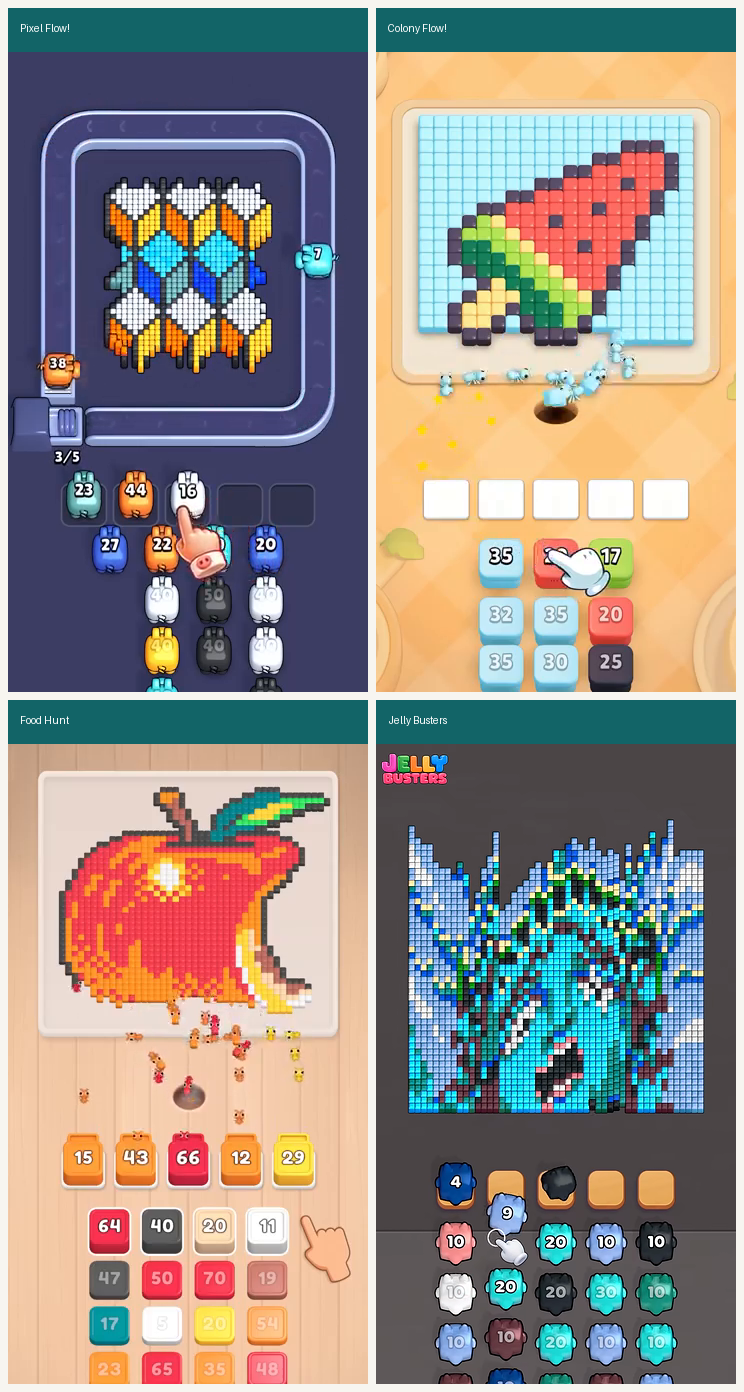
A canvas holds a picture built from colored cells. A strip of five slots sits directly beneath it. Under that, a panel lists colors with remaining counts. A hand taps a color, the count falls, and the canvas loses cells of that color.
Pixel Flow! runs a ring-shaped belt around the canvas and puts pigs on it. Colony Flow! cuts a hole in the sand at the bottom and sends ants out of it. Food Hunt leaves the food sitting on the canvas and lets it drop. Jelly Busters fires from below and bursts what it hits. Four different pictures. One strip.
That strip is the design. It is the only place where the player's decisions queue up, and all four games put it in the same position, at the same size, with the same five openings. Keeping it means a player who has cleared one level of any of these games can pick up another one without a tutorial. Changing it means teaching the interface again, which is a much larger bill than it looks.
Edit one: change who does the work
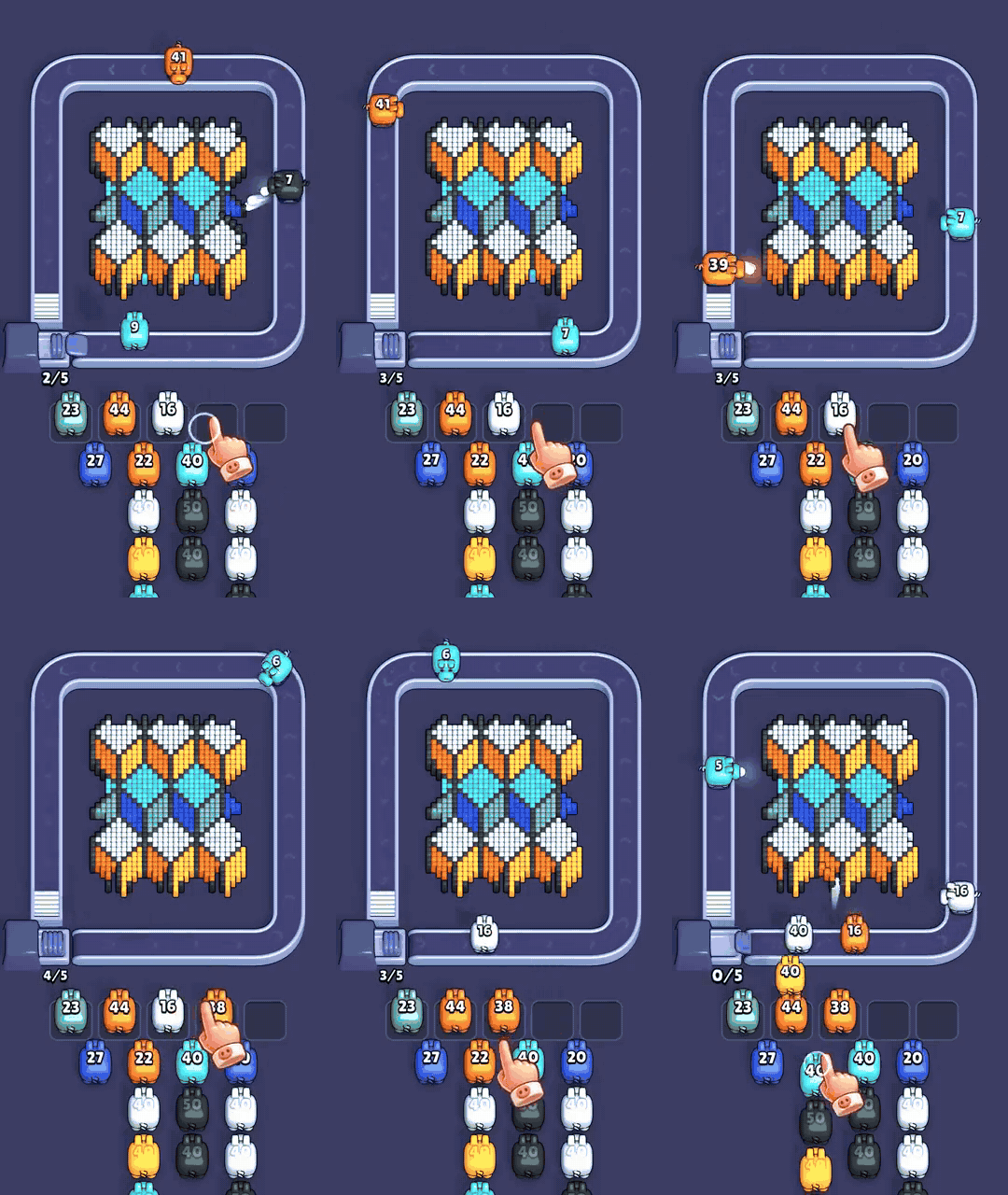
Pixel Flow! is the version most people have already seen. A pig is tapped, enters the ring through a chute, rides around to the matching region of the canvas, and fires. The trip takes about a second and you can watch all of it. A small counter sits at the left of the strip. Across the frames reviewed for this piece it moves without matching the number of filled boxes, so this piece describes it as a counter and does not claim what it counts.
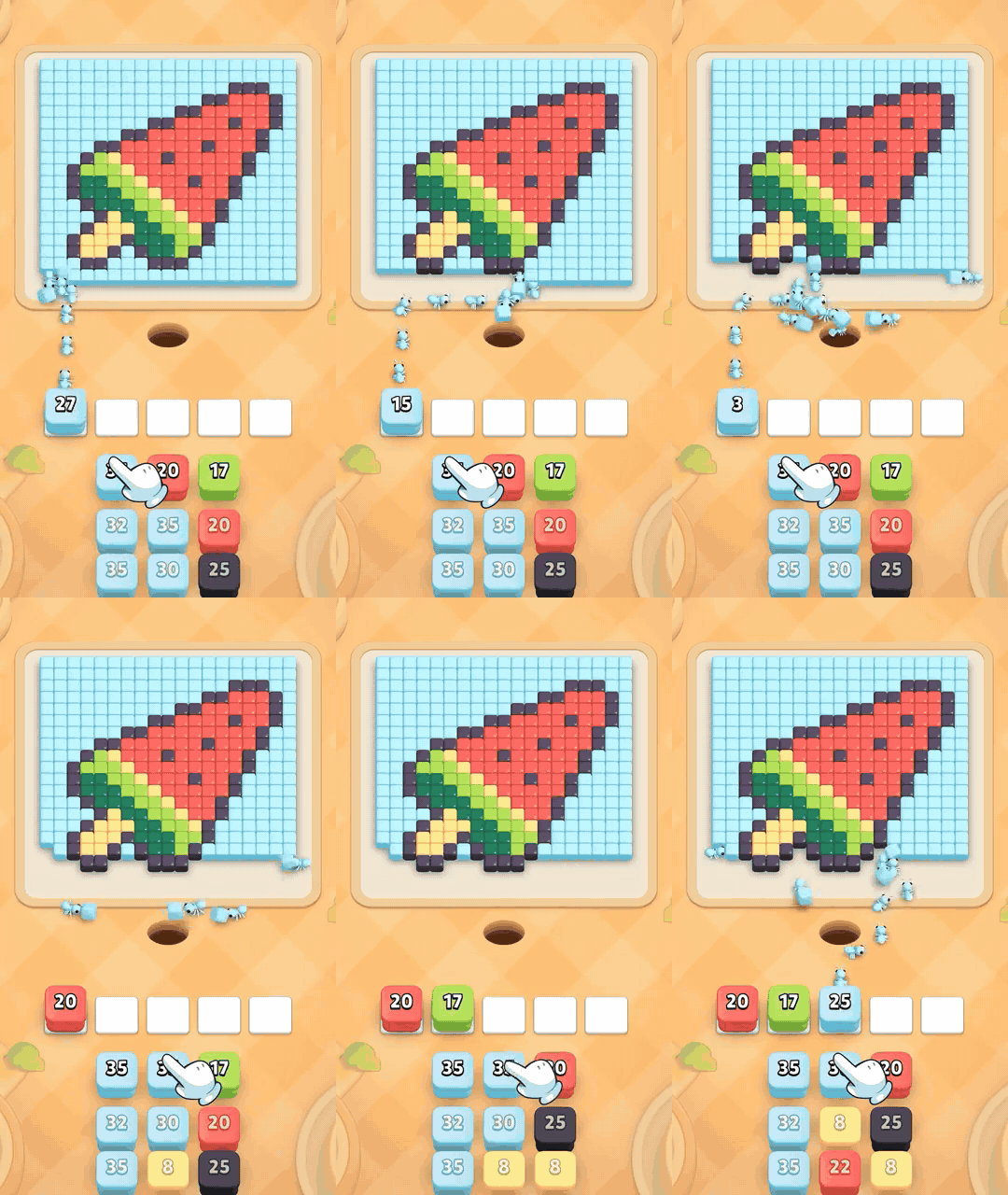
Colony Flow! removes the belt. There is no ring, no chute, and nothing to route. A color is called and ants leave a hole in the sand, walk to the canvas, and take tiles away. The waiting is still there, but there is nothing left to plan around. What the player manages is no longer five overlapping journeys but throughput: how much clearing gets done in a stretch of time.
One deletion, three consequences. It removes a rule the player had to learn, which is where the belt goes. It removes a failure mode, because there is no wrong destination to send a pig to. And it changes what the player watches: not one object moving along a line, but a small crowd doing piecework.
Both choices are cheap to build. New art, new animation, same numbers. That is why this rung of the ladder is crowded, and it is why these two games can sit in the same market while doing genuinely different things with the same rule.
Edit two: change what the material is
Food Hunt and Jelly Busters look like the closest pair in the set. They are actually the furthest apart in feel, and the reason is not the art.
Food Hunt keeps the canvas and the strip, then removes the journey. In the creatives reviewed here nothing walks anywhere: food sits on the picture, a color is called, and the matching food drops into the slots. The material leaves the frame under its own weight, and the panel counts down as it lands. The pleasure is accumulation: a dispenser that empties into your hand.
Jelly Busters keeps the shooter but changes what the shot does. Jelly rounds hit the canvas and burst. Cells do not slide away, they blow out, and what is left behind is burnt grid and sparks. The pleasure is impact.
| Game | Who acts | What the material does | What the player feels |
|---|---|---|---|
| Pixel Flow! | A pig on a belt | Travels, then fires | Scheduling five overlapping trips |
| Colony Flow! | Ants from a hole | Walks to the canvas and carries off | Managing throughput |
| Food Hunt | Nobody: the food falls | Drops under its own weight | Collecting, watching a count fill |
| Jelly Busters | A jelly round | Bursts on contact | Impact, destruction |
This is the line between a material change and a reskin. Food Hunt's material changes a decision, because food falls and stacks into a fixed number of slots, so what you call first changes what fits later. Jelly Busters' material changes the feedback, because a burst lands in a fraction of a second while a slide takes more than a second to land. Both are color matching. Neither feels like the other.
A costume change makes the same game look different. A material change makes the same rules feel different. Players keep the second one.
Edit three: let the material move on its own
Sand Loop is where the ladder gets expensive, and the expense has nothing to do with art.
The worker is not the point here. In the creatives reviewed for this piece, material leaves the canvas rather than being carried across it. What changes is how the material behaves on its own: sand does not stay where you put it.
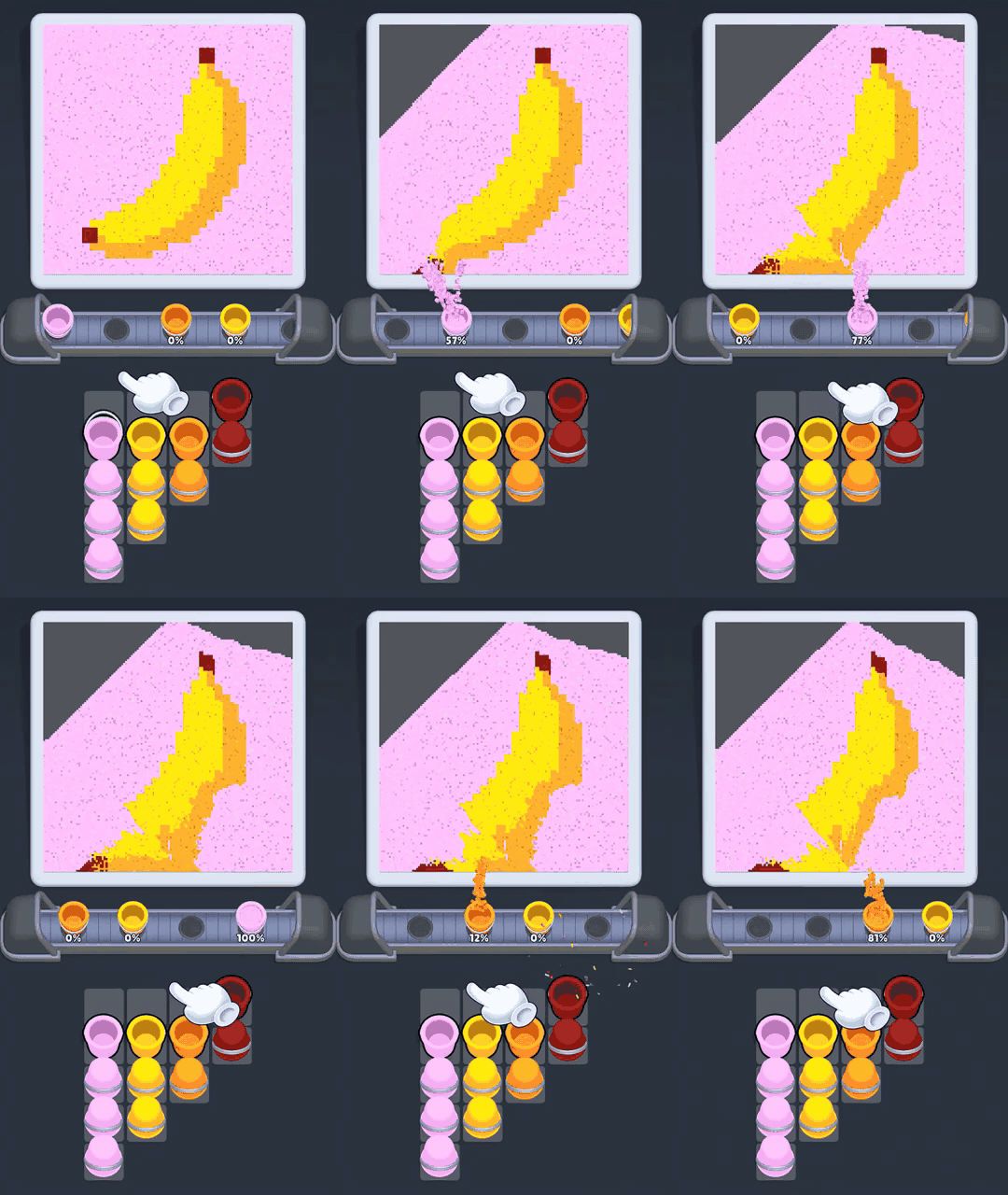
Watch the first six seconds closely. At 3.6 seconds the top-left corner has already fallen away and the bare canvas is showing. By six seconds both upper corners are gone and the banana has been compressed into a diagonal wedge. Nothing about that shape was drawn. It is what is left after the sand above it moved.
That is the trade gravity makes. It buys feedback no wipe animation can produce, because something unplanned happens on every move, and the player is watching a physical process rather than a progress bar. It also costs control. A player who cannot predict the board has less reason to plan ahead, and the game gives up the part where planning was the fun.
So the design question is not whether sand looks better than pixels. It is whether the collapse is legible. If a player can see why the sand fell where it fell, uncertainty reads as physics. If not, the same frames read as a bug, and no amount of art direction fixes that.
There is a second cost, and it lands on the creative side. A collapse is a process, not an event. It cannot be shown in a single beat, which is why the creatives for this game hold one canvas for twelve seconds instead of cutting.
Edit four: add a dimension
Cube Land Puzzle Game takes the same strip, the same panel, and the same color matching, then puts the canvas on a third axis.
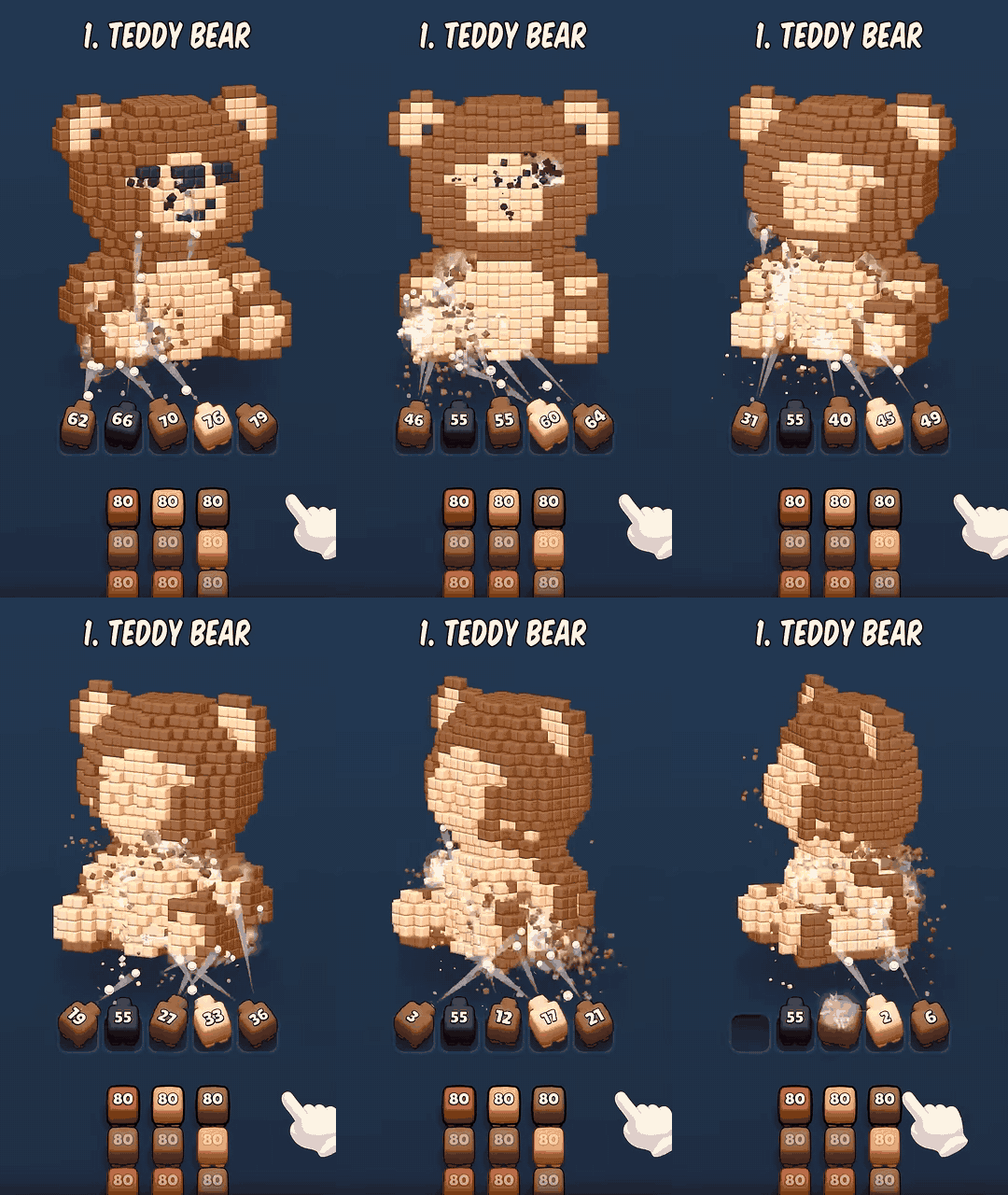
Two things appear here that a flat canvas cannot have. The first is occlusion: tubes enter the structure from below, and whether a cell is in front of or behind another cell decides whether you can reach it at all. The second is structural collapse: take out the support and everything above it comes down, whether or not you cleared it.
Difficulty rises for a reason that has nothing to do with adding colors. The player now has to read depth before reading color, which is a second decision layer stacked on the first. That is what makes the game feel larger than the flat versions, and it is also why a player cannot simply carry over from Pixel Flow! the way they can carry over from Pixel Flow! to Colony Flow!.
The cost shows up in the advertising. Occlusion is hard to demonstrate in a few seconds. A flat game can teach its rule with one tap and one result. A three-dimensional game has to establish the camera angle, show the tube, show the cell behind the cell, and then show the collapse, and that is four beats before the viewer knows what the game is. Cube Land's busiest creative solves this by cutting between six finished objects in sixty seconds and never explaining the rule at all.
Why the cheap edits are the crowded ones
The four edits are not priced the same, and the price is what produces the crowding.
Swapping the worker costs art and animation. The rule, the interface and the numbers all carry over. That is why this rung has the most traffic: four of the six games here sit on it, and none of them had to solve a hard design problem to get there.
Changing what the material does costs level design. Physics has to be tuned per board, and the board stops being a grid you can author by hand. Changing a dimension costs the interface and the art pipeline, because depth has to be taught before color can be played.
Put those two facts together and the shape of the genre appears. The cheap rung fills up until the products sitting on it are hard to tell apart, and the expensive rungs stay thin because most teams cannot pay the bill. That is a cost gradient, not a judgment about which teams are more ambitious.
What each edit does to a thirty-second creative
The edit does not only decide how the game plays. It decides what the ad can be.
| Edit | What the creative has to show | What it can leave out | Typical shape |
|---|---|---|---|
| Worker swap | One tap, one action, one cleared cell | The rule, the goal, the fail state | Loop the same beat, cut on the result |
| Material swap | The material leaving the canvas | The rule, most of the setup | Hold on the canvas while it empties |
| Gravity | A before state, the collapse, an after state | The rule, but not the timing | One long take, no cuts |
| Dimension | Depth cue, tube, the cell behind the cell, the collapse | Nothing | Fast cuts between finished objects |
Read the last column as a consequence rather than a style choice. Sand Loop's creatives hold one canvas for twelve seconds because a collapse cannot be compressed. Cube Land cuts between six objects because collapses shown back to back are hard to follow. Neither team picked that rhythm for taste. The mechanic picked it for them.
And all four of these edits work in advertising for the same reason: the rule is inherited. A viewer who has seen a canvas, a slot strip and a color panel in some other game does not need the new one explained. That inheritance is the genre's real asset. It is also why the market can hold this many near-identical products, because the audience already knows how to read the screen before the first frame arrives.
Five checks before you copy one of these edits
- Can you name the change in one sentence? If the sentence is about art direction, you have a reskin and the market will read it as one within a week.
- Does the new material change a decision? Sand Loop passes because collapse changes what the board will look like next. A costume does not change anything the player decides.
- Can you show it in three seconds without a caption? If not, the creative budget can outrun the design budget, and the ad is usually the thing that fails first.
- Does the edit remove a failure mode or add one? Colony Flow! removed the wrong-destination problem. Cube Land added the unreachable-cell problem. Both are progress; only one is easier.
- Would a returning player need a tutorial? If yes, price the tutorial into the design, because the strip you inherited was doing that work for free.
What the six games actually prove
They prove that the skeleton is not the constraint. It is the same in all six: a picture, a strip of slots, a panel of colors, a clearing action. What the market is competing on is the last two layers, the ones that decide how the clearing feels.
They also prove that the cheapest way to differ is the most crowded one. Swapping the worker is a legitimate product decision and it has produced four games in this set alone. But it cannot produce a moat, because the next team can copy it in a single update.
The edits that survive longer are the ones that cost more: physics that has to be tuned, dimensions that have to be taught, interfaces that have to be rebuilt. They are expensive exactly because they are hard to copy, and hard to copy is the only durable advantage in a genre this crowded.
Frequently asked
Data notes
Window and sources. Creative and ad plan counts cover 23 September to 22 October 2026 and come from CreativeScope. Gameplay descriptions come from the advertisers' own video creatives in the same window, reviewed frame by frame.
Counting rules. A creative is counted once per game and material. An ad plan is counted once per game and plan. Market coverage overlaps and is not additive, which is why this piece does not add markets together.
What the mechanics can and cannot show. A frame proves what the interface displays. It does not prove what the developer intended, how long a level lasts, or whether the mechanic retains anyone. Several readings here are observations from a sample of creatives, not from the shipped build.
Legal. The complaint referenced above is an allegation filed in July 2026. No finding has been made.
- Is this a legal analysis?
- No. This piece describes mechanics and creative execution. It makes no claim about copying, infringement or who originated what.
- Why these six games?
- Because they cover all four rungs of the edit ladder and all six were running live creatives in the same thirty-day window, which makes the comparison a same-period one rather than a comparison across years.
- Does the five-slot strip really matter that much?
- It does for user acquisition, because it is the part a returning player does not have to relearn. Whether it matters for retention is not something this data can answer.
- Where does the lawsuit fit?
- In July 2026 a publisher filed a copyright complaint against another publisher in the Northern District of California over a puzzle title. A complaint is an allegation; no court has ruled. It is mentioned here only because it marks where the line between a shared mechanic and a protected expression is being argued, not because it settles anything.
- Are the numbers in this piece budgets?
- No. Creative and ad plan counts describe buying activity. An ad plan is one configuration of channel, market and language. None of these figures is a budget, and none is a performance result.
Written by Maya Chen for CreativeScope. Mechanics described from advertiser video creatives reviewed frame by frame. Creative and ad plan counts are buying-activity measures, not budgets or performance. This article makes no claims about conversion, retention or commercial outcome.
Get this live in your agent
These rankings come from a single MCP tool. Free key, ask in plain English.
Full genre × market grid?
Team plan unlocks every genre and market cut, plus AI teardowns.