
Yarn Loop: Stitch by Stitch, a Quiet Little Mystery
Yarn Loop: Knit Puzzle unwinds stitch by stitch — and so does its business: a third-party tracker shows daily in-app revenue climbing to a 280,000-dollar peak even as ad delivery shrank to a fraction of its peak. Our November window shows the quiet side of that trade.
Maya Chen
Content Editor, Mobile Game UA
Published
Updated
Yarn Loop: Stitch by Stitch, a Quiet Little Mystery
Yarn Loop: Knit Puzzle is a year old, above one million downloads, and still running 61.2 percent of its plans on AppLovin — with a creative shelf built in May that was still working in November, and the Meta stack effectively absent.
What this breakdown covers
- A year-old book that never changed shape. Released December 19, 2025, above one million downloads — and November ran 251 creatives and 304 plans on AppLovin alone: 61.2 percent, with AdMob at 25.0 and the five Meta surfaces at 1.6 percent each.
- The mirror of this week's AdMob single-rail. Smash Kingdom ran 99.4 percent on AdMob across Europe; Yarn Loop runs 61.2 on AppLovin across a US-and-Europe band. Same shape, opposite network, opposite tenure.
- A supply line that has not needed replacing since May. AppLovin videos at 3.36, 2.63, 2.16 and 1.93 million estimated exposure opened May through July and were still active in November.
- Ten to nineteen plans a day, no pulses. The November rhythm is a flat feeding line — the book does not breathe, it feeds.
- A US-and-Canada head, then a European band. The US 40.8 percent with 19 exclusives, Canada 34.5 percent, then eight markets between 18 and 24 percent.
- High-value markets on one hook. 72 markets observed, all carried by one network and one knitting-sorting concept.
A year-old book that never changed shape
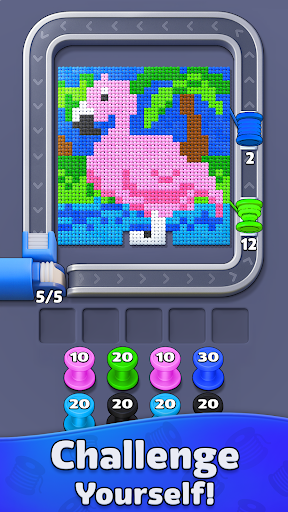
Yarn Loop: Knit Puzzle is a conveyor-belt sorting puzzle with a knitting theme from Combo Game, released on December 19, 2025 — a year-old title with a public Google Play label above one million (internal snapshot 4.31 million). Across November 1–22 it ran 251 creatives and 304 plans on AppLovin alone: 61.2 percent of the book, with AdMob at 25.0 percent and the five Meta surfaces at 1.6 percent each — effectively absent.
The rhythm is the same every week: ten to nineteen new plans a day, no pulses, no floods. The book does not breathe; it feeds.
A year-old book that never changed shape (chart)
The AppLovin mirror of the AdMob single-rail
Two books this week make a matched pair. Smash Kingdom: Tower Crash 3D ran 99.4 percent of its plans on AdMob across ten European markets. Yarn Loop ran 61.2 percent on AppLovin across a US-and-Europe band. Both skipped the Meta stack; both held one dominant network; both kept a second rail thin.
The difference is tenure. Smash Kingdom's single source looks like a launch-phase structure on a new title. Yarn Loop's has held for a year on a million-download game — which turns the same shape from a cold-start choice into a durable operating model.
A supply line that has not needed replacing since May
The creative supply is the oldest this site has documented: the heaviest AppLovin units opened in May — a video at 3.36 million estimated exposure, playables at 3.28 and 2.89 million — and were still active through November. Five videos and the playable pair from May through July carry the whole set, at 1.4 to 3.4 million each.
November's own supply was small and steady: ten to eighteen new creatives a day in short batches, feeding a book that never spiked. The market list matches the patience — the United States at 40.8 percent with 19 exclusives, Canada 34.5, then a European band from Denmark 24.3 down to Finland 20.1. High-value markets, one network, one hook, half a year.
The category context matters for reading that shelf. Yarn Loop belongs to the conveyor-belt sorting family — yarn spools travel a belt, players route them into matching stations — a loop whose appeal sits in watching an orderly system absorb chaos. The May-built creatives sell exactly that: long, uninterrupted runs of satisfying machine logic. It is the kind of hook that ages well, because the pleasure is in the loop rather than in novelty, which may be why a half-year-old shelf never forced a creative rebuild.
The category context for a half-year shelf
Yarn Loop belongs to the conveyor-belt sorting family - yarn spools travel a belt, players route them into matching stations - a loop whose appeal sits in watching an orderly system absorb chaos. The May-built creatives sell exactly that: long, uninterrupted runs of satisfying machine logic.
It is the kind of hook that ages well, because the pleasure is in the loop rather than in novelty, which may be why a half-year-old shelf never forced a creative rebuild. The November supply kept feeding the same loop with small batches instead of testing new ones.
Three missing Meta stacks, read together
The Meta absence is hardly an isolated case this week. The Smash Kingdom AdMob single-rail book also skipped the Meta stack entirely, and the Jam Bus November window found the Meta five still absent from delivery two months after they were first missing. Three books, three developers, three categories - and in none of them did Meta appear in delivery during the window that mattered.
That convergence does not prove a trend; the three absences may have three different causes. But it does mean the default assumption - that a casual puzzle book spreads across Meta surfaces as a matter of course - deserves a check before it is applied. On this evidence, the question is not why these books skipped Meta, but how many running books have quietly done the same.
What the reinvestment rate says about the shelf
Sixteen of 251 creatives carry a reinvestment flag - 6.4 percent, the lowest rate on any book this site has opened at this scale. On a year-old title that number reads differently than on a launch: there is nothing to re-run because nothing ever retired. The May shelf never stopped performing badly enough to need a replacement cycle, so the flag count stays small.
The flip side is stagnation risk. A supply line that never rotates is a line that ages invisibly - the delivery data shows the units still running, not how they are still converting. The 6.4 percent may mean the set is timeless, or that nobody has measured it lately.
Why the US-and-Canada head fits the hook
The market band - the US at 40.8 percent, Canada 34.5, then Northern and Western Europe - is a high-income, high-retention profile that matches the conveyor-belt loop specifically. Watching yarn spools ride a belt and route into matching stations is a patience loop; it indexes in markets where players keep long-running casual titles rather than churning weekly.
The exclusives are thin - only the US holds a real block at 19 plans - because the band rides one fanned AppLovin structure. Concentration comes from the network choice, not from market-specific builds, which keeps the marginal cost of adding a market near zero.
The window and its edge
The material data for this record extends only to November 21, so the window closes there rather than at November 22 - one day shorter than the companion pieces in this batch. The distinction matters for the plateau reading: Yarn Loop shows a stable feeding line through the 21st, and nothing after it.
The longer arc is the more useful frame anyway. A year-old title with a half-year shelf, a single network and a daily drip is not a launch story or a restart story - it is a maintenance story, and maintenance stories are judged on quarters, not days.
What a year of one-network delivery implies for tracking
For teams benchmarking against a book like this, the tracking question is not which networks it uses - that list is short - but whether the single-network structure is a choice or a drift. A book that starts on one network and stays there for a year may never have revisited the decision.
Either way, the benchmark value is the same: Yarn Loop shows the floor cost of running a casual sorter for a year - one dominant network, a fixed shelf, a daily drip - and the delivery data says it held. What it cost per install is precisely what a plan book never says.
Less delivery, more revenue
Our window is only part of the story, and the part we cannot see is the louder one. A third-party games-industry report published this week, citing tracker data, describes the same pull-back we measured: since August, the daily creative output has run at roughly a twentieth of its peak - the ten-to-eighteen units a day in our window are that trade in action. What followed, per the same report: daily in-app revenue climbing from about 30,000 dollars early in the year to a 280,000-dollar peak, with the latest reading above 250,000, on cumulative in-app revenue of 56 million dollars and more than 13 million downloads.
The report also describes where the growth came from, and none of it is delivery: a community of players sharing 50-level days on social platforms, retention strong enough to let the paid-acquisition budget shrink, and a category pioneer - backed by a major-publisher acquisition - whose own daily revenue has been sliding since mid-year while this book climbed. By the report math, the rival still outspends this title roughly eight to one on creatives, yet the two now earn nearly the same per day. Delivery data cannot verify revenue claims, and we cite the report as a third-party estimate. But the shape matches ours exactly: a book that got quieter and a business that did not.
What the quiet numbers still cannot say
Three lessons travel. First: a single dominant network can hold for a year when the creative shelf holds — AppLovin carried delivery, video and playables without a second partner becoming necessary. Two: the long-lived shelf is a cost story — five units from May still working in November means the replacement budget went elsewhere. Three: the ten-to-nineteen daily drip kept the book alive on fixed creatives, the same cadence Smash Kingdom ran at a smaller scale.
The limits are just as clear. This is a delivery record, not a results sheet: the download label covers Google Play only, and no retention, revenue or actual cost data appears here. The Meta absence may be a deliberate strategy, a measurement boundary, or an old deal that lapsed. And a supply line that works is also a line that ages — whether these May units still convert at their May rate is exactly what the record cannot say.
One network, a whole yearThe AppLovin-side mirror of this week's AdMob single-rail teardown.
FAQ
- What is Yarn Loop: Knit Puzzle?
- A conveyor-belt sorting puzzle with a knitting theme from Combo Game, released on December 19, 2025, with a public Google Play label above one million (internal snapshot 4.31 million). This breakdown covers its ad delivery from November 1 to 21, the window its material data covers.
- Why is the channel mix called single-source?
- AppLovin held 61.2 percent of plans, AdMob 25.0, and the five Meta surfaces 1.6 percent each - effectively absent. It is the AppLovin-side mirror of Smash Kingdom's AdMob single-rail book documented the same week.
- How old is the creative shelf?
- The heaviest AppLovin units opened in May - a video at 3.36 million estimated exposure and playables at 3.28 and 2.89 million - and were still active through November. November's own supply ran ten to eighteen new creatives a day in small batches.
- Which markets lead?
- The United States at 40.8 percent of plans with 19 targeting it alone, Canada 34.5 percent, then a European band from Denmark 24.3 down to Finland 20.1. 72 markets observed.
- What are the data caveats?
- Creative and plan counts are deduplicated delivery records per Asia/Shanghai natural day; channel and market coverage overlaps and does not sum to 100 percent; exposure figures are global lifecycle estimates; download figures cover Google Play only. No install, retention or revenue data is used.
Figures are CreativeScope delivery estimates for the period stated; creative and plan counts are de-duplicated, daily counts are per natural day, and download figures cover Google Play only. The window reflects the material data coverage (through November 21). Channel and market shares are based on plan coverage with multi-attribution, so they overlap and do not sum to 100%. No install, retention or revenue data is used.
Get this live in your agent
These rankings come from a single MCP tool. Free key, ask in plain English.
Full genre × market grid?
Team plan unlocks every genre and market cut, plus AI teardowns.