
Foodie Pop! Ads: A Food Puzzle That Skips the Usual Playbook
Foodie Pop! ran tracked ad plans 15 days before its App Store date, then daily plans stepped from 25 to 196, on a small video set that skips the usual networks.
Emma Lee
Editorial Research Contributor
Published
Updated
Foodie Pop! reached the App Store on October 5, 2026. Its tracked ad plans - the term for one delivery setup of a creative, meaning a network, a target list and a language - start fifteen days earlier, and on day four after release the daily plan count went from 25 to 196 in a single step. This is what a brand-new title's delivery build-up looks like from the outside: the networks it picks, the markets it opens in, and the small creative set carrying all of it.
Foodie Pop!'s first month of buying reads less like a ramp than a switch. 274 creatives and 380 tracked ad plans sit behind the window, and the whole schedule runs on six networks with no Meta-family placement at all. Daily plans held between 5 and 25 for eighteen days, then hit 196 on October 8 - day four after the App Store release - before settling in the sixties. The shape of that step is a delivery decision. It is not yet a performance result, and the data here cannot make it one.
What we found
- The build started before the store date. The earliest tracked creative is dated Sep 20, 2026 - fifteen days before the App Store release - and the account then ran a low, flat schedule of 5 to 25 plans a day for eighteen days.
- The step lands on day four. Daily tracked plans jump to 196 on Oct 8, the tracker logs 87 newly recorded creatives on Oct 9 and 55 on Oct 10, and volume then settles into the sixties rather than climbing further.
- There is no Meta-family placement in the window. Mintegral covers 42.4% of tracked plans, Unity 27.1%, AppLovin 13.7%, AdMob 11.6%, ironSource 5.0% and Vungle 0.3%.
- Japan and Singapore lead on coverage, the United States trails. Japan's target-country list appears on 172 plans (20 of them Japan-only), Singapore on 153 (24 exclusive) and Switzerland on 143 - while the United States appears on 114 plans with just three exclusives.
- The creative set is small and video-shaped. Of 350 video records, 196 are vertical and 259 run 30 seconds or longer; playables account for 24 records and there is no long catalog of static images to fall back on.
In plain terms. A creative is the ad itself - a video, an image or a playable. A playable is an interactive creative a player can try inside the ad. An ad plan is one delivery setup for a creative: a network, a set of target countries and a language. One creative can sit behind several plans, and the same plan record is counted once per network it appears on. Market coverage figures overlap because a plan can list many countries, so the market bars never sum to 100%; network shares are recorded one network per plan, and the six networks here account for all 380 records between them.
Data scope. CreativeScope tracked ad records for Foodie Pop!, September 14 to October 14, 2026, all platforms, global. One creative equals one game-material record counted once; one ad plan equals one game-plan record counted once. The game carries two separate store identities and CreativeScope keeps two separate records for them - the larger record (274 creatives, 380 plans, 47 markets, six networks, 4,479,835 estimated lifetime exposure) sits under the Google Play package com.abi.foodpop, and a second record (60 creatives, 60 plans, two networks, 943,553 estimated exposure) sits under the App Store identity. The two are reported side by side throughout and are never added together.
Not covered. Spend, CPI, ROAS, installs, retention and conversion all sit outside what tracked records support, and no figure in this article comes from outside CreativeScope. A market or network appearing on a plan describes a target list, not a result. Estimated exposure is a lifetime estimate attached to the creatives active in the window, not a period increment and not country-level exposure.
One title, two store records
Foodie Pop! is a cooking-simulation and match puzzle hybrid: read what each customer has ordered, tap the right ingredients out of a grid, and the kitchen cooks and serves them automatically. The store listings describe it as a blend of cozy cooking simulation and match-and-serve puzzle gameplay, and the creatives are built around exactly that loop - a service counter at the top of the frame, a board of ingredient tiles at the bottom.
The first thing to settle on this account is identity, because there are two store listings and two tracked records. The App Store listing is offered by ABI GLOBAL LTD.; the Google Play listing for the package com.abi.foodpop is offered by ABI GAMES PTE. LTD. CreativeScope holds a separate record for each, and the split is not cosmetic: the Google Play record carries 274 creatives and 380 ad plans across 47 markets and six networks, while the App Store record carries 60 creatives and 60 ad plans on two networks. Read them separately or the account's size is fiction.
Lifecycle is the second thing to settle, and it is a two-sided answer. The App Store listing dates the release to October 5, 2026, with the current build published a week later on October 12. The Google Play listing publishes no release date at all - the only date it shows is an update stamp of Oct 13, 2026 - so the two sides cannot be averaged into a single age, and they are not. Every time anchor in this article uses the App Store date: day one is October 5, so October 8 is day four and the end of the window is day ten. The Google Play record is dated by its own activity instead, and its earliest tracked creative lands on September 20, 2026.
What the store pages do say about scale is modest and should be read that way: Google Play shows a public download label of 50,000+ and an average rating of 4.6, and the App Store listing shows a 4.84 average rating from 25 ratings on the US storefront. Neither is a measure of the buying, and neither is a measure of what the ad schedule cost.
The creative clock: a quiet build, then a step change
The daily series is the clearest single view of how this account was built. Nothing is recorded for the first six days of the window. Activity starts on September 20 with 13 plans and 8 new creatives, and then the account sits in a narrow band - 5, 9, 11, 12, 17, 20, 25 - for eighteen consecutive days. Nothing about that stretch looks like a campaign. It looks like a small, steady test rig running the same few ideas.
Then, on October 8, the number is 196. It stays high for two more days at 164 and 123, and settles into the sixties: 63, 68 and 69 to close the window. The new-record days line up behind the spike - 63 creatives and 163 plans first recorded on October 8, 87 and 87 on October 9, 55 and 57 on October 10 - which tells you the step was mostly fresh traffic being ingested at once rather than a handful of existing plans being scaled.
Put against the release date, the timing is tight. October 8 is day four; the flat eighteen days before it fall entirely in a period when the game was not on the App Store at all. That sequencing is a delivery-design observation, and it is worth being precise about how far it goes: a test phase that runs two weeks ahead of a store date, followed by a volume step on day four, is a recognizable shape - but it is a shape, not a verdict. It tells you when the buyer moved. It does not tell you why.
There are at least two readings of the same curve. The first is a deliberate ramp: a quiet pre-release test followed by a decision to open up. The second is a tracking artifact: a brand-new title takes time to enter a dataset, and a large batch of records can land on one day simply because the ingestion caught up. The new-record days support both readings, and this window is too short to separate them. What can be said without hedging is the register: zero creatives in the window are flagged as re-invested, so eighteen days into a tracked build there is no sign of the account settling onto its own material yet.
Where the plans point: markets and networks
Forty-seven markets appear on the tracked plans, and the leading ten do not look like a United States-first list. Japan's target-country list shows up on 172 plans - 45.3% of the account - followed by Singapore at 153, Switzerland at 143, Canada at 139 and Brazil at 122. The United States, which is usually the anchor market in this genre, sits sixth on coverage at 114 plans and carries only three exclusives, fewer than Germany's eleven.
Exclusivity is the more interesting column. Singapore runs 24 plans whose target list is Singapore only - the largest exclusive pool in the set - and Japan adds 20. Switzerland, Germany and Brazil add 10, 11 and 11 more. A market-only plan is a narrower bet than a broad one, and on this account the exclusives are clustered in South and Southeast Asia plus Switzerland rather than in the United States. Coverage and exclusivity are different claims: a market appearing on a plan means it is on the target list, not that the game is performing there, and neither figure is country-level exposure.
The network split is where the account looks least like a default setup. Mintegral carries 161 of the 380 tracked plans (42.4%), Unity 103 (27.1%), AppLovin 52 (13.7%), AdMob 44 (11.6%), ironSource 19 (5.0%) and Vungle a single plan. Facebook, Instagram, Messenger, Audience Network and Threads appear on none of them. TikTok and YouTube are absent too. For a casual puzzle title in 2026 that is a striking omission by itself, and it is the kind of structure that shows up in the creative set as well - the interactive formats land where the network list is strongest, with the 24 playable records split across AppLovin (8), Unity (8), Mintegral (7) and ironSource (1).
The App Store record points the same way on a smaller scale: 54 of its 60 plans sit on AppLovin and 6 on Unity, with Switzerland and Japan leading on coverage at 29 plans each. The two records agree on the shape even though they are counted separately.
What the creatives are: a format story, not a deep library
This is a small creative set, and it is honest about that. 274 deduplicated creatives over 30 days is a modest library for a casual title, and the internal split is narrower still.
Three things stand out. First, video does almost all of the work: 350 of the 380 creative records, or 92.1%, against 24 playables and only 6 static images. Second, the video is mostly vertical but not exclusively so - 196 vertical cuts, 149 horizontal cuts and 5 square - and the horizontal inventory is not scattered evenly across the account. Mintegral alone carries 80 of the 149 horizontal cuts, and the horizontal files are frequently the vertical capture repackaged with blurred bars rather than a fresh shoot. Third, the films are long: 259 of the 350 videos run 30 seconds or longer, and only 55 are under 15 seconds. A format mix this video-heavy and this long-running is a producer's bet on demonstration over interruption.
Exposure inside that set is concentrated at the top, and it does not follow the format mix. The single highest-exposure record in the window is a Unity playable at an estimated 259,633, first seen September 20 and still running on October 13, and the two records behind it are playables as well, at an estimated 195,424 and 193,449. The strongest films come fourth: two Unity videos at 162,219 apiece - the 16:9 and 9:16 pair in Spotlights 2 and 3 - then further Unity cuts at 157,055 and 127,951. The AppLovin and Mintegral films sit lower, in the 30,000 to 90,000 band, with shorter first-seen windows: most of them appear only after October 6.
Read together, the shape is a test library, not a catalog. Playables are only 24 records out of 380, yet the top three exposure positions in the window all belong to them, and the two Unity playables that sit just below the leader carry dates that start on the same day as the earliest Unity film. A frame-level check on the delivered files makes the same point from the other end: the 60-second fail-state film in Spotlight 4 also turns up on AppLovin under a separate record with its own exposure figure, so the account reuses a whole film across networks instead of cutting a new one for each placement. A handful of long vertical demonstrations built in the two weeks before release, an interactive unit that out-exposed every film, a fail-state variant added a few days later and a story-driven family delivered in two aspect ratios once the schedule opened up in October - that is the whole library. Whether it gets deeper is the thing to watch next.
Creative Spotlight
Six creatives from the window, taken from the top of the exposure ranking. The first is the highest-exposure record the account has - an interactive Unity playable - followed by five films reviewed frame by frame: three on Unity, one on AppLovin and one on Mintegral, covering both aspect ratios and the whole span of the window's dates.
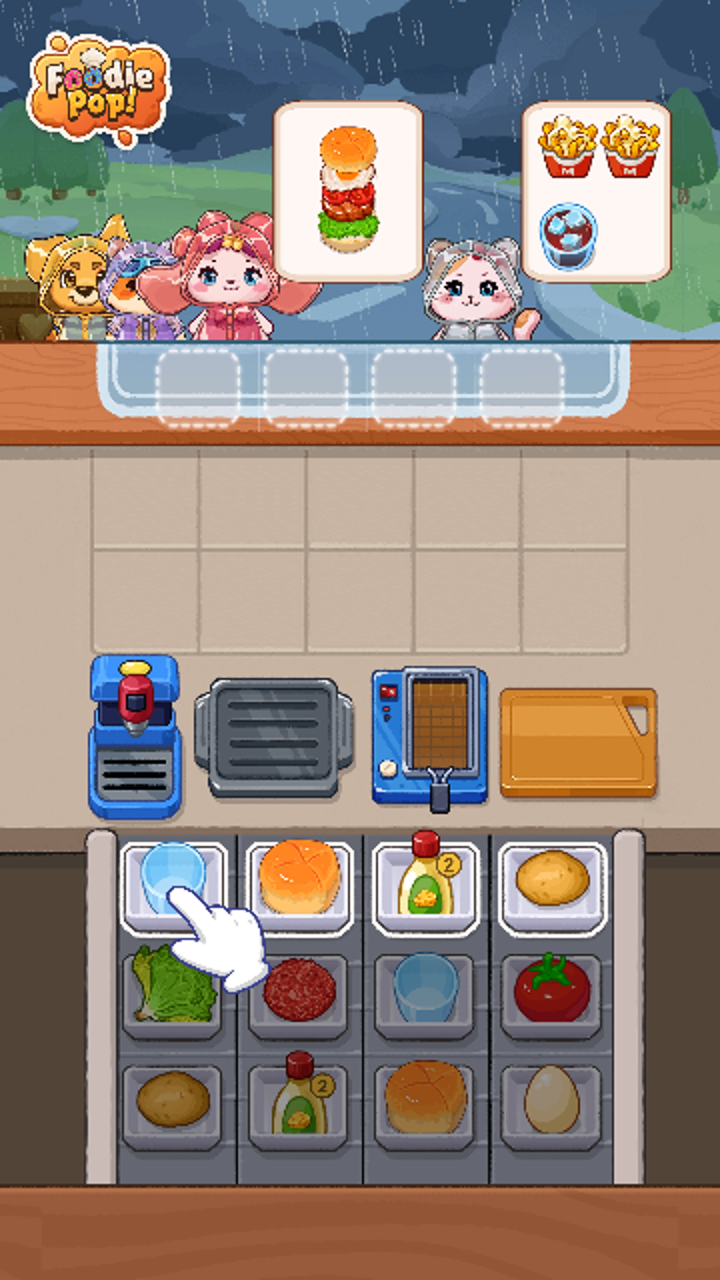
Opening frame (0:00)
A playable starts under the user's finger, so there is no hook to watch and no second to lose - the first frame is already interactive. What the capture shows is an outdoor counter under a dark, rainy sky, the Foodie Pop! logo in the top-left corner, three animal customers and two open order cards: a stacked burger on one card, two boxes of fries and a drink on the other.
What the record preserves
The layout is the same counter-over-board build as the video cuts - a five-column, four-row ingredient board at the bottom holding buns, a lettuce leaf, a patty, eggs, tomatoes, potatoes and bottle tiles stamped 2, with a white hand cursor already resting on the top-left tile, and empty dashed slots on the counter above waiting for finished dishes. Because it is a playable, this opening frame is the whole visual record the dataset keeps: the rest of the experience is interaction, not footage.
End sequence
There is no end card here - no install prompt, no FAIL state and no PLAY NOW button - because a playable ends whenever the player stops. Counted as a creative record it is a single entry; counted as exposure it is the largest in the window at an estimated 259,633.
Takeaway for UA and creative teams
This is the sharpest single data point on the account. By CreativeScope's lifetime exposure estimate, the highest-exposure record for a brand-new title is an interactive unit on Unity rather than a film, and the two Unity playables behind it sit at an estimated 195,424 and 193,449. The top three records by exposure are all playables. For a team deciding whether to fund an interactive build for a casual puzzle launch, this account did not treat it as an afterthought.
CreativeScope creative record, exact match. Estimated exposure is a global lifetime estimate of impressions behind creatives active in the window, not a period increment, not country-level exposure and not a view count. A playable is captured as a single opening frame, so no frame-by-frame review is possible for this unit.
Hook (0:00-0:03)
The film opens already inside the kitchen. There is no logo sting, no cold-open story and no voice-over - the first frame is a pink counter with three animal customers and their order cards, and the blurred backdrop to the left and right makes it obvious the master was exported for a horizontal slot from a vertical capture.
Body
From 0:09 to 0:47 the creative is one continuous play session. The bottom of the frame is a five-column ingredient board - brownies and chocolate squares, blueberries, strawberries, ice cubes, a white piping bag, milk cartons, doughnuts - interleaved with unopened question-mark tiles, gold and red key badges and number badges reading 1 and 2. A white hand cursor keeps dragging pieces down into that board while the shelf above collects what has been made: at 0:27 the shelf is holding a chocolate square, a pink heart-shaped item and a milk carton. Each order card above the counter ticks itself off as it fills, and every finished tile is replaced by a locked one.
End sequence
At 0:47 the run is still going. The cursor drags another tile, one more order card empties, and the clip stops mid-service rather than on a result. The only on-screen text in the whole minute is the game's own logo, parked in the top-right corner from the first frame to the last.
Takeaway for UA and creative teams
This is the vertical capture with blurred bars rather than a purpose-built horizontal edit - and it is not a one-off. Its 9:16 sibling carries the same five target markets, the same first-seen date and the identical exposure figure, which reads as one creative idea bought for portrait and landscape inventory at the same time. If you are shipping a horizontal cut for a portrait-native game, this is the cheap version of that decision.
CreativeScope creative record, exact match. Estimated exposure is a global lifetime estimate of impressions behind creatives active in the window, not a period increment, not country-level exposure and not a view count.
Hook (0:00-0:03)
Full-bleed vertical gameplay, no letterbox and no story beat. The logo is already in the top-right corner from the first frame, and the customers - a pink elephant, a white mouse in a chef's hat, an orange dog in a blue shirt and a child in an orange cap and blue overalls - are mid-order before the second passes.
Body
By 0:09 two order cards are open above the counter: a chocolate doughnut with an iced drink, and an iced coffee with a cupcake. The only words on screen belong to the game itself - a blue carton on the middle shelf is printed MILK and carries a small 2 badge. The board below runs five columns with a clear vertical channel down the middle, gold and red key badges on individual tiles and number badges reading 1 and 2 on the tiles that unlock next, and the white cursor works it continuously from 0:09 to 0:47. At 0:36 the customer line-up has changed completely - a gray wolf in a sleeping cap and a rabbit in a pink bow have replaced the earlier group - and a fresh order card is filling with a cupcake while more tiles have flipped to their unlocked state. Nothing about the loop changes; only the orders do.
End sequence
The clip ends on the board with the cursor still working a tile. There is no end card, no install prompt and no call to action - the last thing on screen is the puzzle.
Takeaway for UA and creative teams
This is the 9:16 sibling of Spotlight 2, and it is not the same footage: the customer line-up swaps mid-film, the tile states advance on a different rhythm and the order cards carry different dishes, while both films share the same counter-over-board layout and the same five markets. The read for creative strategists is that the account kept the format that worked and paid to record it twice, once for each aspect ratio, rather than re-cutting one master.
CreativeScope creative record, exact match. Estimated exposure is a global lifetime estimate of impressions behind creatives active in the window, not a period increment and not country-level exposure.
Hook (0:00-0:03)
The first frame is a line of impatient animal customers behind a wooden counter - a dark bear in a red cap, a white rabbit, a small pig in a bow tie, a beaver in an orange cap and green overalls, a raccoon with a red bow tie and a white cat in a pink bow - all with brows down and mouths open, under a bright sky with clouds and green bushes. No logo, no product shot and no text appear anywhere in the frame. The premise arrives before the product does.
Body
By 0:09 the same counter has become a working kitchen. Three customers hold green-bordered order cards listing a burger, a taco, a drink and a dessert; along the counter sit a blue drink dispenser, a panini press, a blue toaster with a slice of bread inside, a rice container and a wooden cutting board. Above them the shelf carries a red padlock tile and an ice-block tile stamped 6, a second ice tile stamped 1 sits to the right, and a gold padlock marks the tile that opens next. At 0:18 and 0:27 the cursor moves cherries, ice and vegetables through the grid, and each finished order is ticked off on the card above.
End sequence
At 0:57 the frame dims behind a large red FAIL banner with OUT OF MOVE in white letters underneath. A brown capybara in a red apron and a white chef's hat, tearful and blushing, slumps over the counter holding a plate with a finished burger, smoke curls up from a pan behind it, a plate of tomatoes sits on the counter, and the board below has gone gray and unplayable.
Takeaway for UA and creative teams
A brand-new account choosing a failure state as its closing frame is a deliberate creative bet. For a cooking puzzle, running out of moves is the shortest possible statement of pressure, and this cut spends its last seconds on the failure rather than on the store badge. It also gives the account a second emotional register inside one format: Spotlights 2 and 3 sell the loop, this one sells the tension.
CreativeScope creative record, exact match. Estimated exposure is a global lifetime estimate of impressions behind creatives active in the window, not a period increment and not country-level exposure.
Hook (0:00-0:03)
Unlike the Unity cuts, this one starts outside the game. A small pink rabbit in a raincoat hops along a wet street at dusk past a bakery and a florist, rain streaking the frame and the shop windows glowing warm. The first three seconds contain no gameplay at all.
Body
At 0:05 the rabbit reaches a burger restaurant with a striped awning, stands at the open door and looks in - and then the film cuts straight into the product. From 0:09 the layout is a horizontal service line: order cards along the top holding burgers, fries and drinks, a run of counters below them, and an ingredient grid that scrolls left to right rather than top to bottom. The cursor drags a cherry, a tomato and a handful of ice through the board at 0:14 and 0:18, and finished dishes stack up on the serving counter.
End sequence
At 0:23 the cut moves to a fast end card: three phone panels fan out across a green-to-lavender gradient, the game's logo sits centered on a doughnut shape with a chef's hat perched on top, and a yellow-orange pill button below it reads PLAY NOW.
Takeaway for UA and creative teams
The AppLovin cut runs on its own target list rather than the Unity one, but the runtime is half as long - 30 seconds against the 60-second Unity cuts - and the structure is inverted. The story carries the first frame that the other creatives give to a customer queue, and the reward for staying to the end is a branded button rather than a fail state. For a new title testing a story-first open on a shorter clock, this is the clearest example in the set.
CreativeScope creative record, exact match. Estimated exposure is a global lifetime estimate of impressions behind creatives active in the window, not a period increment and not country-level exposure.
Hook (0:00-0:03)
The same rainy-street opening as Spotlight 4, this time letterboxed inside a 1920x1080 master. The story beat is identical - the raincoat, the wet street, the warm shop windows - and the vertical core is doing the acting while the surrounding frame is filled with blurred color.
Body
At 0:06 the core shows a roadside burger counter under a dark rainy sky rather than the indoor kitchen of the Unity films: three customers hold order cards stacked with burgers and a box of fries, and the counter below them is still empty, with dashed slots waiting for the first dishes. From 0:13 to 0:33 the film stays on the kitchen and the board - a dark grill, a blue toaster with a slice of bread, a cutting board with a slice of cheese, and a grid running through tomatoes, lettuce, patties, cheese, eggs and burger buns while the cursor drags pieces up into the service counter.
End sequence
The horizontal cut closes on the same end card as the 30-second AppLovin version: the logo, the fan of phone screens and the yellow-orange PLAY NOW button.
Takeaway for UA and creative teams
This is the same opening scene and the same end card as Spotlight 5, on a different network, in a different aspect ratio and running 12 seconds longer. The copy is the interesting part: this record carries a headline and a body, and that turns out to be a Mintegral habit rather than a creative choice - the Mintegral records, playable and video alike, carry the game's name as the headline and one welcome line as the body, while the Unity and AppLovin records in the exposure top twenty are empty apart from a single Unity film that carries the name and nothing else. Nowhere near the top of this set is there a benefit line, a price or a character line. Two of the six networks then took one story-driven family and cut it to their own shape - AppLovin vertical and 30 seconds, Mintegral horizontal and 42 - which is what a small creative set looks like when it is spread across a wide network list.
CreativeScope creative record, exact match. Estimated exposure is a global lifetime estimate of impressions behind creatives active in the window, not a period increment and not country-level exposure.
The CreativeScope take
A brand-new title's first month is usually read through downloads. Read through delivery instead, and Foodie Pop! looks unusually orderly: a two-week test phase that starts before the store date, a single step up on day four, a market list weighted toward Japan, Singapore and Switzerland, and a network mix with no Meta-family placement anywhere in it. For a UA lead planning a casual launch, the transferable part is the sequence - test early, hold the creative set small, and buy the same five markets in both aspect ratios rather than spreading thin.
The alternative explanations matter, and they are not small. The day-four step could be ingestion catching up on a new title rather than a decision, and only the next few weeks will separate those. The absence of Meta-family inventory could mean the account is not buying there, or that the tracker has not captured it; we can report what is tracked and nothing more. Market coverage describes target lists, so Japan and Singapore leading says where the plans point, not where the game works.
What this article cannot support is equally specific. There is no spend figure, no CPI, no ROAS, no install number and no retention read inside tracked ad records, and nothing here should be read as evidence that the ad schedule caused any download, chart position or revenue movement. Estimated exposure is a lifetime estimate of impressions attached to the creatives active in the window - it is not a period increment, not country-level, and not comparable across windows. A zero re-investment count in an eighteen-day-old build says nothing about durability either way.
At the end of this window the game is ten days past its App Store release, and the account has only just started to repeat itself. Whether the sixties hold, whether the small creative set grows, and whether Instagram or Facebook ever enters the mix are all worth continuing to watch.
Every creative behind Foodie Pop!'s 380 tracked ad plans - the videos, the playables and the market and network splits in this piece - is searchable in CreativeScope.
Browse the account yourself at creativescope.ai/mcp.
Related reading
FAQ
Everything in this article describes tracked ad delivery, not organic reach. CreativeScope can show that 380 ad plans and 274 creatives were recorded in the window and when the daily plan count stepped up; it cannot show that any of that caused downloads, chart movement or app store discovery. The two ideas should be kept apart.
The App Store listing records the release on October 5, 2026, so the end of this window is day ten. The Google Play listing publishes no release date - its only date is an update stamp of October 13, 2026 - so the two storefronts are not averaged together. The Google Play record's own tracked ad activity starts on September 20, 2026.
CreativeScope records 380 ad plans for the Google Play identity in the 30-day window, behind 274 deduplicated creatives, plus a separate 60 ad plans for the App Store identity. Those two numbers belong to two different store records and are never summed. An ad plan is one delivery setup - a network, a set of target countries and a language - not a budget line.
Forty-seven markets appear across the tracked plans. Japan leads on coverage at 172 plans, Singapore at 153 and Switzerland at 143, and Singapore carries the largest exclusive pool with 24 market-only plans. The United States appears on 114 plans with three exclusives. Coverage means the market is on a plan's target list; it is not a statement about where the game performs.
Mostly long video. Of 380 creative records in the window, 350 are video (92.1%), 24 are playables and 6 are static images. Two hundred and fifty-nine of the 350 videos run 30 seconds or longer, and 196 are vertical against 149 horizontal. The playables are spread across AppLovin, Unity, Mintegral and ironSource.
Not in this window. None of the 380 tracked ad plans sits on Facebook, Instagram, Messenger, Audience Network or Threads, and none sits on TikTok or YouTube either. The coverage sits on Mintegral, Unity, AppLovin, AdMob, ironSource and a single Vungle plan. This describes what is tracked; it is not a claim about what the account may run outside those records.
Data notes. All figures come from CreativeScope tracked ad records for Foodie Pop!, window September 14 to October 14, 2026, all platforms, global, queried on October 14, 2026. One creative is one game-material record counted once; one ad plan is one game-plan record counted once; market coverage is multi-attribution, so those shares overlap and never sum to 100%, while network shares are recorded one network per plan. The game is tracked under two store identities - a Google Play package record and an App Store record - reported separately and never combined. Estimated exposure is a global lifetime estimate of impressions behind the creatives active in the window: it is not a period increment, not country-level, and not comparable across different windows. Plan counts are not budgets, and no spend, CPI, ROAS or conversion figure can be derived from them.
No metrics from outside CreativeScope appear in this article, and no external download, revenue or install estimate is used. Store details (release date, update date, ratings and the public download label) are read from the two storefront listings. The five films in the Spotlight section are exact material matches, and the frame descriptions reflect what is visible in the delivered files. Their frames were compared with a 32x32 grayscale fingerprint: the closest two of the five sit 22.3 apart on the 0-255 difference scale, well outside the near-duplicate band, so none of them is a re-upload of another. The same check did find near-identical copies elsewhere in the sampled files - several cuts repeat footage, and the closest pair of all is one 60-second film carried on two networks. The featured image is original artwork generated for this article.
Get this live in your agent
These rankings come from a single MCP tool. Free key, ask in plain English.
Full genre × market grid?
Team plan unlocks every genre and market cut, plus AI teardowns.