
Overgeared Hero Ad Creatives: 1.8M Downloads in 3 Months
Inside the ad playbook behind Overgeared Hero's 1.8M downloads in three months: 1,480 tracked creatives, Meta-heavy delivery, and one 90-day playable.
Daniel Brooks
Creative Strategy Analyst
Published
Updated
Overgeared Hero passed 1.8 million downloads roughly three months after launch — and it did it in a genre that has quietly killed nearly every mobile attempt before it. Its answer is a 4,284-plan buy spread across 172 markets, exclusive ad plans stacked on Japan and Korea while everyone else rides shared coverage, and creatives that are mostly the game itself: shop, drag, merge, auto-battle — plus one interactive playable its maker credits with half a million installs.
Key takeaways
- Overgeared Hero is a pixel roguelike auto-battler from 5minlab, the Seoul studio KRAFTON bought outright in February 2022 (the team behind Smash Legends). You drag loot into a backpack grid, merge duplicates into stronger gear, and your layout — not your reflexes — fights the battle for you.
- The buy is a blanket with two stitches. Plans cover 172 markets, but the exclusive pools sit almost entirely in Japan (330 single-country plans, 51.9% of its coverage) and Korea (324, 53.9%). The US, the largest revenue market per industry reporting, holds just 97 exclusives out of 639 plans covering it.
- Delivery is one Meta package plus a Google layer: Instagram carries 75.40% of plan coverage, Audience Network, Facebook and Threads report an identical 3,068 plans each, Admob takes 17.58%, and everything else — including AppLovin’s 2.73% — is small. What AppLovin lacks in plan volume it makes up in format: every playable in the window runs there.
- The creative pool is the game wearing three costumes: unedited gameplay captures, hyper-casual side-doors (number gates, tower defense, survivor swarms) rendered in the same pixel art, and comic-style character key art localized per market. A UK ad vendor, TheoryCraft, claims its playable lifted buying efficiency fourfold and drove 500,000+ installs.
Data scope
This breakdown uses CreativeScope’s advertising record for Overgeared Hero: Merge RPG, developer 5minlab Corp., over August 24 – September 23, 2026 (30 days). Every figure is deduplicated — each plan and each creative counts once: 1,480 creatives, 4,284 ad plans, 762 reinvested creatives, and a 330 million lifetime estimated exposure for the creatives active in the window.
The same three limits apply as in every breakdown we publish. Country and network shares are target-coverage shares under multi-attribution: a plan can list several countries, so shares overlap and never sum to 100%. “Exclusive” means a plan whose delivery-country set contains exactly one market — a targeting decision, not evidence of results. And lifetime estimated exposure is a relative delivery-scale signal for creatives active in the window, not a platform impression count; the record carries no spend, installs, conversions or revenue.
One field note on dates: the record’s own release-date field carries a placeholder value, so no launch date below comes from tracked data. The May 2026 launch timing is industry reporting dated September 22, 2026, backed by public store trackers; download figures mix three sources that are labeled wherever they appear.
The milestone: from soft start to 1.8 million in about three months
Two sources agree on the shape of this curve. A September 22 industry report puts the launch in May 2026, cumulative downloads past one million about two months in, and 1.8 million cumulative by early September — alongside estimates of roughly $100,000 in daily revenue, a DAU above 120,000 and a peak of No. 46 on the US Strategy top-grossing chart. Our own Google Play tracking fills in the path between those points:
| Date (2026) | Milestone | Source |
|---|---|---|
| Late March | ~4,000 downloads on the current listing — early, quiet traction | Tracked Google Play net downloads |
| May 28 – 30 | Scale-up begins: +136,000 and +140,000 in single days | Tracked Google Play net downloads |
| Jun 10 | 500,000 installs store badge | Store badge tracking (AndroidRank) |
| Jul 10 | 1,000,000 installs store badge | Store badge tracking (AndroidRank) |
| Early September | 1.8 million cumulative (industry reporting, dual platform) | Industry reporting |
| Sep 15 | 1,907,062 cumulative, Google Play alone | Tracked Google Play snapshot |
Read strictly, our Android-only curve needs roughly three and a half months from the late-May scale-up to 1.9 million; that dual-platform industry figure rounds the same curve to three months and 1.8 million. Either way the milestone in the headline holds, and it is worth stating plainly: independent industry estimates put August alone at around 600,000 downloads and $3 million in revenue, with AppBrain counting about 290,000 installs in the last 30 days against a 4.6-star average from 67,000 ratings. For a game in a genre widely written off on mobile, that is the part that demands an explanation — which starts with the game itself.
The game: a backpack-merge roguelike in a genre mobile kept failing
The loop is three moves deep. You buy gear from a rotating shop and drag it into a grid-style backpack, where placement matters like a chessboard — items buff their neighbors, pets occupy slots, class skills change what a full bag is worth. Duplicate items merge into higher rarities, and then the hero walks into an auto-battle that resolves entirely from the build you packed. The store listing is blunt about the pitch: “every item placement decides the fight.” Sessions are short, runs are procedurally varied, and there is PvP for the build-nerds.
None of this is new on PC, which is exactly the trap. Backpack Hero opened the genre there, and Backpack Battles sold over a million copies while still in early access. The mobile ports, though, kept dying: industry tallies put Nox’s Weapon Master: Backpack Battle at roughly 470,000 downloads but only about $140,000 in lifetime IAP, with Backpack Survivors: Idle RPG and Pompo: Backpack Heroes faring no better. The demand was proven; the monetization was not.
5minlab’s answer reads like a checklist against those failures. This is the studio’s second attempt at the theme after 2024’s Backpack Arena: Fantasy Battle, and the monetization splits a difference PC games never had to face: a restrained ad layer (rewarded video only, no forced interstitials, about 15% of revenue per industry reporting) sitting on top of an aggressive IAP spine — permanent backpack expansions as the deepest lever, gacha for heroes, and stamina gating late-game growth. The ads bring players in; the bag itself asks them to stay and pay.
Two exclusive bets inside a 172-market blanket
Coverage tells you where a plan can appear; exclusives tell you where it can only appear. Most 172-market blankets are all coverage and no commitment. This one is not:
| Market | Plans covering it | Plans exclusive to it | Exclusive rate |
|---|---|---|---|
| United States | 639 (14.92%) | 97 | 15.2% |
| Japan | 636 (14.85%) | 330 | 51.9% |
| South Korea | 601 (14.03%) | 324 | 53.9% |
| Hong Kong | 566 (13.21%) | 72 | 12.7% |
| Taiwan | 527 (12.30%) | 42 | 8.0% |
| Canada | 527 (12.30%) | 15 | 2.8% |
| Germany | 455 (10.62%) | 7 | 1.5% |
| Spain | 457 (10.67%) | 7 | 1.5% |
| France | 458 (10.69%) | 8 | 1.7% |
| Thailand | 450 (10.50%) | 38 | 8.4% |
Japan and Korea are the only two markets where exclusives approach coverage — 330 and 324 single-country plans, more than half of each market’s plan set. Together they account for 654 exclusive plans. The US, the game’s biggest revenue market by industry reporting, gets 97, and every other market in the top ten combined adds 286 — fewer than Korea on its own. Everything from Germany to Thailand is reached through shared, multi-country plans.
Orange bars: markets where most plans are single-country. Teal bars: markets reached mostly through shared plans. Bar length reflects plans covering the market; the second number is the exclusive count.
The direction of the bet is legible in the product, not just in the plan set. This is a Korean studio’s game: the home-market listing carries a Korean-language title, the Japanese listing a dedicated localized subtitle, and industry reporting places Japan and Korea as its second and third revenue markets behind the US — with the game briefly topping the strategy charts in Canada, Japan and Australia. The tracked data can’t say whether those exclusive plans performed better; it only shows where 5minlab chose to operate alone rather than share.
Channel structure: one Meta package, Instagram slightly on top
Twelve networks carry plans in the window. Most of them barely matter.
Plan-coverage share under multi-attribution; overlapping shares do not sum to 100%. The tail beyond these eight: Vungle (84), Unity (50), Ironsource (33), TikTok (17).
Three Meta surfaces — Audience Network, Facebook and Threads — report an identical 3,068 plans at an identical 71.62%, which is the footprint of one placement package bought across surfaces, not three strategies. Instagram sits a step above at 3,230 plans and 75.40%, meaning a slice of the buy is Instagram-only — an unusual tilt worth noting, since most Meta-first accounts treat the four surfaces as interchangeable. Messenger, at 1,620 plans, is Meta’s own placement subset rather than a separate network.
That leaves Admob as the only independent network with real weight at 753 plans (17.58%), doing what it usually does here: carrying static families and long-running reused video. AppLovin’s 117 plans look like a rounding error until you check formats — every playable in the window runs there. The remaining four networks are exploratory at best.
Creative formats: video-first, and playables actually in the mix
The format mix in our 30-day window leans on one conviction the genre forces on everyone: dragging and arranging a backpack simply cannot be sold in a still frame.
- Video leads everywhere. The top of the exposure table is video on AppLovin, Admob and Meta alike, and the biggest single asset in the window — a reused Google-channel cut — accumulated a lifetime estimated 5.97 million exposures across just four active days in the window (Sep 15–18).
- Statics are a localization layer, not a demo. The image set is character and celebration art, not interface screenshots: a #1-ranked chart-celebration master carries up to 45 related ad plans, and the same hero-introduction card ships with an English headline (“One Shot Zero Misses!”) and a mirrored Chinese version for Taiwan. More in the Spotlight below.
- Playables are live, plural, and long-running. Multiple interactive creatives have run on AppLovin continuously since June 26 — roughly ninety days — with individual playables accumulating 1.2–2.0 million lifetime estimated exposures. For comparison, Last Echo, the last single-game breakdown on this site, ran zero playables in its window.
- The pool is deeply templated. Reinvestment sits at 762 of 1,480 creatives, and top-heat entries commonly carry 10–45 related plans each. Distinct scenes are far fewer than the creative count suggests.
Creative observations: the game is the ad, the hooks are side doors
The core family is almost anti-creative: screen-captured gameplay with minimal dressing. A shop opens, the cursor buys an item, the item drags into the backpack grid, two duplicates flash into one upgraded slot, and the auto-battle resolves with damage numbers popping over pixel enemies. No voiceover, no fake fail state, no “can you solve this” framing. The genre’s whole appeal is the ten seconds of grid-tidying satisfaction, and the ads simply hand it over.
Around that core sit two side-door families. The first borrows proven hyper-casual hooks — number-gate choices, tower-defense placement, survivor-style swarms — but renders them in the game’s own pixel art, so the bait and the product share a skin and the bounce happens later than it would against a mismatched aesthetic. The second is a branding layer rather than a demo: comic-style character key art that ships localized per market — the same illustration carrying an English headline in one version and the game’s Chinese title and a market-specific line in another.
The copy layer is thin, and it localizes instead of shouting. The registered ad copy on the top Admob statics is a single dare — “It’s not luck. It’s skill.” — with “Harder Than You Think.” registered on the top Meta videos. On the assets themselves, the same footage and the same hero art ship per market: frame review found the identical gameplay capture running with English, Korean and both Chinese-script interfaces, and the hero card re-issued with a Chinese headline. In a buy of 4,284 plans, one production system speaking four languages is the discipline.
The playable: a vendor-claimed 500K installs
The interactive layer is the loudest number in this story, so it deserves the loudest caveat. 5minlab worked with the UK ad vendor TheoryCraft on a set of interactive ads that let users refresh the shop, plan a backpack and watch an auto-battle before installing. TheoryCraft’s own account of the work claims the playable lifted buying efficiency fourfold and drove more than 500,000 installs. Those are vendor figures for vendor work; CreativeScope’s record carries no install or conversion data, so this article repeats the claim without endorsing it.
What the tracked data does show is the shape of a serious playable investment. The playables in the window are not one test asset but a family: several distinct interactive builds, delivered on AppLovin, most live since late June and still active as the window closed, with preview frames showing the shop-and-grid loop rather than a minigame reskin. Whatever the true install number is, ninety continuous days of interactive delivery on the one network that specializes in playables is itself the structural finding: this account treats the playable as a pillar, not an experiment.
Delivery cadence: a rolling 700-creative library
The window has no launch burst and no dead weeks. The active library holds between roughly 530 and 810 creatives and 1,000 to 2,000 ad plans on every single day, and the busiest days are re-cutting days more than shooting days:
| Date | New creatives | New ad plans |
|---|---|---|
| Sep 21, 2026 | 277 | 366 |
| Sep 15, 2026 | 59 | 548 |
| Sep 16, 2026 | 154 | 425 |
| Sep 10, 2026 | 58 | 292 |
| Sep 22, 2026 | 78 | 99 |
| Sep 17, 2026 | 58 | 70 |
| Sep 18, 2026 | 61 | 61 |
September 15 is the tell: 548 new plans from 59 new materials, nearly ten plan shells per asset. That is a library being sliced into new targeting and bidding configurations at pace, with 762 reinvested creatives doing the heavy lifting. The one heavy production day — September 21, with 277 new creatives — restocked the library after the mid-month wave rather than starting it, while the window’s highest-exposure asset, a reused Google cut, ran across four days (September 15–18). Steady state, with periodic restocks, is the operating model.
Creative Spotlight: five cuts, three networks
The five creatives below are the highest-signal assets in the window — one playable, three video families and one static family — spanning AppLovin, Meta and the Google channels.
Spotlight 1 — The ninety-day playable (AppLovin)
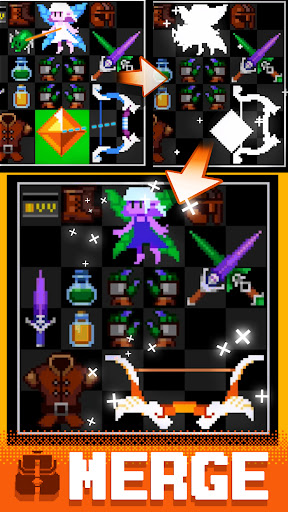
What it shows. The preview still is the game’s own interface: a shop row of pixel gear above the backpack grid, already half-packed. The interaction — buy, drag, merge, fight — is the entire core loop compressed into a tap-through.
Takeaway. This is the asset behind TheoryCraft’s 500K-install claim, and its delivery pattern is the credible part: not a two-week test but a quarter of continuous rotation on the playable-native network, with siblings refreshed alongside it.
Spotlight 2 — The AppLovin workhorse video
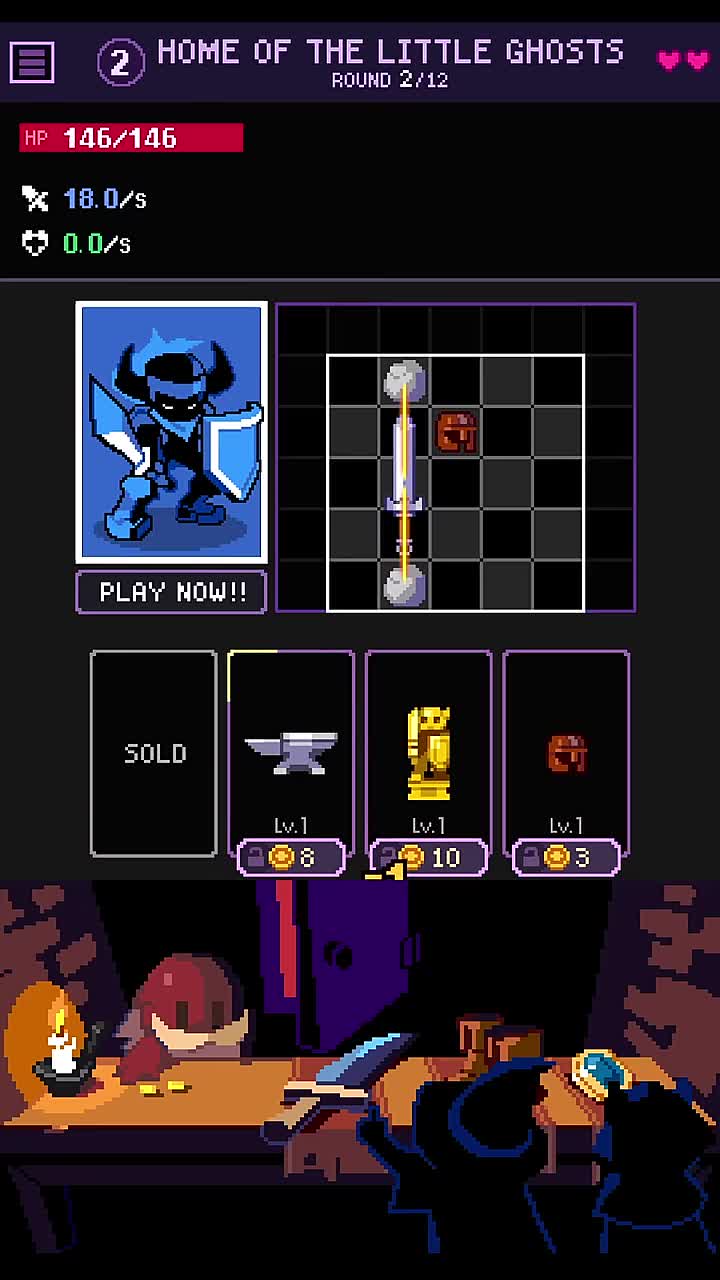
What it shows. Vertical 9:16 cut, 40 seconds. Frame review (t=5.7s, 11.4s, 17.2s): a shop row of pixel gear under a hero card, items bought with coins and dragged into the grid; at t=22.9s and t=28.6s the auto-battle resolves with damage numbers (18.5K, 263.8K, MISS) over “Overgrown Forest 2/12”; t=34.3s closes on the Overgeared Hero logo end card with a PLAY NOW button.
Takeaway. Video and playable share one visual grammar on AppLovin — the network where interactivity converts best is fed the most literal version of the product.
Spotlight 3 — The Meta template family (five surfaces)
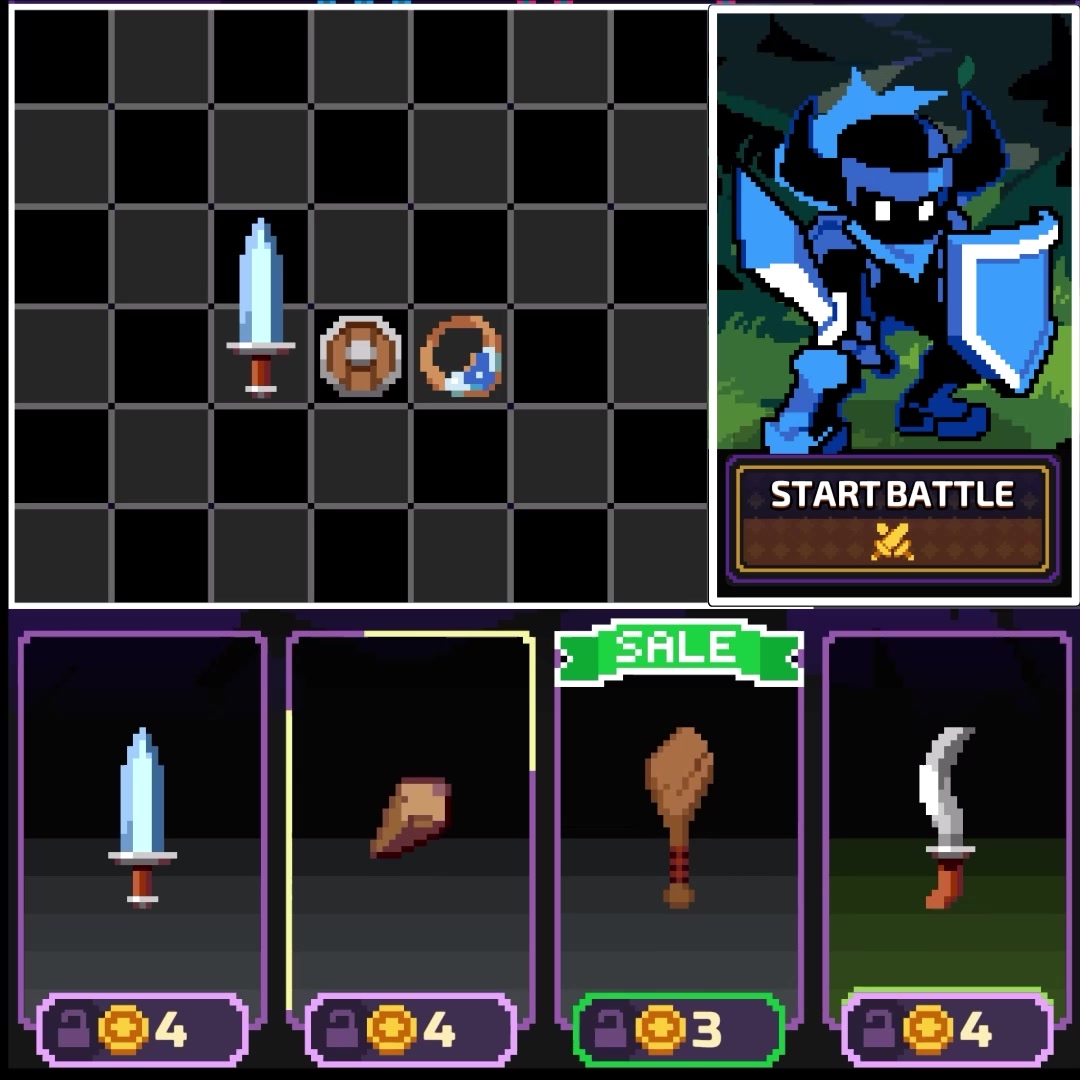
What it shows. A master cut with dynamic product fields — the name and brand slots resolve per placement — cloned across the whole Meta surface group.
Takeaway. One template, five surfaces, ten plan shells: this is what the identical 3,068-plan counts in the channel chart actually look like at the asset level. The Meta buy is a distribution machine bolted onto a single creative.
Spotlight 4 — The four-day Google burst (highest exposure in the window)
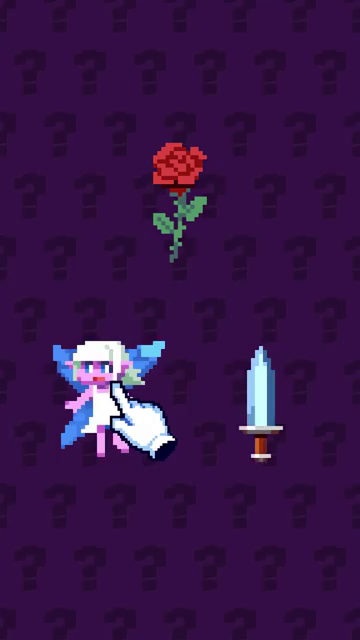
What it shows. A recycled cut pushed hard across Admob and YouTube for four days — the same stretch as the September 15 re-cut wave (548 plans from 59 assets).
Takeaway. The window’s single biggest exposure event is old material, new plan shells, on Google inventory. Admob, the network holding only 17.58% of plans, hosts the game’s biggest reach moment of the month — plan share and exposure share are different maps.
Spotlight 5 — The tagline static (Admob)
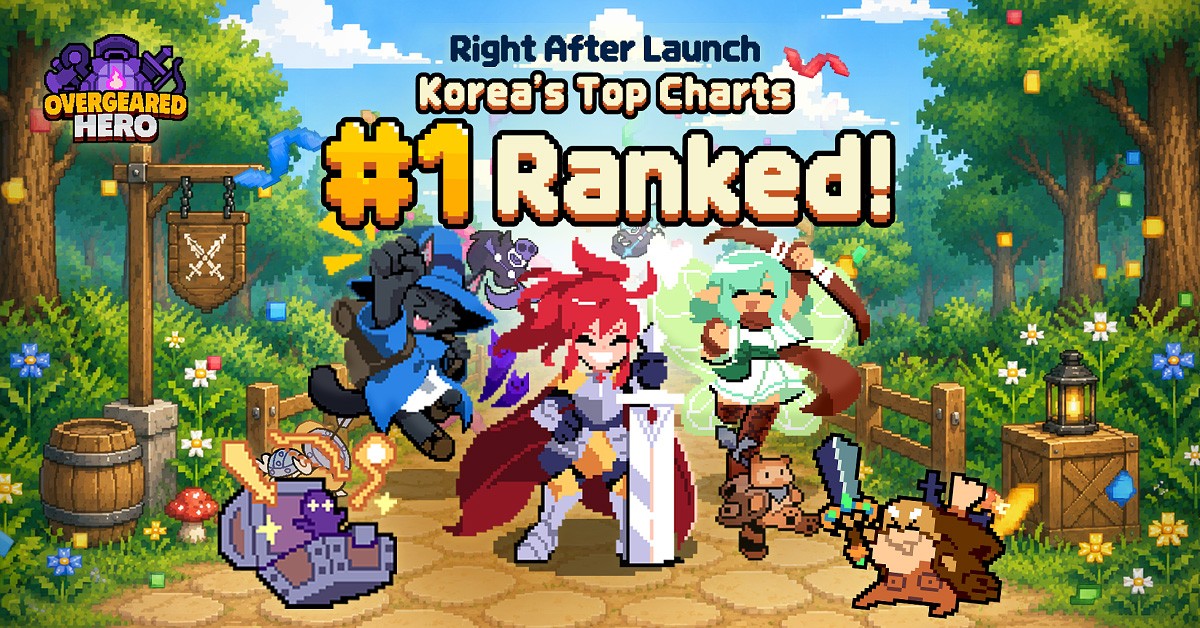
What it shows. A launch-celebration graphic, not a product shot: the hero cast in front of the game’s forest hub under a #1 Ranked headline, logo top-left. The dare of a tagline lives in the ad’s registered copy fields rather than painted on the image.
Takeaway. The Admob static layer repeats one message per market until it becomes the game’s reputation: a chart-celebration master carries up to 45 related plans, and the same hero cast ships with a #1 Ranked headline in English and a mirrored Chinese version for Taiwan. For a backpack-management game whose registered pitch is “skill, not luck,” the statics do the positioning work gameplay trailers do for other genres.
CreativeScope take
Overgeared Hero is the mirror image of the last single-game breakdown on this site. Last Echo concentrated: one market, one Meta package, zero playables. This account spreads: 172 markets, twelve networks, an Instagram tilt, and a playable pillar running for a quarter. Both structures can work; what they share is a creative pool that knows exactly what it is selling.
The transferable lesson sits in the three-family creative stack. Pure gameplay sells the loop to players who already want it. Pixel-skinned hyper-casual hooks rent cheap attention from players who don’t. The localized key art and the chart-celebration statics brand everything in between. And the whole machine runs on recuts — 548 plans from 59 assets in a single day — because in a 4,284-plan operation, the scarce resource is not footage. It is targeting.
Related reading
- The War for Survival Ads: Why the Number-Gate Hook Works — the hyper-casual hook Overgeared Hero borrows as a side door, dissected as a main dish.
- Last Echo Ads: A 346-Plan Bet on One Market — the opposite structure: total concentration instead of blanket-and-bets.
- Obsidian Knight Ads: Early-2000s Browser RPG Aesthetics — another game selling a nostalgia-styled fantasy RPG through its ads.
Want the raw structure behind this breakdown — every plan, creative and network for Overgeared Hero and 4,000+ other tracked games? Explore the data at creativescope.ai/mcp.
FAQ
What is Overgeared Hero?Overgeared Hero: Merge RPG is a pixel-art roguelike auto-battler for mobile by the Korean studio 5minlab. Players drag gear into a grid-based backpack, merge duplicate items into stronger equipment, and battles resolve automatically from the resulting build. The game launched in May 2026 according to industry reporting and passed 1.8 million downloads within roughly three months.
How many downloads does Overgeared Hero have?Industry reporting put cumulative downloads past 1.8 million by early September 2026, about three months after launch. Our own Google Play tracking shows 1,907,062 cumulative Android downloads as of the September 15 snapshot, and public trackers recorded the 500,000 and 1,000,000 install badges on June 10 and July 10, 2026.
Who makes Overgeared Hero?5minlab Corp., a Seoul studio founded in 2013 and best known for Smash Legends. KRAFTON acquired 100% of the studio in February 2022 for an earn-out payment of $19.9 million, making it one of KRAFTON’s independent creative studios.
Why do so many of its ad plans run only in Japan and Korea?In the 30 days to September 23, 2026, Japan had 330 single-country plans (51.9% of its 636 covering plans) and Korea 324 (53.9%), while the US held 97 out of 639. The tracked data shows where the plans point, not why — but the direction matches a Korean studio’s home-region focus, localized store listings in both markets, and industry-reported revenue rankings that place Japan and Korea just behind the US.
Do Overgeared Hero’s ads show real gameplay?The core creative family is direct gameplay capture: shopping, dragging items into the backpack grid, merging duplicates and auto-battle resolution. Around it sit hyper-casual hook scenes (number gates, tower defense, survivor swarms) rendered in the same pixel art, comic-style character key art localized per market, and interactive playable ads that recreate the shop-and-backpack loop before install.
Which ad networks does Overgeared Hero run on?Twelve networks in our 30-day window. The Meta package dominates — Instagram at 75.40% plan coverage, with Audience Network, Facebook and Threads each at exactly 71.62% — followed by Admob at 17.58%. AppLovin carries only 2.73% of plans but hosts every playable in the window; YouTube, Vungle, Unity, Ironsource and TikTok are marginal.
Data notes
- Advertising figures: CreativeScope record for Overgeared Hero: Merge RPG (
com.fiveminlab.overgeared.hero.backpack.merge), window August 24 – September 23, 2026, deduplicated by plan and creative. Coverage and platform shares are overlapping target-coverage shares under multi-attribution and do not sum to 100%. “Exclusive” = a plan whose delivery-country set contains exactly one market. Lifetime estimated exposure is a delivery-scale reference for creatives active in the window, not an impression count; the record contains no spend, install, conversion or revenue data, and no country-level exposure. - Download figures: Google Play cumulative snapshot 1,907,062 dated September 15, 2026, and daily net increments (tracked); store install badges June 10 and July 10, 2026 (AndroidRank). Cumulative snapshots are point-in-time and never summed across days.
- Attributed reporting: launch timing, revenue, DAU, chart positions, August download/revenue estimates, launch-window download and revenue estimates are independent industry estimates published September 22, 2026. The playable’s 4x efficiency and 500K-install figures are TheoryCraft’s own account of its work, repeated as a vendor claim.
- The tracked record’s release-date field is a placeholder; no launch-date claim in this article derives from it. KRAFTON’s acquisition of 5minlab is per KRAFTON’s official press release (February 2022).
Get this live in your agent
These rankings come from a single MCP tool. Free key, ask in plain English.
Full genre × market grid?
Team plan unlocks every genre and market cut, plus AI teardowns.